

PHYSICS · GRAVITY AND ORBITS
Why astronauts float when gravity is still 90 % as strong
Gravity does not switch off in orbit. Astronauts float because they, their spacecraft and everything inside are falling together. The numbers, the mechanism, and the word that misleads almost everyone. For undergraduate and graduate students.
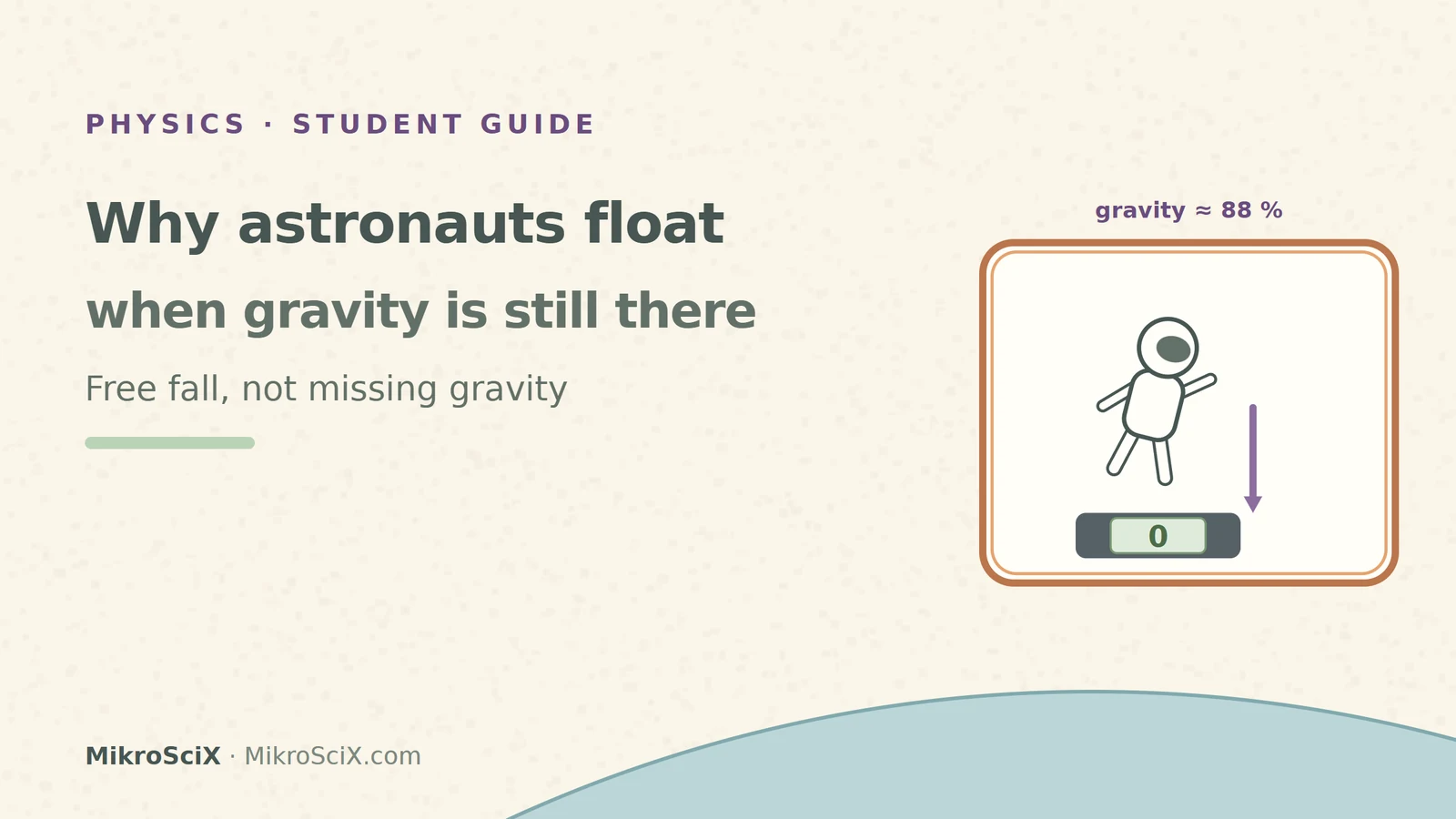
Every video from the International Space Station shows the same thing: astronauts drifting, water forming wobbling spheres, a pen hanging in mid-air. The usual caption is "zero gravity". It is one of the most widespread misconceptions in physics, and it is easy to check with one line of arithmetic.
This guide walks through that arithmetic, then explains what is really happening: the station is falling all the time, sideways fast enough that it never lands, and everything inside falls with it. For each step there is a number you can check yourself and a note on what usually goes wrong.
1. Gravity at the station: still close to 90 %
Gravity weakens with distance from Earth's centre, as the inverse square of that distance. At the surface you are about 6370 km from the centre. The station orbits roughly 400 km higher, at about 6770 km. So the pull there is
g(h) = g₀ · (R / (R + h))²
Check it yourself. (6370 / 6770)² = 0.9409² ≈ 0.885. With g₀ ≈ 9.8 m/s², that gives about 8.7 m/s². OpenStax works the same example and gets 8.67 m/s²: astronauts on the station "still have 88 % of their weight". NASA rounds it to about 90 % of surface gravity.
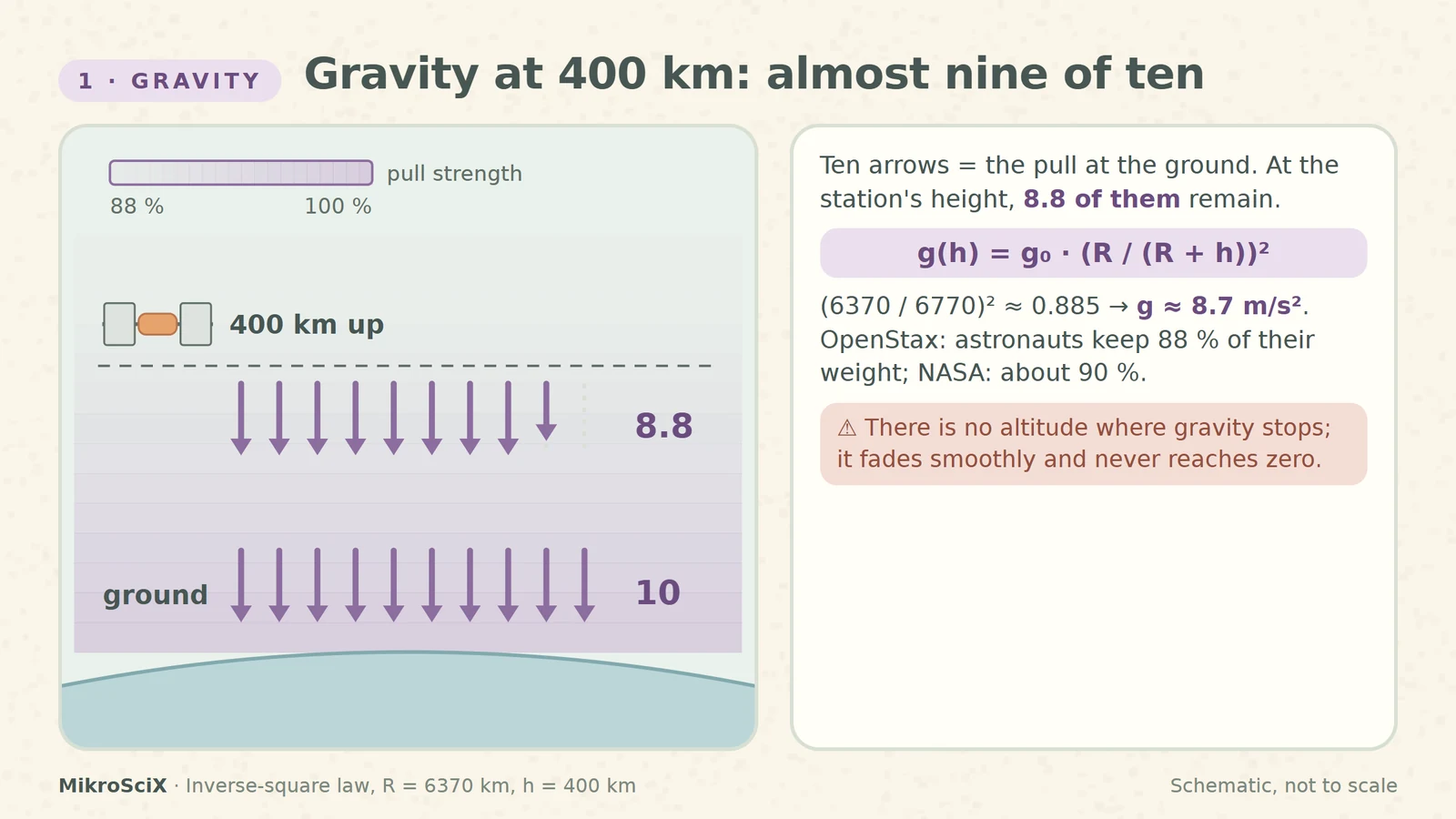
Count it as arrows: if ten arrows stand for the pull at the ground, almost nine of them are still there at the station. Gravity is not gone. It is barely weaker.
What breaks:
- "Space is above gravity." There is no altitude where gravity stops; it fades smoothly with distance and never reaches zero.
- One fixed number. The station's altitude changes over time (NASA quotes 200 to 250 miles), so "about 90 %" is the honest rounding.
2. The station is falling, and keeps missing Earth
If gravity pulls the station with almost full strength, why does it not crash? Because it is also moving sideways, very fast. Newton drew the idea as a cannon on a mountain. Fire a ball slowly and it lands nearby. Fire it faster and it lands farther away. Fire it fast enough and Earth's surface curves away beneath it exactly as fast as the ball falls toward it. The ball never lands: it is in orbit.
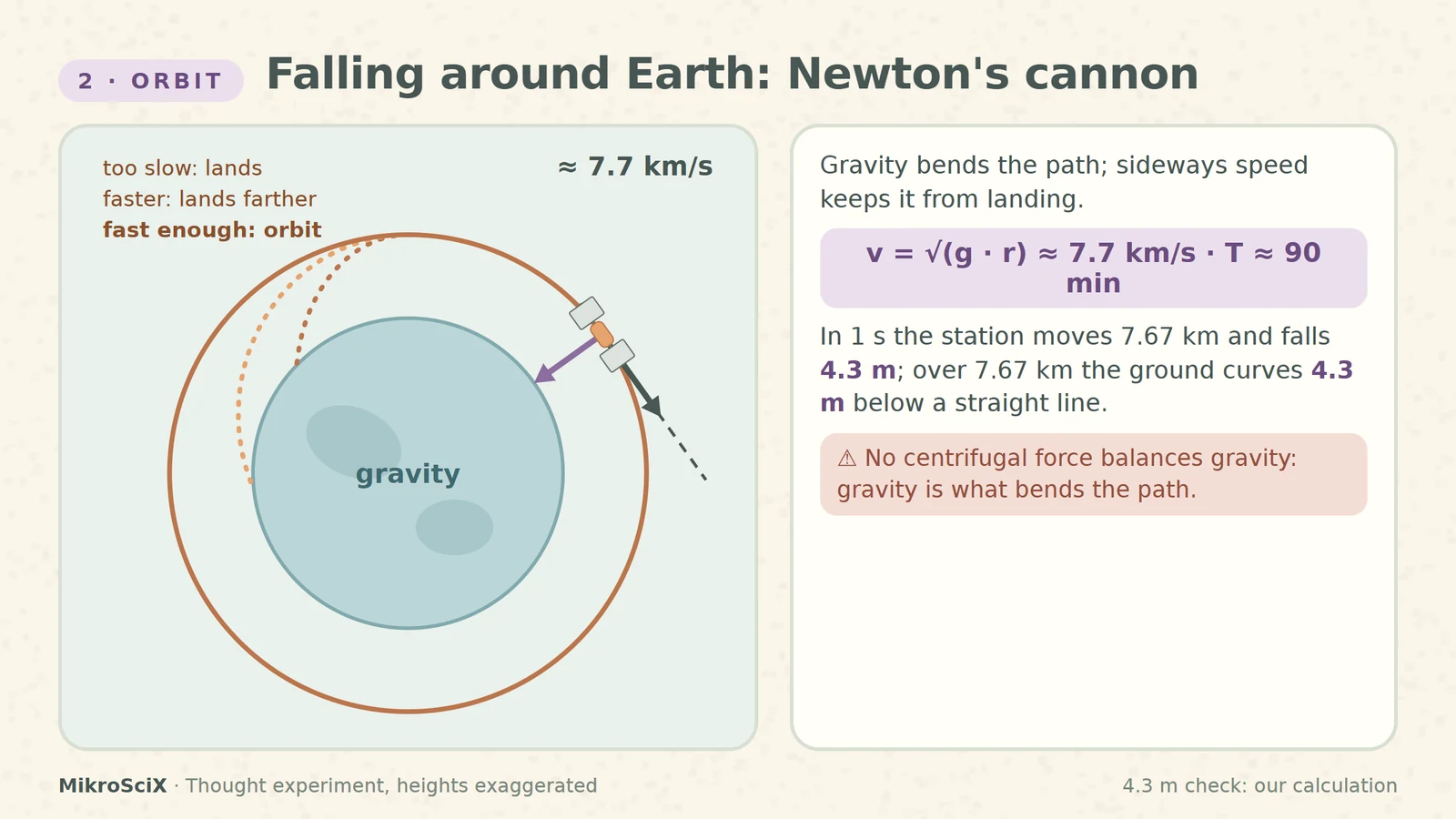
For a circular orbit, gravity supplies exactly the centripetal acceleration: v² / r = g(h), so v = √(g · r).
Check it yourself. v = √(8.67 m/s² × 6.77 × 10⁶ m) ≈ 7.66 km/s, matching the 7.67 km/s of OpenStax Example 13.9 (NASA: "five miles per second"). One lap is 2πr / v = 2π × 6770 km / 7.67 km/s ≈ 5550 s, just over 90 minutes, which is why the crew sees about 16 sunrises a day.
A second check makes "falling around Earth" concrete. In one second the station moves 7.67 km sideways. Starting from rest, anything falls ½ g t² = ½ × 8.67 × 1² ≈ 4.3 m in that second. Over the same 7.67 km, a circle of radius 6770 km drops below a straight line by d² / (2r) = 7670² / (2 × 6.77 × 10⁶) ≈ 4.3 m. The station falls 4.3 m, the ground curves away 4.3 m: it stays at the same height. (These two numbers are our own calculation from the sources' values.)
What breaks:
- "A centrifugal force balances gravity." In the frame of the stars, only gravity acts on the station. It is not balanced; it is what bends the path into a circle.
- "Orbit means high." Height alone does nothing. A balloon at 400 km with no sideways speed would simply fall back down.
3. Why nobody feels it: everything falls together
What you feel as "weight" is not gravity itself. It is the floor, a chair or a scale pushing back on you. A scale shows exactly that push, which physicists call the apparent weight.
On the station, the astronaut, the floor, the scale and a loose pen all have the same acceleration, 8.7 m/s² toward Earth, because gravity gives every mass the same acceleration. Nothing has to push on anything else to keep up. The scale under the astronaut's feet reads zero. That is the floating: free fall, the condition in which gravity, and nothing else, causes the acceleration.
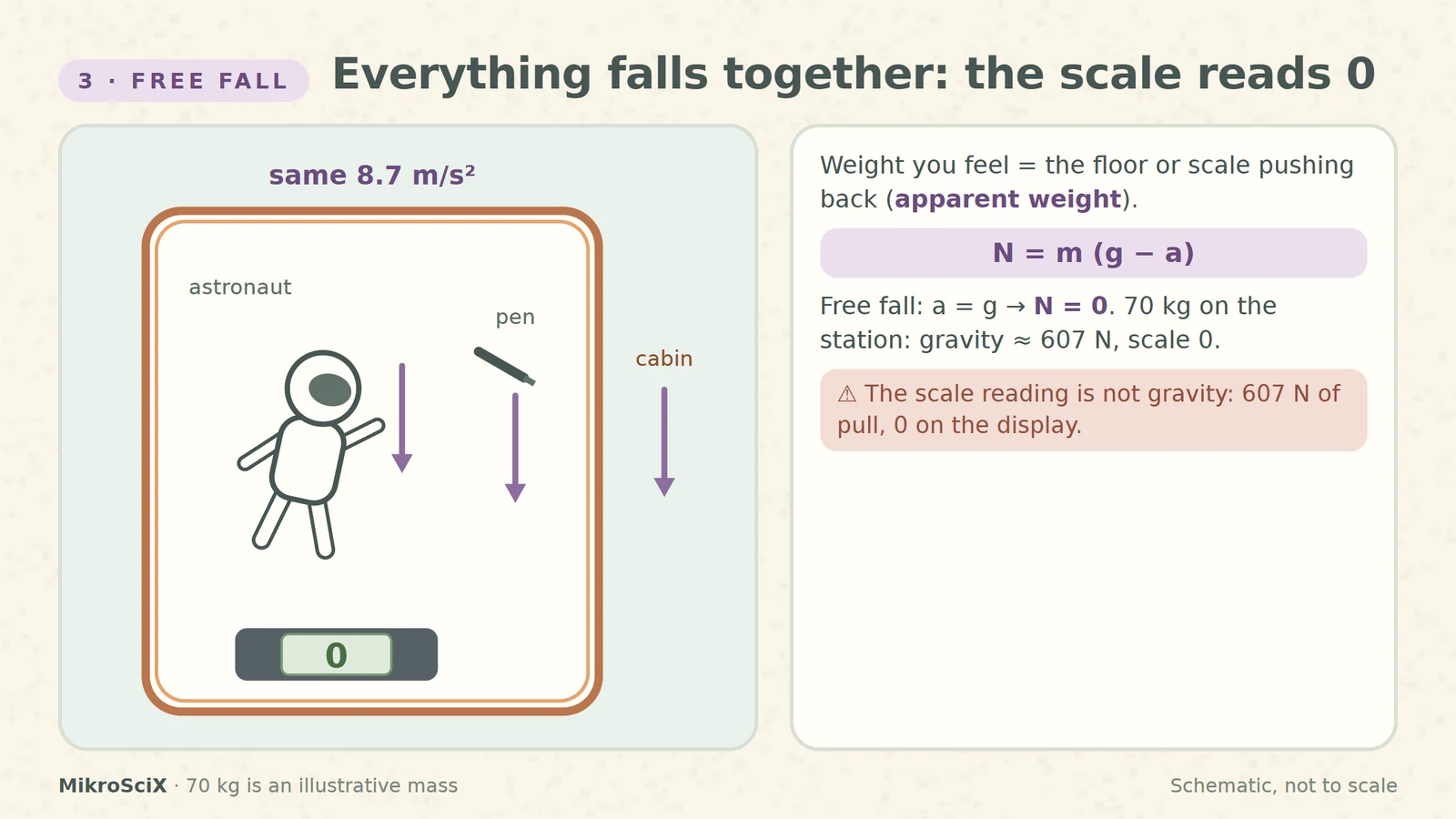
Newton's second law for a person on a scale in a moving box gives the reading directly: N = m (g − a), where a is the box's downward acceleration.
Check it yourself. Take a 70 kg person (an illustrative mass). Standing still on Earth: a = 0, N = 70 × 9.8 ≈ 686 N, the familiar reading. In a lift accelerating downward at 4.9 m/s²: N = 70 × (9.8 − 4.9) ≈ 343 N, half. In free fall, a = g: N = 0. On the station the same person is pulled with 70 × 8.67 ≈ 607 N, yet the scale still reads 0, because the scale is falling with the same acceleration.
What breaks: calling the scale reading "gravity". Gravity is 607 N in this example; the reading is 0. They are different quantities.
4. The same feeling on Earth, for seconds
Because floating is just free fall, you can have it without leaving the atmosphere, as long as nothing pushes on you:
- Drop towers and free-fall rides. A cabin falls down a tower; objects released inside it float relative to the cabin for the few seconds the drop lasts. This is the real-life version of Einstein's falling lift.
- Parabolic flights. An aircraft climbs steeply, then flies a parabola, the path a thrown stone would take. At the top, everyone inside is in free fall for about 20 seconds (ESA; NASA quotes 20 to 30 seconds). A typical flight repeats this about 30 times. Before and after each parabola the load rises to about 2 g.
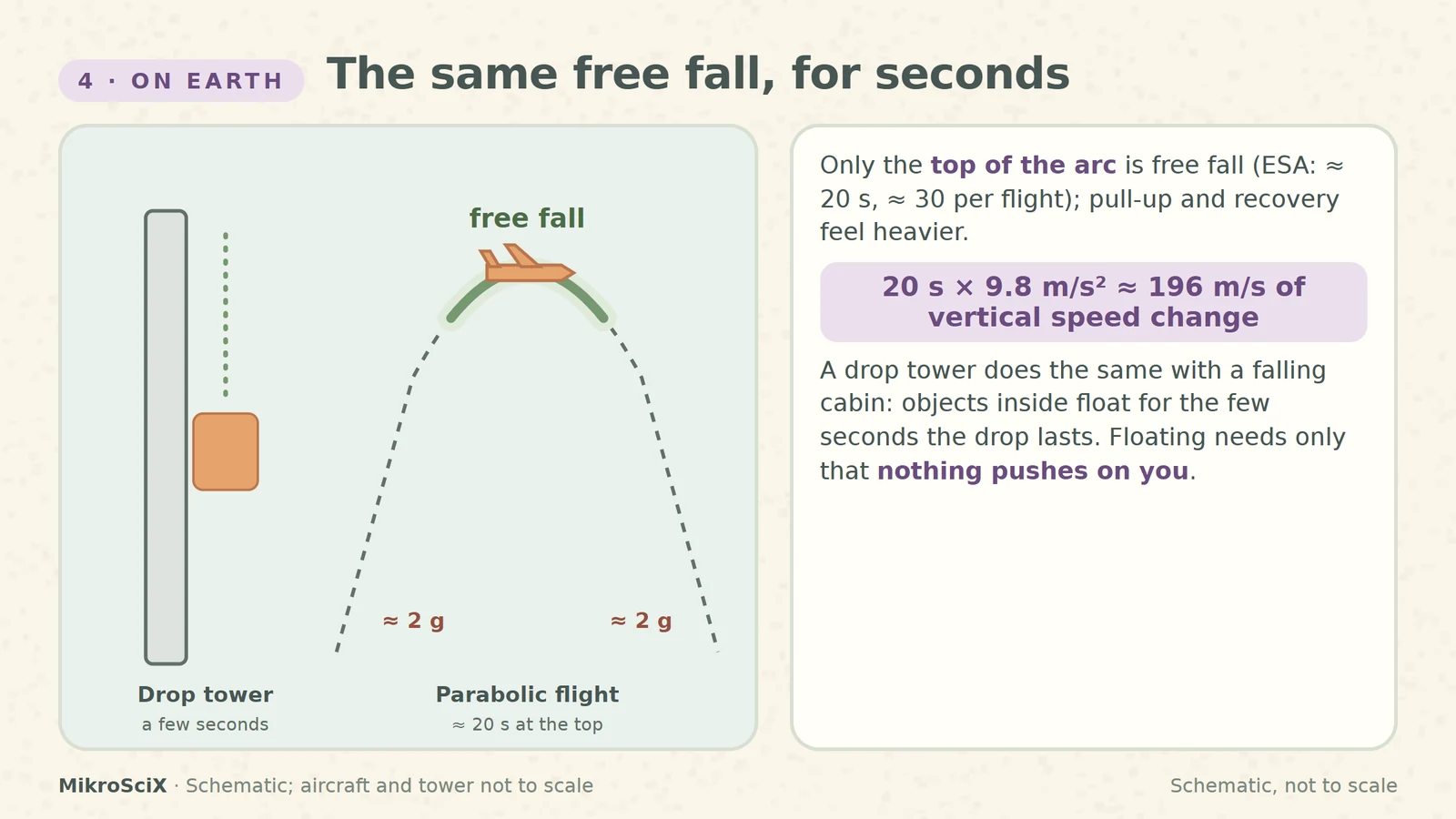
Check it yourself. In free fall the vertical speed changes by g every second. Over a 20 s parabola that is 9.8 × 20 ≈ 196 m/s. If the aircraft enters and leaves symmetrically, it starts the parabola climbing at about 98 m/s and ends it descending at about 98 m/s, which is why the manoeuvre needs the steep climb before it.
What breaks: treating the whole flight as weightless. Only the top of each arc is free fall; the pull-up and the recovery feel heavier than normal.
5. Artemis II: falling all the way to the Moon
Artemis II launched on 1 April 2026 and flew four astronauts (Reid Wiseman, Victor Glover, Christina Koch and Jeremy Hansen) around the Moon and back in a little over nine days, splashing down on 10 April. Far from Earth, the reason for floating is exactly the same.
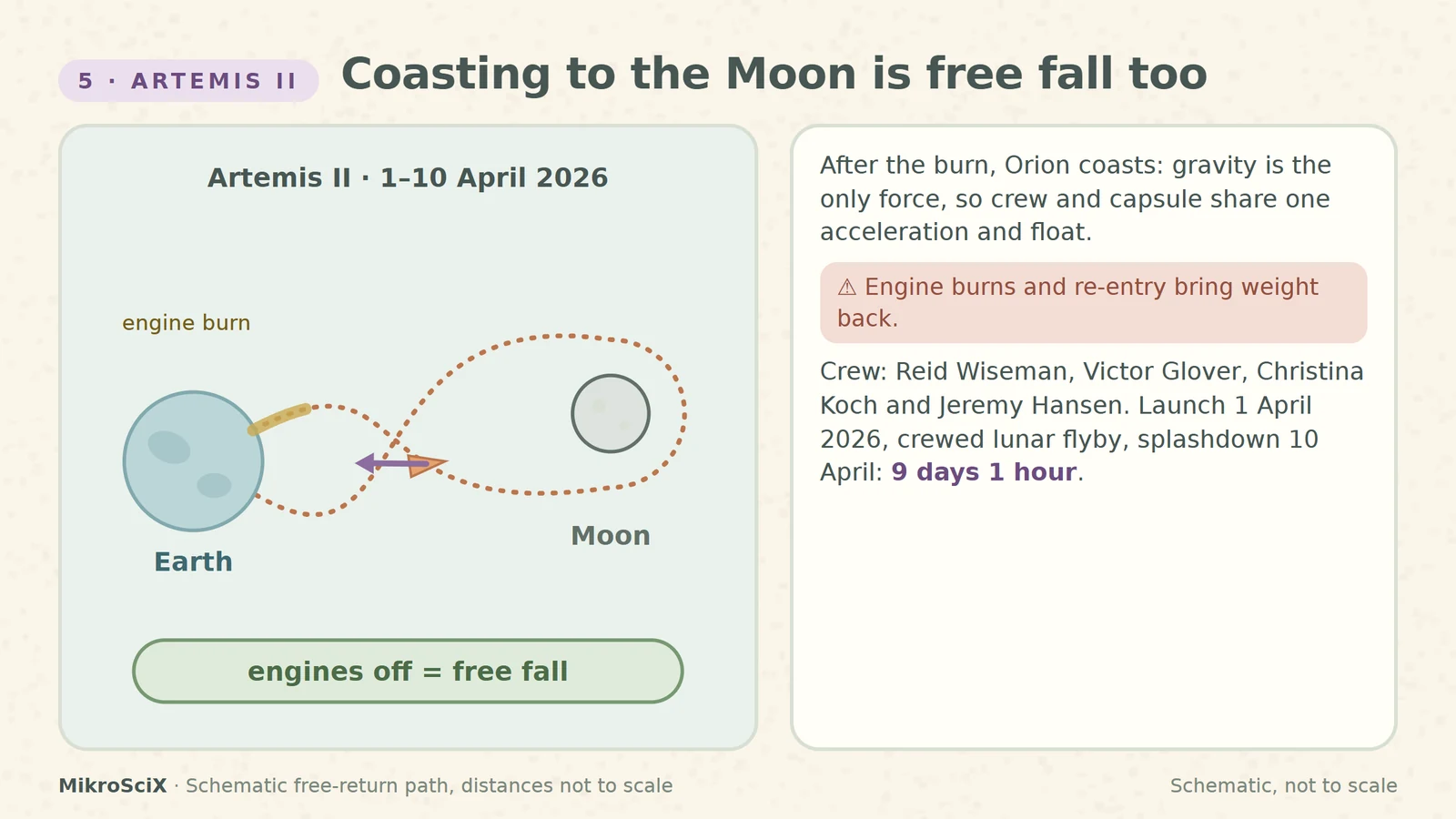
Once the engine burn that sends Orion toward the Moon is over, the capsule coasts. Gravity from Earth (and, near the Moon, from the Moon) is the only force acting on it, so Orion and its crew share one acceleration: free fall. The path is a long curve instead of a circle, but OpenStax makes the same point for noncircular paths: astronauts on them "feel weightless" too.
What breaks: assuming floating needs Earth orbit or great distance. It needs only that no engine, floor or air pushes on you. During engine burns and during re-entry, the crew feels weight again.
6. The word that misleads: "zero gravity"
Put the two numbers side by side. Gravity at the station: about 88 % of the surface value. Scale reading: 0. What has vanished is the felt weight, not gravity. NASA calls the condition microgravity and notes that "zero gravity" is misleading: small residual accelerations remain, but the main point is that gravity is very much present.
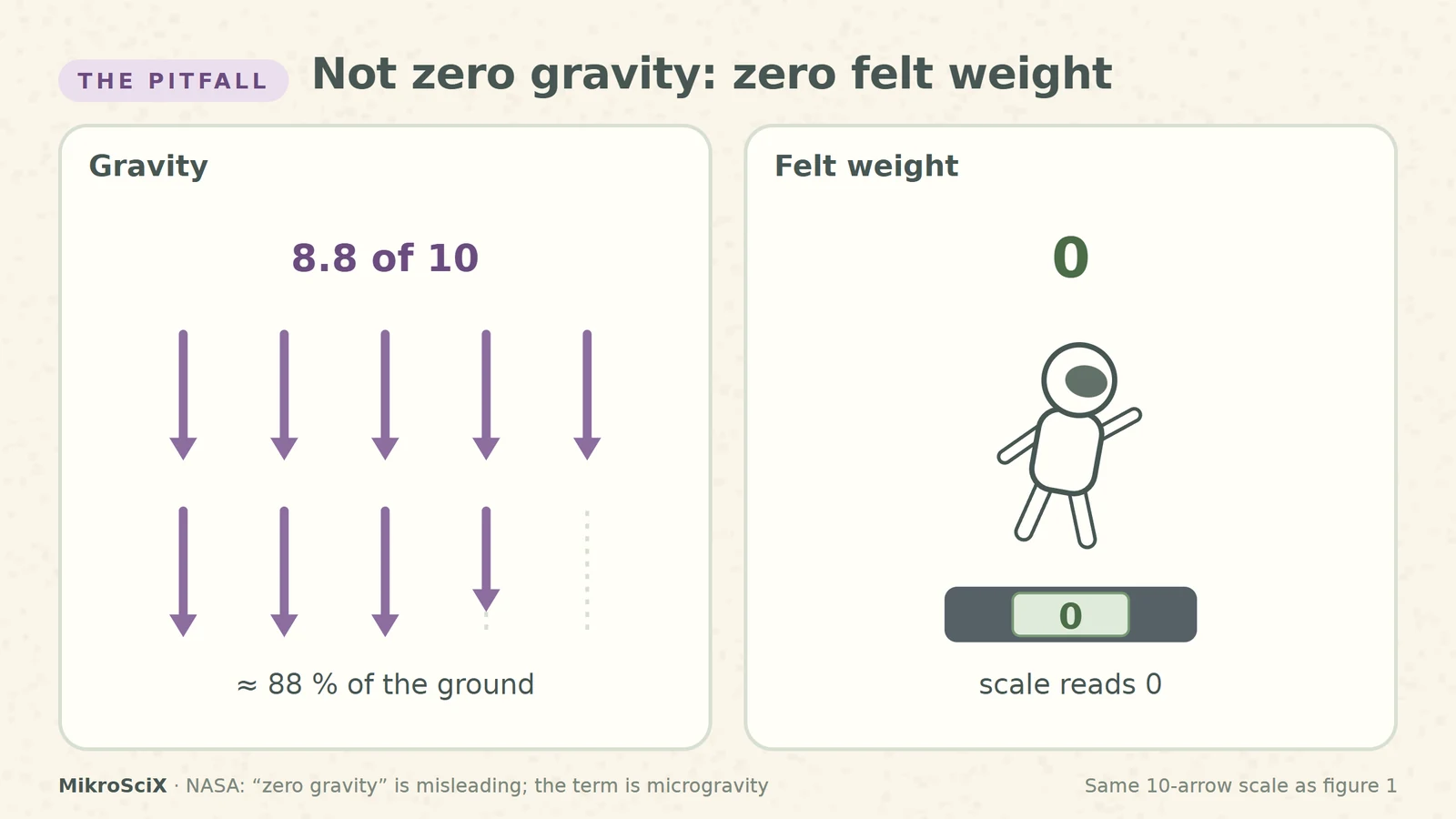
Astronauts float not because gravity is missing, but because they and their spacecraft fall together, sideways fast enough to keep missing Earth.
Try it yourself
- Using g(h) = g₀ (R / (R + h))² with R = 6370 km, what is g at 2000 km altitude?
- A 60 kg astronaut is on the station (g ≈ 8.67 m/s²). How strong is gravity's pull on them, and what does a scale under their feet read?
- A lift accelerates downward at 2.5 m/s². What does a scale read for a 70 kg person?
Answers: (1) (6370 / 8370)² ≈ 0.579, so g ≈ 5.7 m/s²: astronauts there would still float, for the same reason. (2) 60 × 8.67 ≈ 520 N of gravity; the scale reads 0. (3) 70 × (9.8 − 2.5) ≈ 511 N, about three quarters of the normal reading.
Watch the short
Videos don’t load automatically. The videos are hosted on YouTube. Allow YouTube once and every video on the site loads by itself; your choice is remembered. The articles never need consent.
Sources
- NASA — What Is Microgravity? (Grades 5-8)
- OpenStax University Physics Volume 1 — 13.2 Gravitation Near Earth's Surface
- OpenStax University Physics Volume 1 — 13.4 Satellite Orbits and Energy
- NASA — Space Station Facts and Figures
- ESA — Parabolic flights
- NASA — Artemis II mission page
Diagrams are schematic and not to scale. The 4.3 m fall-versus-curvature check, the parabolic-flight speeds and the lift examples are our own calculations from the sources' values; the 70 kg and 60 kg masses are illustrative.