

THIN-FILM DEPOSITION
DC magnetron sputtering: how one argon ion builds a metal film
Vacuum, argon, electrons, magnets and ion hits: what each step does, the numbers behind it, a worked example you can check yourself, and the one target that DC cannot sputter. For undergraduate and graduate students.
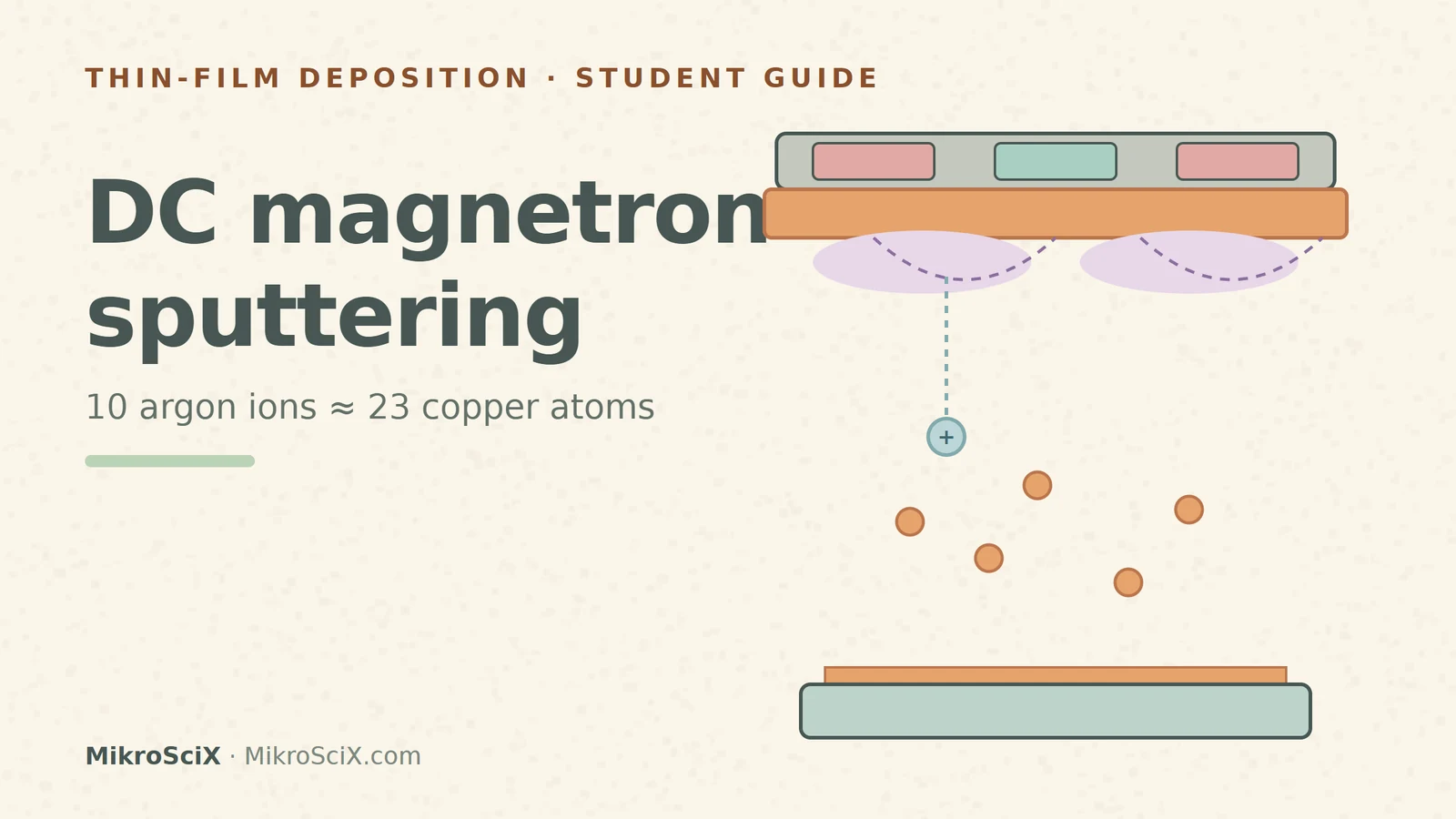
Chips, mirrors and solar panels all carry a metal film only tens or hundreds of nanometres thick. One of the most common ways to make it is DC magnetron sputtering: argon ions hit a metal plate, the target, and knock atoms out of it; those atoms fly across a vacuum chamber and stick to a wafer.
The idea fits in one sentence, but each step hides a question students often get wrong. Why argon and not air? What do the magnets actually hold? How many atoms does one ion free? And why does the same machine fail completely on a quartz target? This guide answers them in the order the machine works.
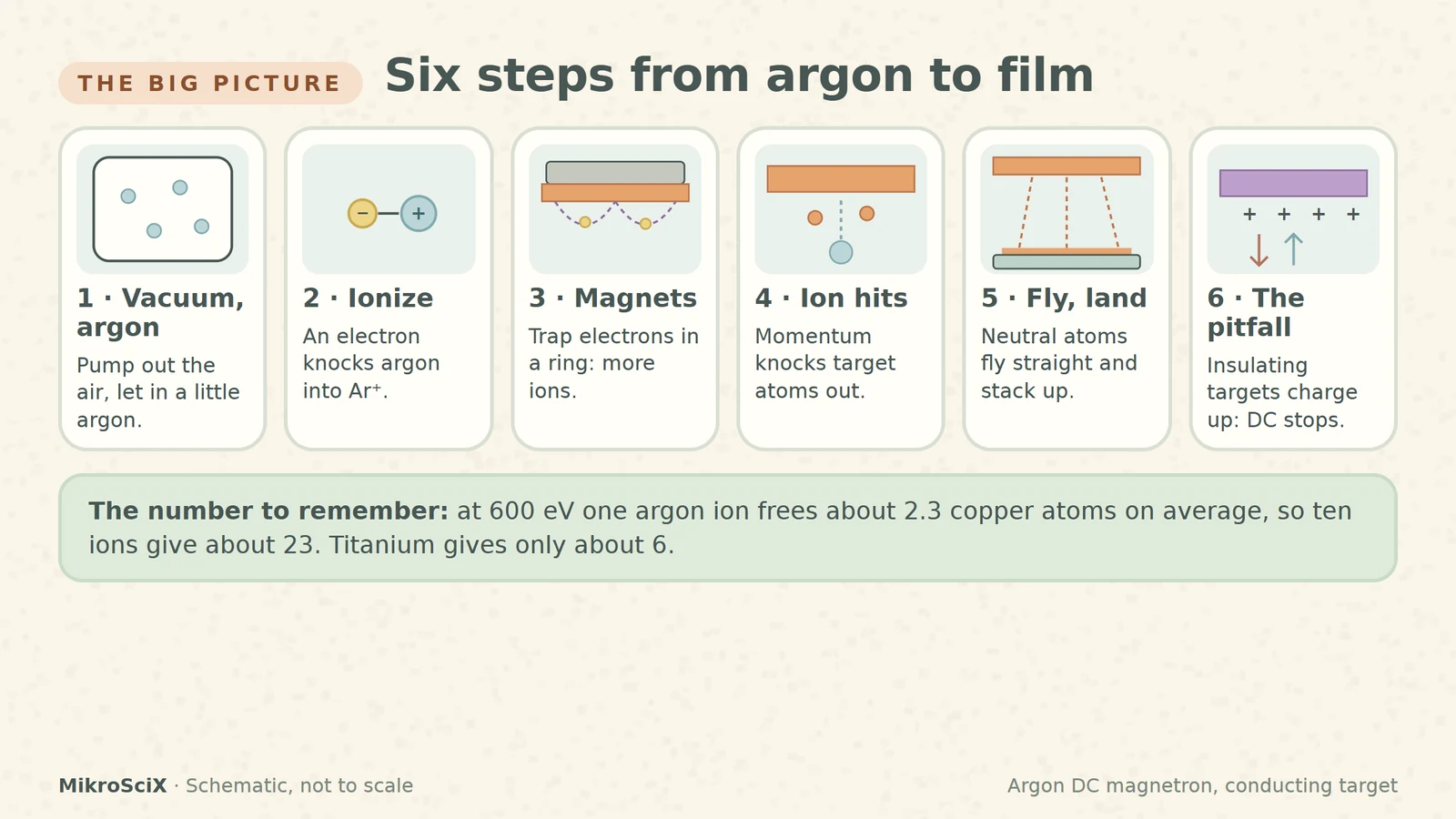
1. First vacuum, then a little argon
The chamber is pumped down first, then argon is metered in until it reaches a low working pressure; AJA International gives 3 mTorr as an example, and NPTEL's course notes quote 1 to 100 mTorr for DC sputtering in general. Two separate steps: pumping removes the air, and the argon, an inert gas, gives the discharge something to ionize.
What breaks: the working chamber is never empty. If the drawing shows an empty chamber while the target is sputtering, it is wrong: argon is always there, and the sputtered atoms meet it on the way.
2. Electrons turn argon into ions
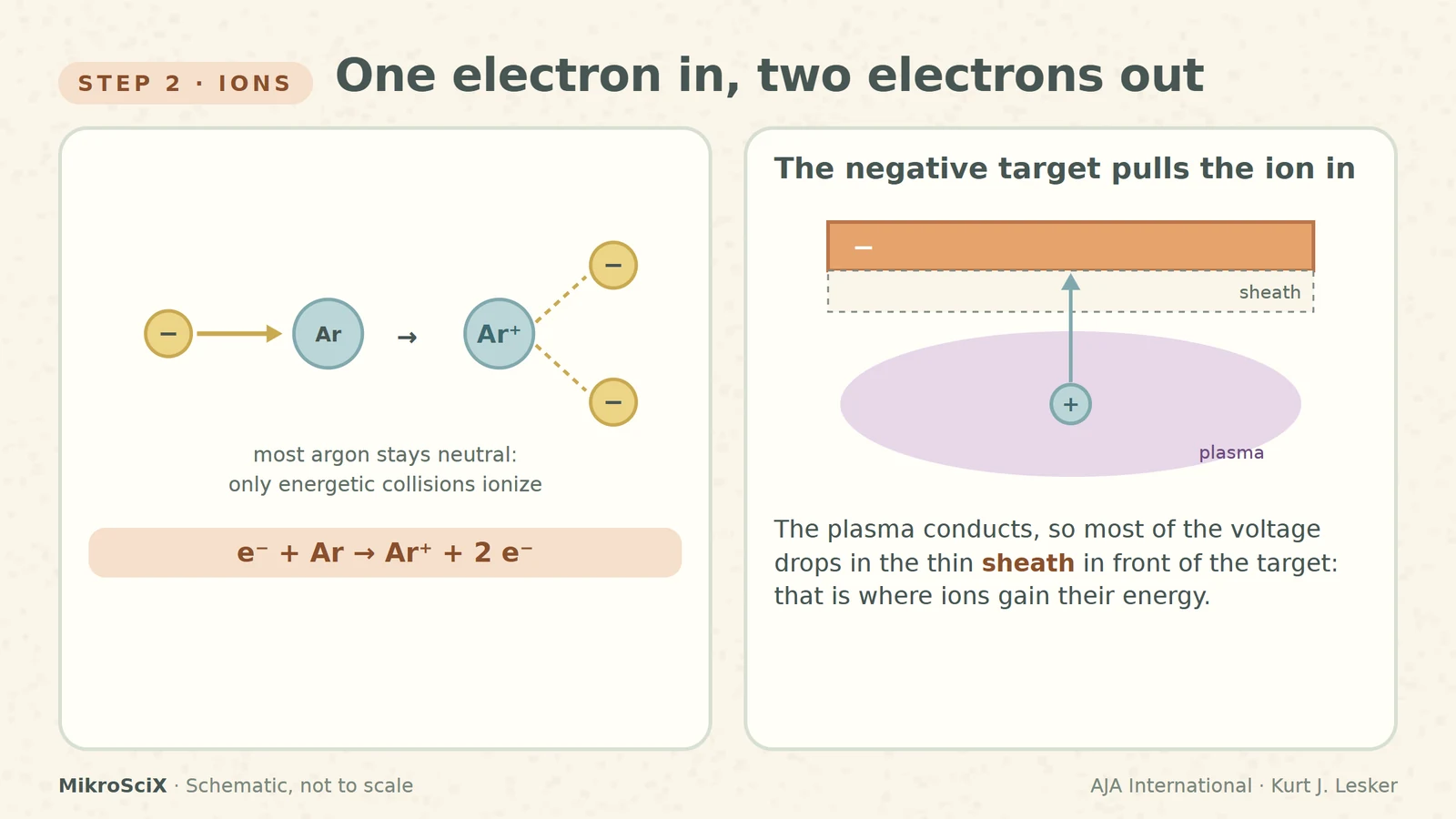
The DC supply holds the target negative (it is the cathode). Free electrons are accelerated away from it, collide with argon atoms and knock an outer electron off. What remains is a positive argon ion, Ar⁺, and now there are two free electrons instead of one:
e⁻ + Ar → Ar⁺ + 2 e⁻
The negative target pulls the positive ion in. Most of the acceleration happens in a thin dark region, the sheath, just in front of the target, because the glowing plasma itself conducts well and carries little voltage drop (Kurt J. Lesker). When the ion hits, it also frees more electrons, which keeps the discharge going.
What breaks: not every collision ionizes. Most argon stays neutral; only collisions with enough energy produce an ion.
3. Magnets trap the electrons, not the atoms
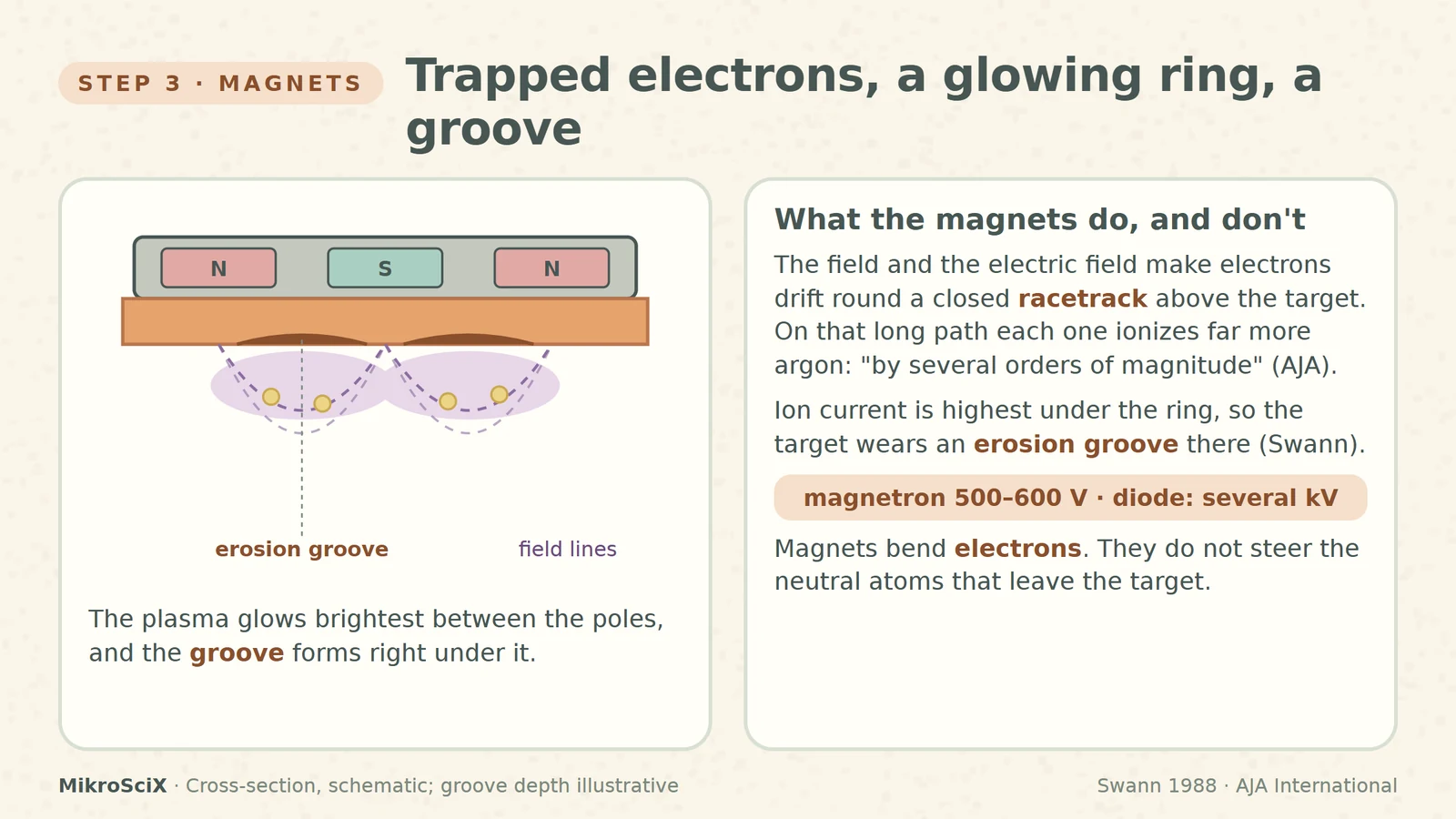
In a plain diode system, the electrons are free to leave the target region, and they bombard the substrate heavily (AJA). A magnetron puts magnets behind the target. Their field arcs over the target surface and, together with the electric field, makes the electrons drift around a closed loop, the "racetrack" (Swann, 1988). Trapped on that long, circuitous path, each electron has a much better chance of ionizing argon; AJA writes "by several orders of magnitude".
Two consequences you can see in any lab. First, the plasma glows brightest in a ring above the target. Second, the target wears fastest under that ring: ion current density is highest there, and an erosion groove forms as the target is used. Swann also notes that the denser plasma lets a magnetron run at 500–600 V instead of the several kilovolts of a plain diode system.
What breaks: the magnets act on moving charges. They curve the paths of electrons; they do not steer the neutral atoms that leave the target.
4. One ion, how many atoms?
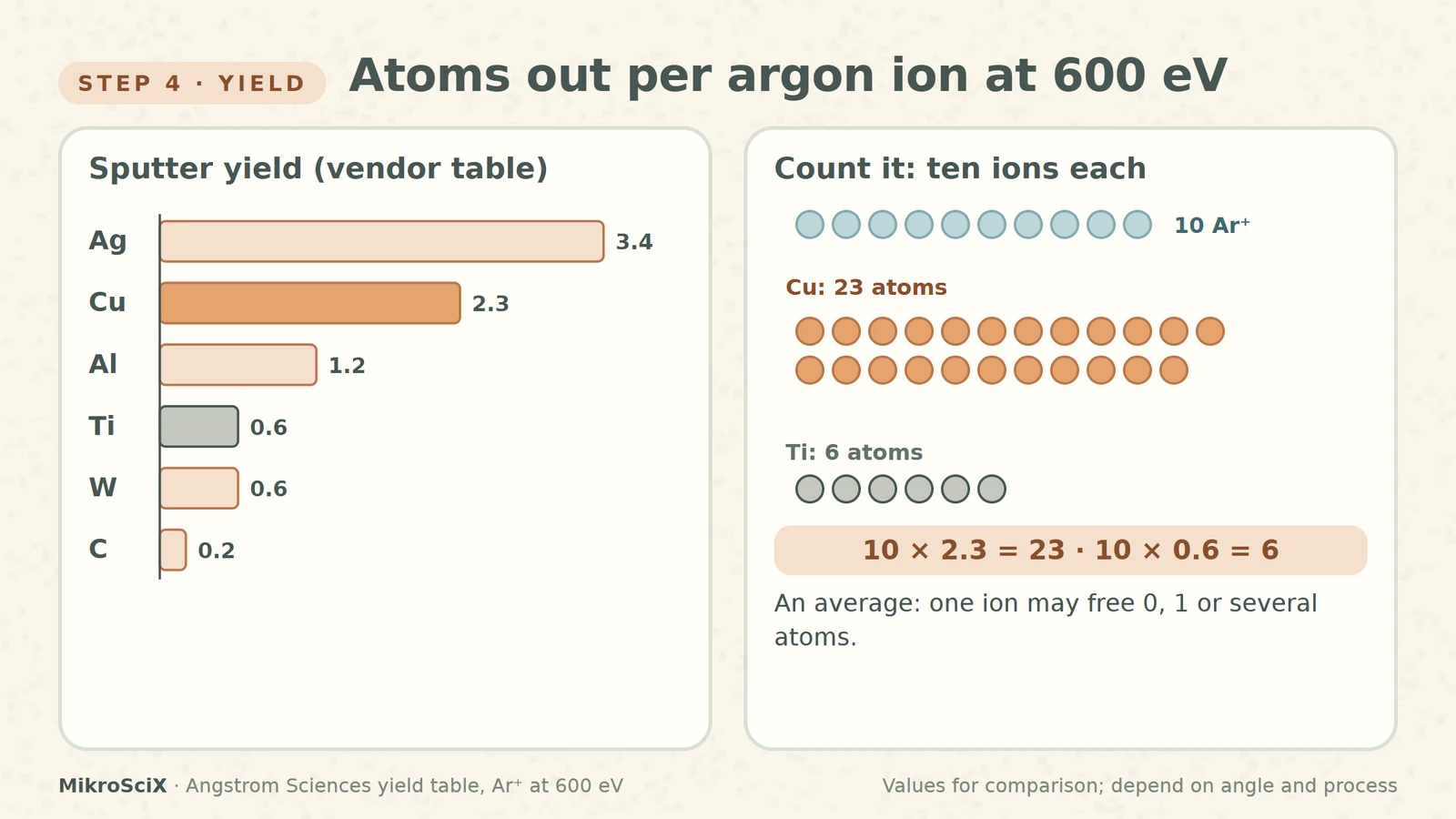
When an Ar⁺ ion hits the target, it passes its momentum to the atoms of the surface, and some of them leave. The average number of target atoms ejected per incoming ion is the sputter yield. Angstrom Sciences publishes yields for argon ions at 600 eV, an energy typical of an argon plasma:
- Silver 3.4 · copper 2.3 · aluminium 1.2
- Titanium 0.6 · tungsten 0.6 · carbon 0.2
Check it yourself. Ten ions on copper: 10 × 2.3 = 23 atoms. Ten ions on titanium: 10 × 0.6 = 6 atoms. Copper gives 2.3 / 0.6 ≈ 3.8 times more atoms per ion. The same table lists representative deposition rates at full power and a 4-inch distance: copper 320 Å/s, titanium 80 Å/s, a ratio of 4.0, close to the yield ratio.
What breaks:
- "One ion, one atom." The yield is an average. A single ion may free none, one, or several atoms; only the total over many ions follows the table.
- One number per metal. The yield changes with ion energy and angle, and the vendor stresses that magnetron design and process conditions shift it. Use the table to compare materials, not to predict your exact rate.
5. Neutral atoms fly to the wafer
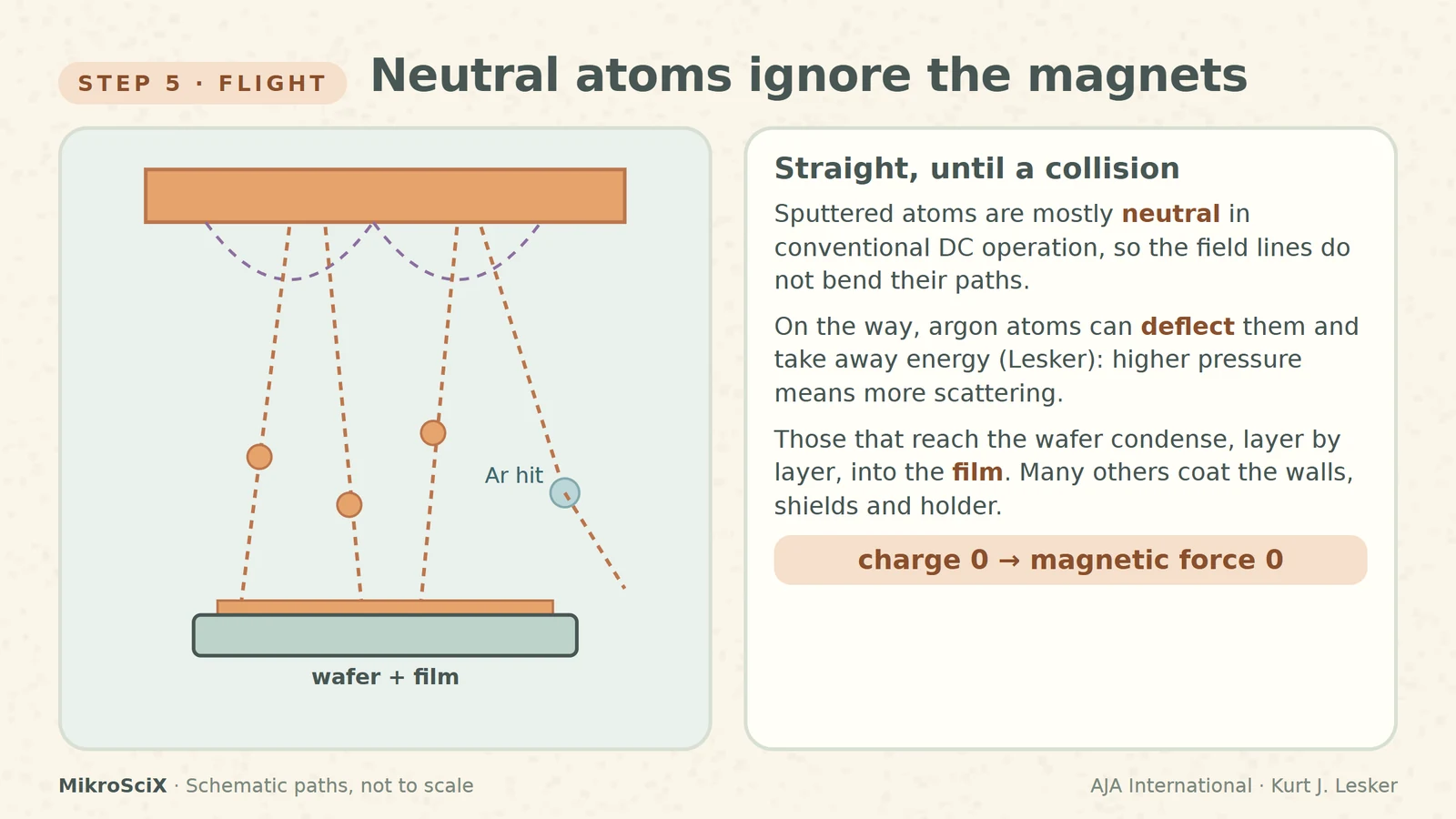
In conventional DC operation, the ejected atoms are mostly neutral (Lesker, AJA). With no charge, they ignore the magnetic field and travel in straight lines until they collide with something. Those that reach the substrate condense, layer by layer, into the film.
"Straight" has a limit: on the way, an atom can hit argon atoms that deflect it and take away energy (Lesker). That is why the target-to-substrate distance and the pressure matter for uniformity, and why higher pressure means more scattering, not simply better or worse films.
What breaks: not every atom lands on the wafer. Many coat the walls, the shields and the holder.
6. The pitfall: DC needs a conducting target
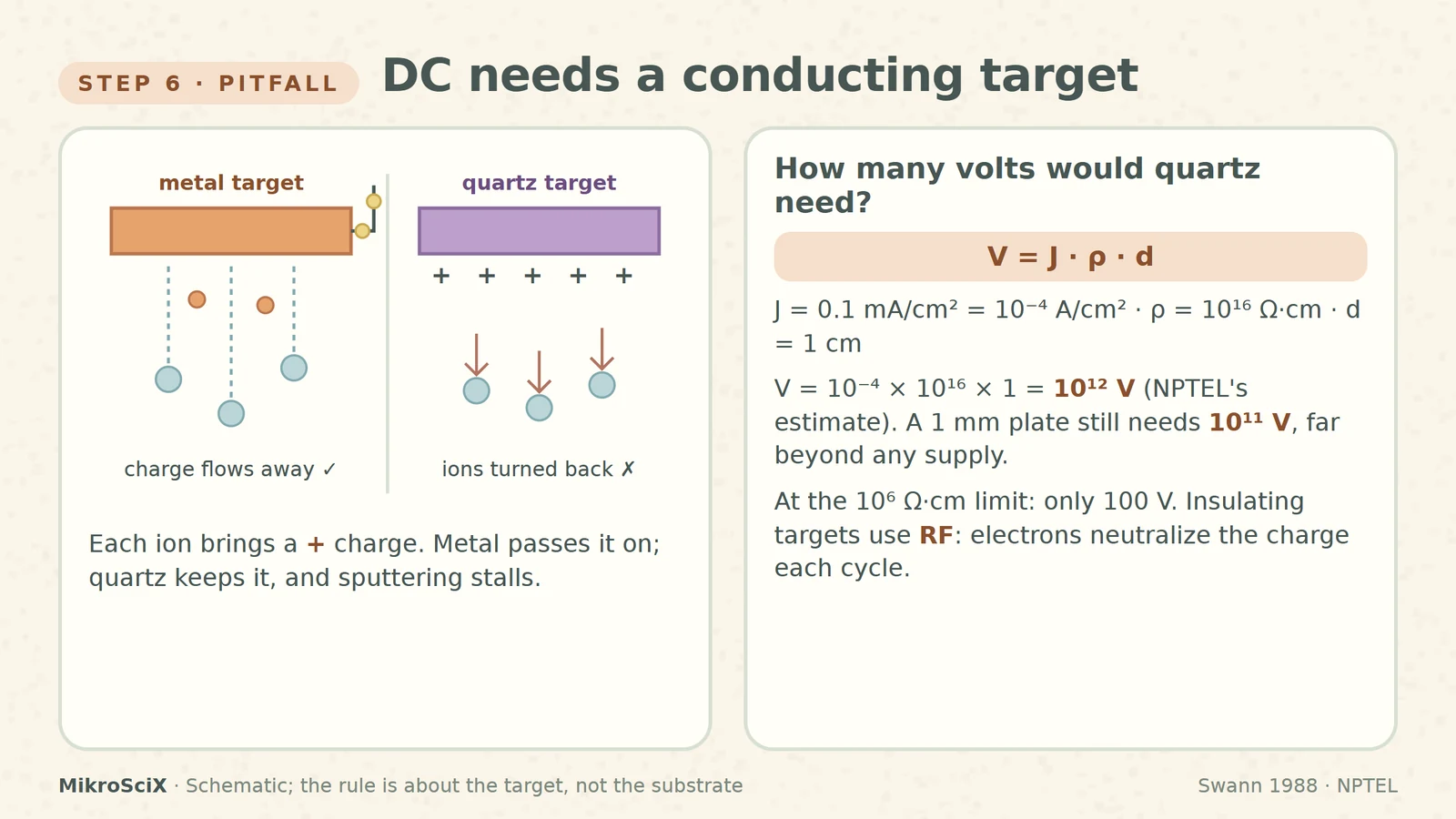
Every ion that lands brings a positive charge. A metal target passes it straight on to the power supply, so the target stays negative and keeps attracting ions. An insulating target such as quartz cannot: "DC magnetrons will not work if an insulating target is used, because no current can flow through it" (Swann). Positive charge piles up on the surface, the target stops pulling ions in, and sputtering stalls.
How hopeless is it? NPTEL's estimate: quartz has a resistivity of about 10¹⁶ Ω·cm, so drawing a modest 0.1 mA/cm² through it would take about 10¹² volts. Its rule of thumb: targets above 10⁶ Ω·cm cannot be DC-sputtered.
Check it yourself. Treat the target as a resistor: V = J · ρ · d. With J = 0.1 mA/cm² = 10⁻⁴ A/cm², ρ = 10¹⁶ Ω·cm and a 1 cm thick plate: V = 10⁻⁴ × 10¹⁶ × 1 = 10¹² V. A 1 mm plate still needs 10¹¹ V, far beyond any supply. At the 10⁶ Ω·cm limit the same 1 cm plate needs only 100 V, small compared with the 500–600 V a magnetron runs at.
The way out is RF sputtering: an alternating voltage lets electrons from the plasma neutralize the positive charge during part of each cycle, so insulators can be sputtered too (NPTEL, Swann). Note what the rule is about: the target must conduct for DC. The substrate and the film do not.
Putting it together
- Pump, then argon: a clean chamber with something to ionize.
- Negative target + electrons: Ar⁺ ions accelerate into the target.
- Magnets: trapped electrons, a bright plasma ring, an erosion groove beneath it.
- Yield: about 2.3 copper atoms per ion at 600 eV, only 0.6 for titanium.
- Neutral atoms fly straight (between gas collisions) and build the film.
- DC only for conducting targets; insulators need RF.
Magnets hold electrons, ions do the work, and a metal target has to carry the charge away.
Try it yourself
- Fifty argon ions at 600 eV hit an aluminium target. About how many atoms leave?
- Using the same table, how many times more atoms per ion does silver give than titanium?
- A 2 mm thick target has a resistivity of 10⁸ Ω·cm. What voltage would 0.1 mA/cm² of DC current need? Could a 600 V magnetron supply it?
Answers: (1) 50 × 1.2 = 60 atoms on average. (2) 3.4 / 0.6 ≈ 5.7 times. (3) V = 10⁻⁴ × 10⁸ × 0.2 = 2000 V, more than three times what the supply delivers: use RF.
Watch the short
Videos don’t load automatically. The videos are hosted on YouTube. Allow YouTube once and every video on the site loads by itself; your choice is remembered. The articles never need consent.
Sources
- AJA International — Thin Film Deposition Overview
- Kurt J. Lesker — R&D Magnetron Sputtering Sources Overview
- S. Swann (1988), Magnetron sputtering, Physics in Technology 19, 67–75 (university copy)
- Gencoa — The Basic Theory of Magnetron Sputtering
- Angstrom Sciences — Sputtering Yields
- NPTEL (IIT), Lecture 39 — DC sputtering
- NPTEL (IIT), Lecture 39 — RF sputtering
Diagrams are schematic and not to scale. Yields and rates are vendor table values for comparison at 600 eV; the 10¹² V figure is NPTEL's estimate, reproduced here for a 1 cm thick target.