

ASTRONOMY · METEOR SHOWERS
Shooting stars on a timetable: why the Leonids return every November
A shooting star is a sand grain, a meteor shower is a comet's dust stream, and the date is fixed by where Earth is on its orbit. With the numbers for the 17–18 November 2026 peak, a rate formula you can use yourself and how to watch. For students and curious observers.
Every year in mid-November, people in both hemispheres see more "shooting stars" than usual, and the extra ones all seem to fly out of the constellation Leo. This is the Leonid meteor shower. It is not a coincidence of the calendar: the date is set by geometry, the number you see is set by your sky, and the streaks themselves are made by grains smaller than a pea.
This article follows one grain from the comet that released it to the moment it lights up above your head. For each step: what happens, the number behind it, a calculation you can check yourself, and the misreading that most often goes wrong.
1. A shooting star is not a star
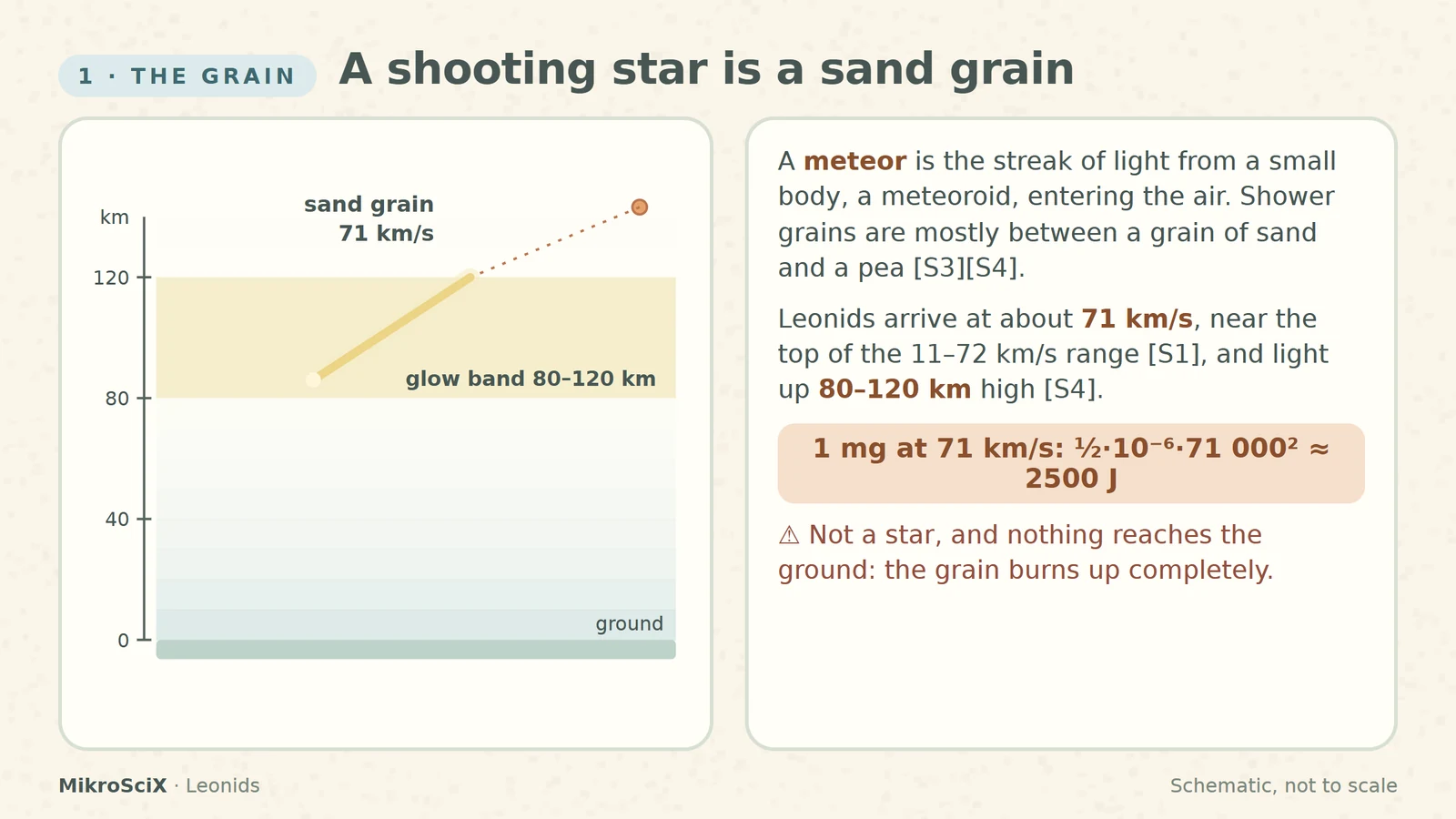
A meteor is the streak of light produced when a small body from space, a meteoroid, enters the atmosphere at high speed. No star is involved. Many visible meteors are produced by particles between a grain of sand and a small pebble, and comet debris in showers is mostly between a grain of sand and a pea [S3][S4].
Meteoroids enter the atmosphere at about 11 to 72 km/s. The Leonids are among the fastest: about 71 km/s, close to the upper limit [S1][S2]. Most visible meteors light up roughly 80–120 km above the ground [S4], far above aircraft and weather. A sand-sized Leonid grain burns up completely; nothing reaches the ground.
Check it yourself. Take an illustrative grain of 1 mg (10⁻⁶ kg) at 71 km/s. Its kinetic energy is ½ · 10⁻⁶ kg · (71 000 m/s)² ≈ 2500 J, about the same as a 1 kg ball moving at 71 m/s (≈ 256 km/h). That energy, released in the thin upper air, is what makes a speck of dust visible from 100 km away.
What breaks: drawing a meteor as a moving star, or as a rock that crashes down. The light comes from the air and the evaporating grain along a short path high in the atmosphere.
2. Where the grains come from: comet Tempel-Tuttle
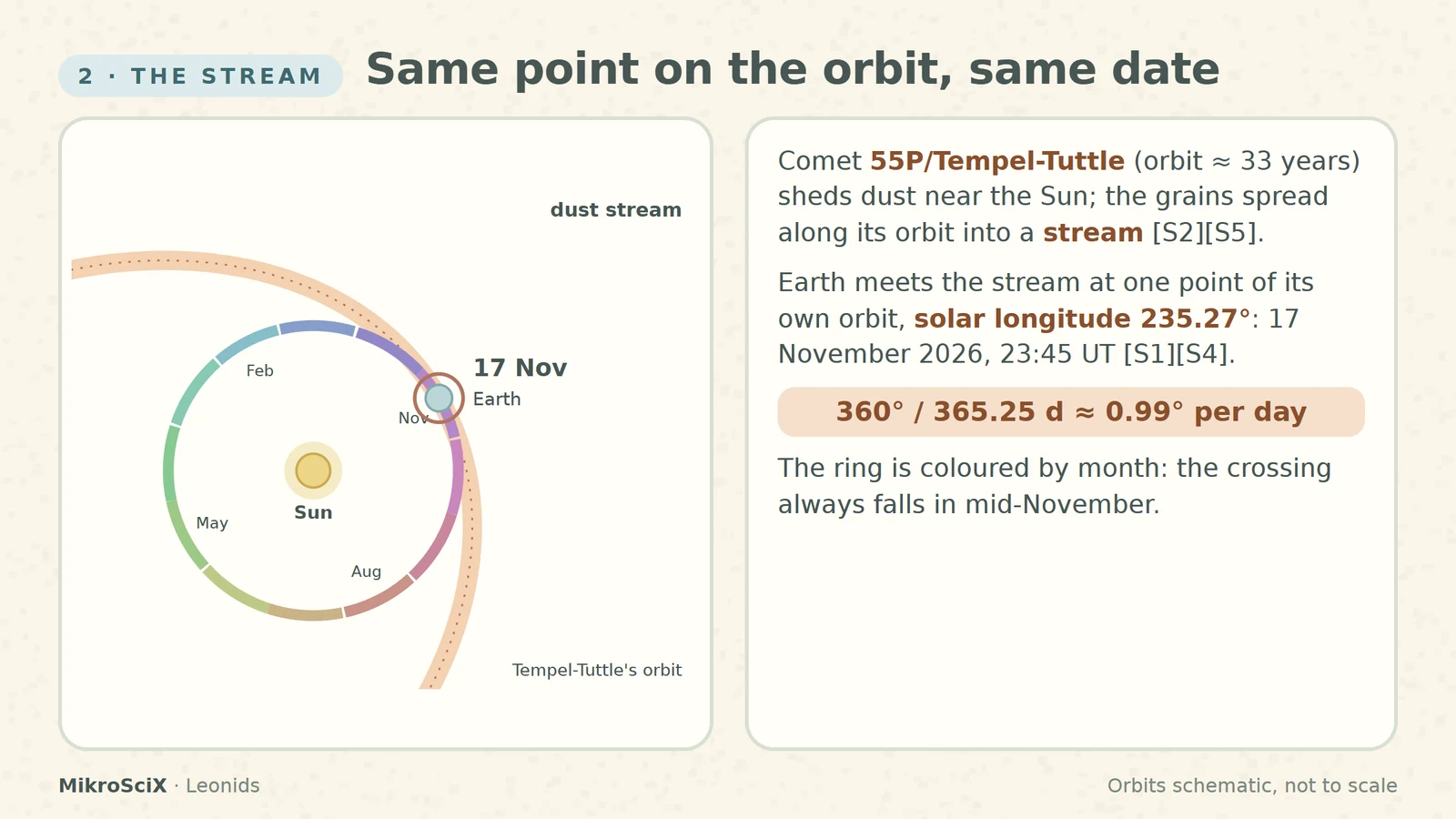
The Leonid meteoroids come from comet 55P/Tempel-Tuttle, which orbits the Sun about every 33 years [S2]. Each time it passes close to the Sun, ice evaporates and releases dust. The released grains keep moving on nearly the same orbit as the comet, but with slightly different speeds, so over time they spread out along the orbit into long trails. Many old trails together form a stream of debris around the whole orbit [S3][S5].
The comet's next perihelion (closest approach to the Sun) is due on 20 May 2031, so the grains Earth meets in 2026 are ahead of the comet [S1].
What breaks: the shower is not Earth "passing through the comet's tail". The comet is far away; Earth crosses old dust that has spread along the comet's path.
3. Why the date never changes
Tempel-Tuttle's orbit comes very close to Earth's orbit at one point. Earth reaches that point of its orbit at the same time every year, so the shower returns on the same dates [S4]. Astronomers describe Earth's position with the solar longitude λ⊙, a precise measure of where Earth is on its orbit that does not depend on the calendar [S1]. The regular Leonid maximum is at λ⊙ = 235.27°, which in 2026 falls on 17 November at 23:45 UT [S1].
Check it yourself. Earth moves 360° in 365.25 days: about 0.99° per day. A calendar year of 365 days ends about 6 hours "early" each year, and the leap day puts it back. So the moment Earth reaches 235.27° moves by at most about a day on the calendar: the same night, year after year.
What breaks: a shower date is not a property of the comet's timing. The comet can be on the other side of its orbit; the dust stream is always there to be crossed.
4. How many will you see? The rate formula
Shower strength is given as the zenithal hourly rate (ZHR): the number of meteors an ideal observer would see in one hour under a perfectly clear sky with stars down to magnitude +6.5 and the shower's radiant overhead [S1]. For the Leonids in 2026 the IMO expects ZHR ≈ 15 [S1]; EarthSky quotes 10 to 15 per hour under a dark, moonless sky [S9].
Real skies are worse than ideal. The IMO handbook formula used by meteor observers corrects for this [S6]:
ZHR = n · r^(6.5 − lm) / (T · sin h)
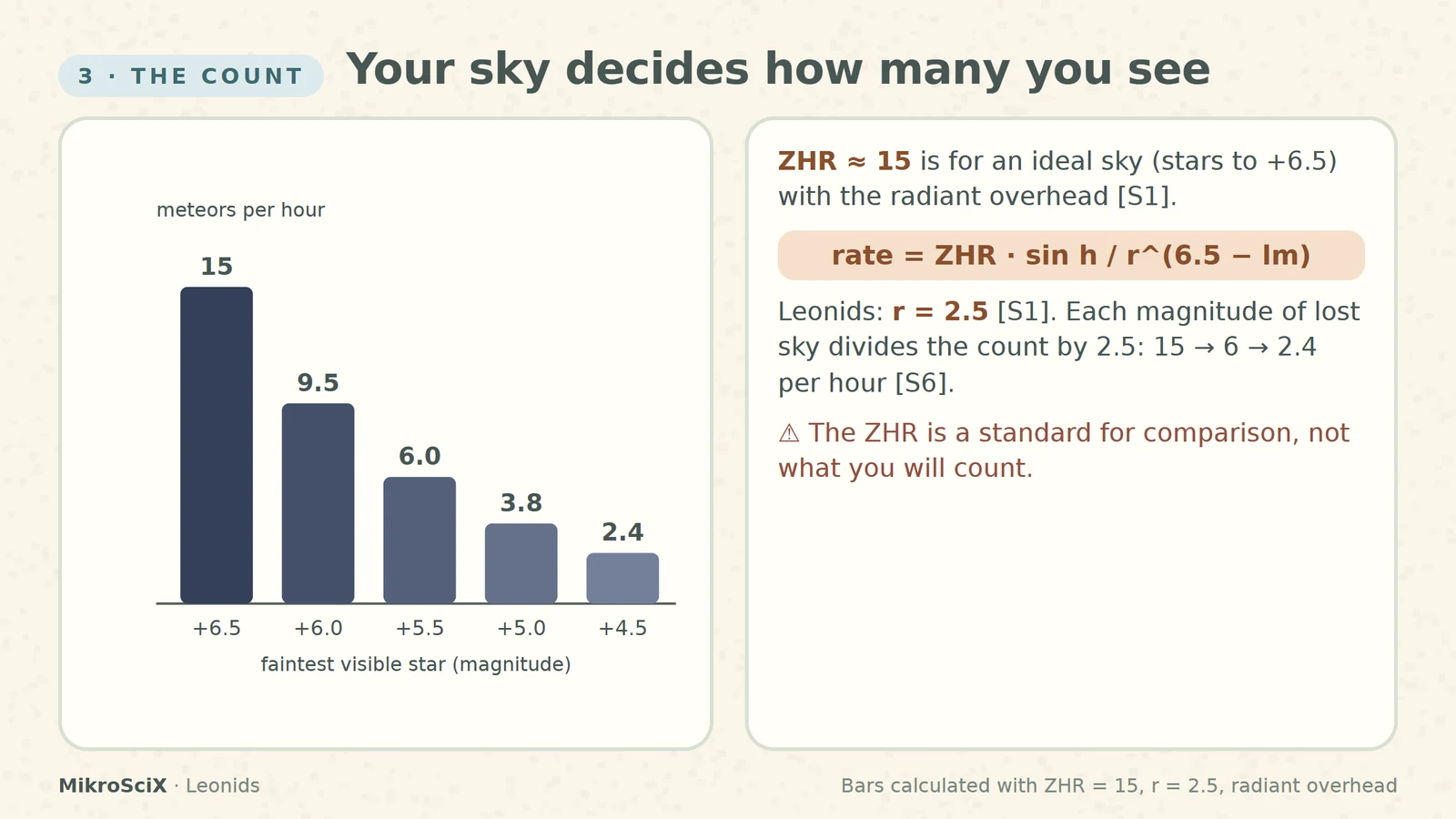
Here n is the number counted in T hours, lm is the faintest star you can see (the limiting magnitude), h is the radiant's altitude, and r is the population index: how many more meteors there are for each magnitude fainter. For the Leonids r = 2.5 [S1]. Turned around, it tells you what to expect: rate = ZHR · sin h / r^(6.5 − lm).
Check it yourself. With ZHR = 15 and the radiant overhead (sin h = 1):
- Perfect sky, lm = +6.5: 15 / 2.5⁰ = 15 per hour.
- One magnitude brighter sky, lm = +5.5: 15 / 2.5 = 6 per hour.
- Suburban sky, lm = +4.5: 15 / 2.5² = 15 / 6.25 ≈ 2.4 per hour.
- Perfect sky but the radiant only 30° high: 15 · 0.5 = 7.5 per hour.
What breaks: treating the ZHR as a promise. It is a standardised number that lets observers compare showers; what you see is almost always lower.
5. The 2026 Leonids
- Active: 6–30 November [S1].
- Peak: 17 November, 23:45 UT, which is 02:45 on 18 November in Türkiye (UTC+3): the night of 17 to 18 November [S1].
- Rate: ZHR ≈ 15; no storm is expected. Model calculations only show encounters with weak, low-density trails [S1].
- Moon: first quarter on 17 November [S1][S9]. A first quarter Moon rises around midday and sets around the middle of the night [S7], so the hours after midnight are darker, and the radiant in Leo is higher then [S9].
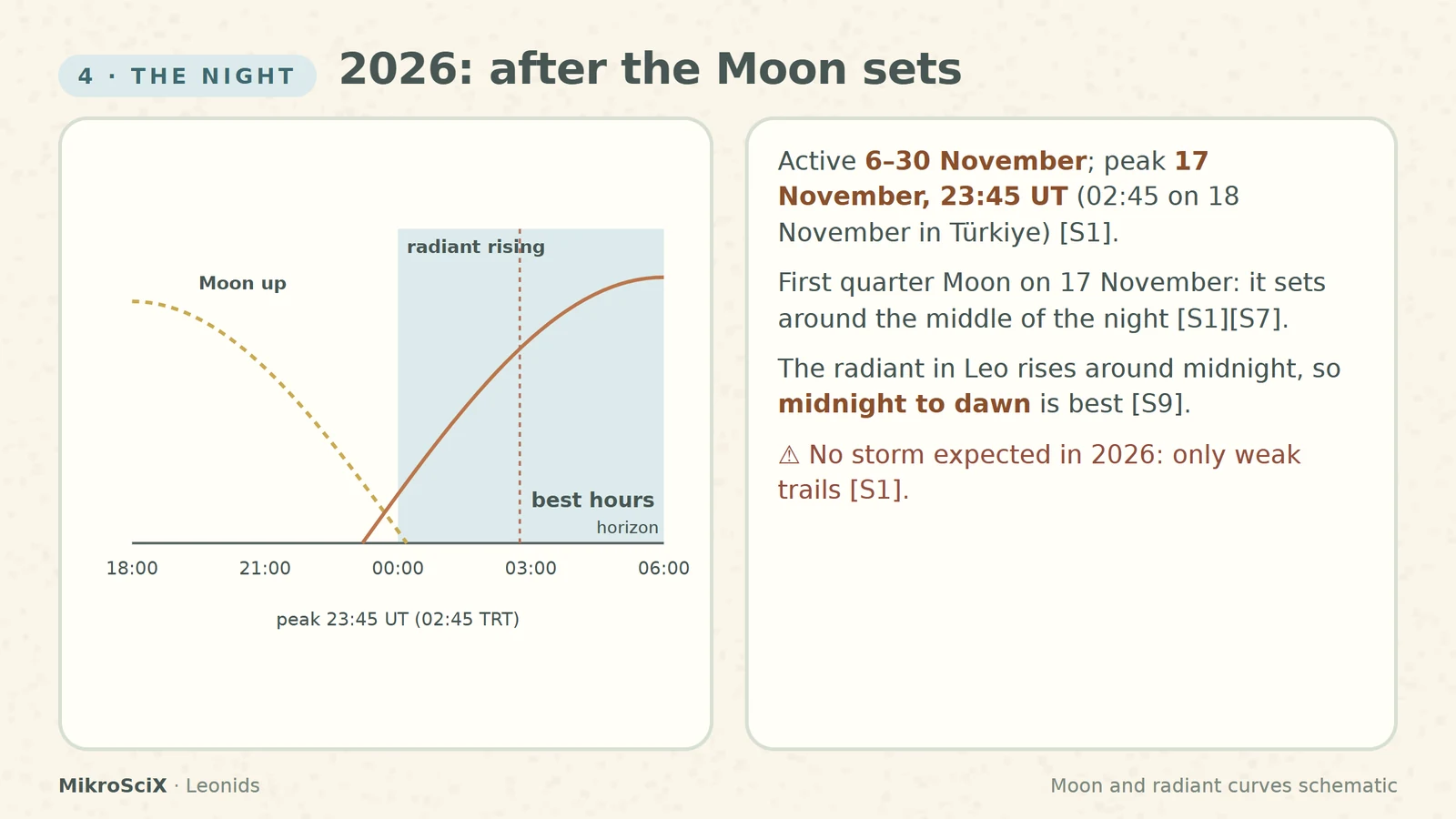
Popular guides disagree about the Moon (some call it waxing gibbous) and about the peak night; this article follows the IMO's 2026 calendar, which lists both the lunar phases and the shower data.
6. Storms: when Earth hits a fresh trail
The Leonids are famous because some years they turn into storms, defined as at least 1000 meteors per hour [S2]. In 1966 observers in the south-western United States reported up to 70 meteors per second for 15–20 minutes [S9]. Storms happen when Earth passes through a young, dense trail released at a recent perihelion; the 1833 and 1966 storms came from trails released in 1800 and 1899, at times when the comet's path ran unusually close to Earth's orbit [S5]. Because the comet returns every 33 years, storms tend to come in roughly 33-year cycles; the last one was in 2002 [S2].
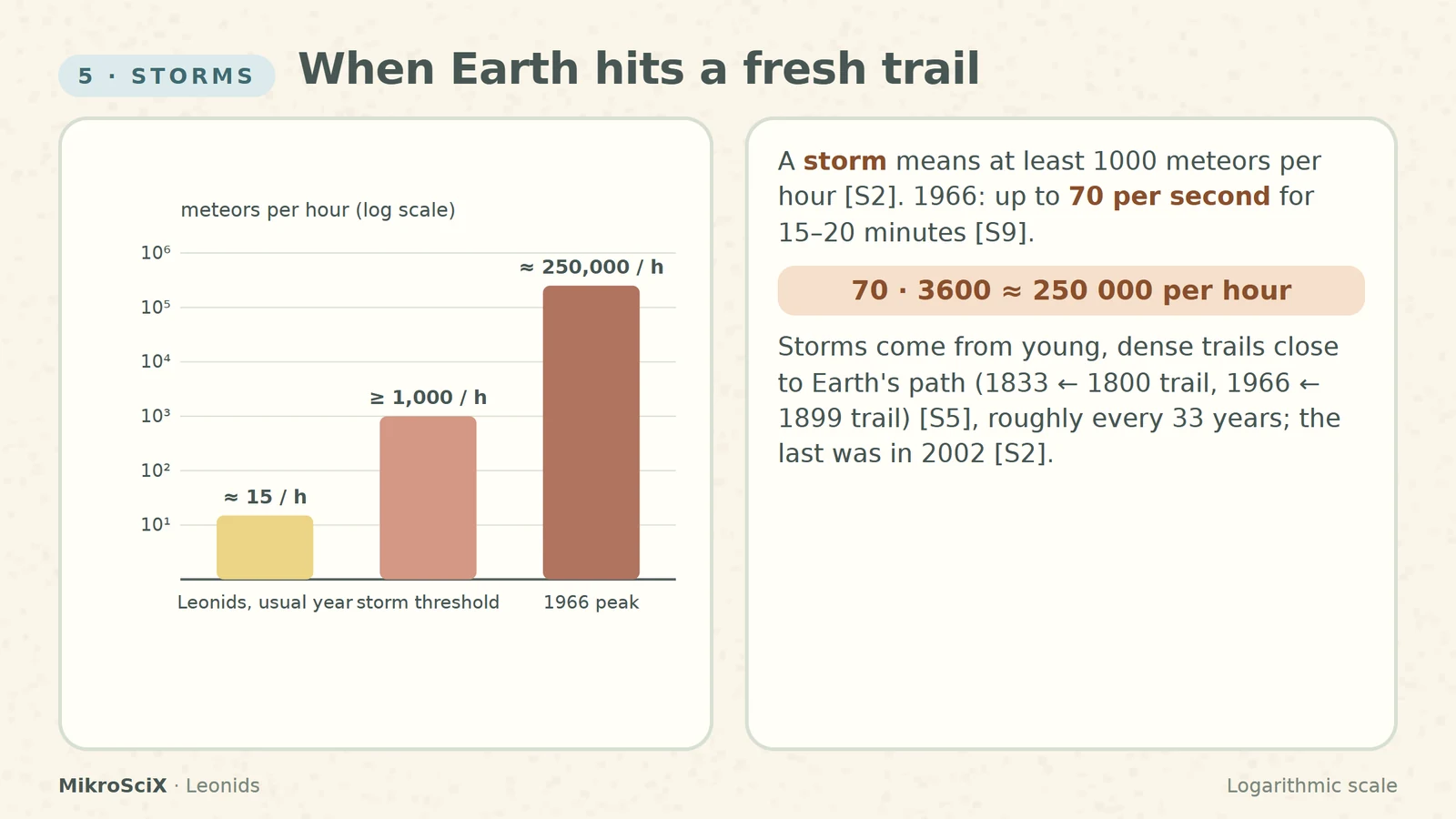
Check it yourself. 70 per second is 70 · 3600 ≈ 250 000 per hour, over 16 000 times the usual ZHR of 15, and 250 times the storm threshold.
7. Meteoroid, meteor, meteorite, asteroid
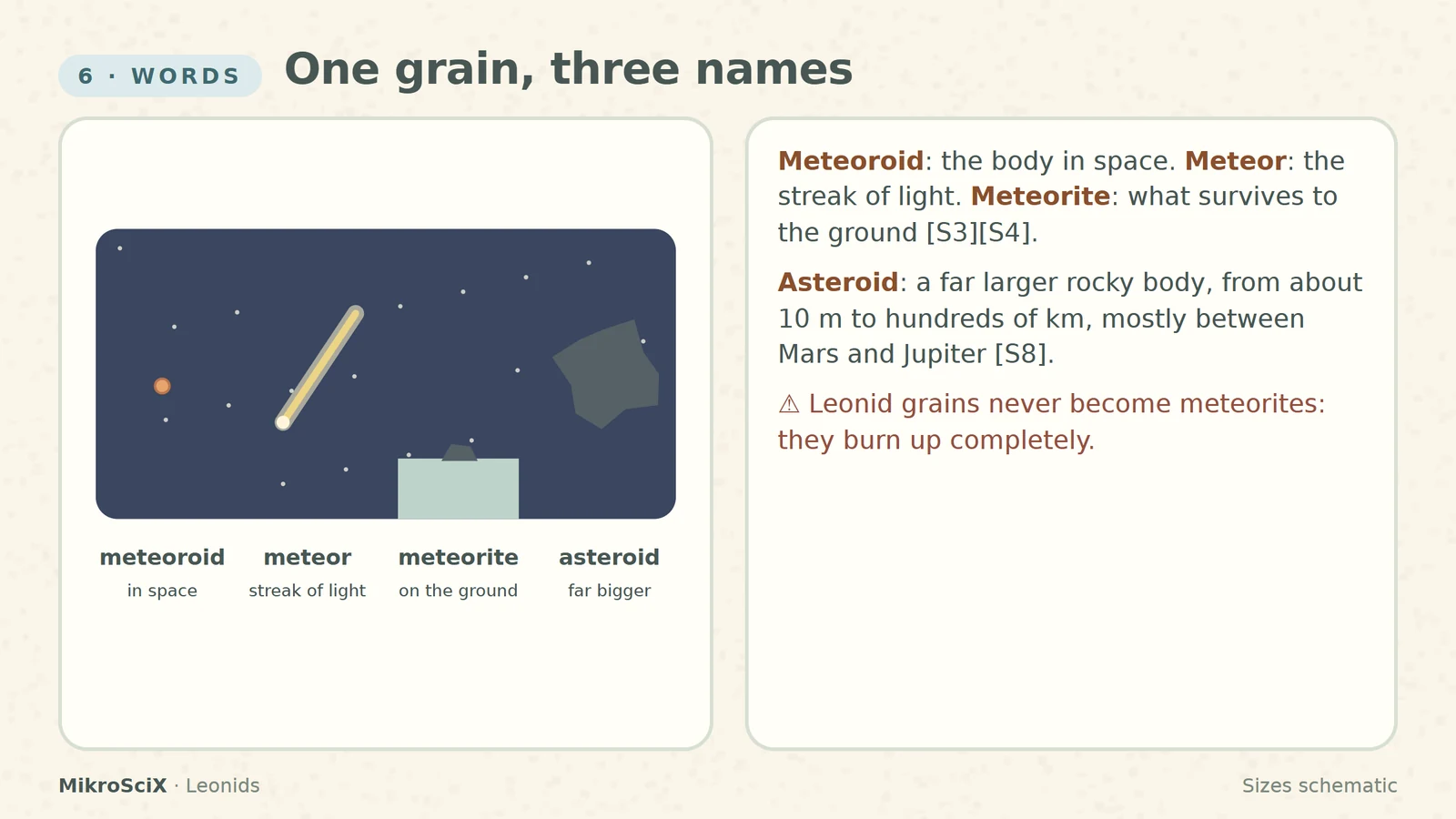
Four words, often mixed up [S3][S4][S8]:
- Meteoroid: the small body while it is still in space.
- Meteor: the streak of light in the atmosphere.
- Meteorite: material that survives the trip and reaches the ground. Only a small share of meteoroids do; Leonid grains never do.
- Asteroid: a far larger rocky body left over from the formation of the solar system, from about 10 m up to hundreds of kilometres; most orbit between Mars and Jupiter.
8. How to watch
- Find a dark place with an unobstructed view of the sky, away from city lights [S4].
- Give your eyes at least 20–30 minutes to adapt, and stay off your phone screen; use a dim red light if you must [S4].
- Use your eyes only: binoculars and telescopes narrow your field of view [S4].
- You do not need to stare at Leo; meteors appear all over the sky, their paths pointing back to the radiant [S4].
- In 2026, watch after the Moon has set, from around midnight until dawn [S7][S9].
The date comes from Earth's orbit, the grains from a comet, and the count from your sky: dark site, after midnight, 17–18 November.
Try it yourself
- The faintest star you can see is +5.0. How many Leonids per hour can you expect at best (radiant overhead)? Answer: 15 / 2.5^1.5 = 15 / 3.95 ≈ 3.8 per hour.
- Perfect sky, radiant 45° high. Answer: 15 · sin 45° ≈ 15 · 0.71 ≈ 11 per hour.
- A larger grain of 0.1 g hits the air at 71 km/s. Its kinetic energy? Answer: ½ · 10⁻⁴ kg · (71 000 m/s)² ≈ 250 000 J, a hundred times the 1 mg grain.
Watch the short
Videos don’t load automatically. The videos are hosted on YouTube. Allow YouTube once and every video on the site loads by itself; your choice is remembered. The articles never need consent.
Sources
- International Meteor Organization — Meteor Shower Calendar 2026 (J. Rendtel)
- NASA Science — Leonids
- NASA Science — Meteors and Meteorites: Facts
- American Meteor Society — Meteor FAQ
- D. J. Asher (1999), The Leonid meteor storms of 1833 and 1966, MNRAS 307, 919
- G. Barentsen, R. Arlt, H.-E. Fröhlich, Estimating meteor rates using Bayesian inference (WGN)
- NASA Science — Moon Phases
- NASA Science — Asteroids: Facts
- EarthSky — Leonid meteor shower 2026: All you need to know
Orbit diagrams are schematic and not to scale. The 1 mg and 0.1 g grains and the lm = +5.5 sky are illustrative worked examples; rates use the IMO correction with r = 2.5.