

PHYSICS · ASTRONOMY
Why the Moon and the Sun look the same size, and why it won't last
The Sun is about 400 times wider than the Moon and about 400 times farther away. The two factors cancel, so both span about half a degree in our sky. Here is the arithmetic, what it means for eclipses, and why total eclipses have an expiry date. For undergraduate and graduate students.
On 12 August 2026 the Moon slid exactly over the Sun for viewers in Greenland, Iceland and Spain. For under two and a half minutes the sky darkened and the Sun's faint outer atmosphere appeared around a black disc. That is only possible because the Moon and the Sun look almost exactly the same size from Earth.
They are not the same size at all. This guide shows, with numbers you can check yourself, why they still match in the sky, why that match is not exact, and why it will not last forever.
1. About 400 Moons across the Sun
NASA's fact sheets give the Sun a mean radius of 695,700 km and the Moon an equatorial radius of 1738.1 km. Doubling them gives the diameters.
Check it yourself. Sun: 2 × 695,700 = 1,391,400 km. Moon: 2 × 1738.1 = 3476.2 km. Ratio: 1,391,400 ÷ 3476.2 ≈ 400.3. Line Moons up along the Sun's diameter and you need about 400 of them.
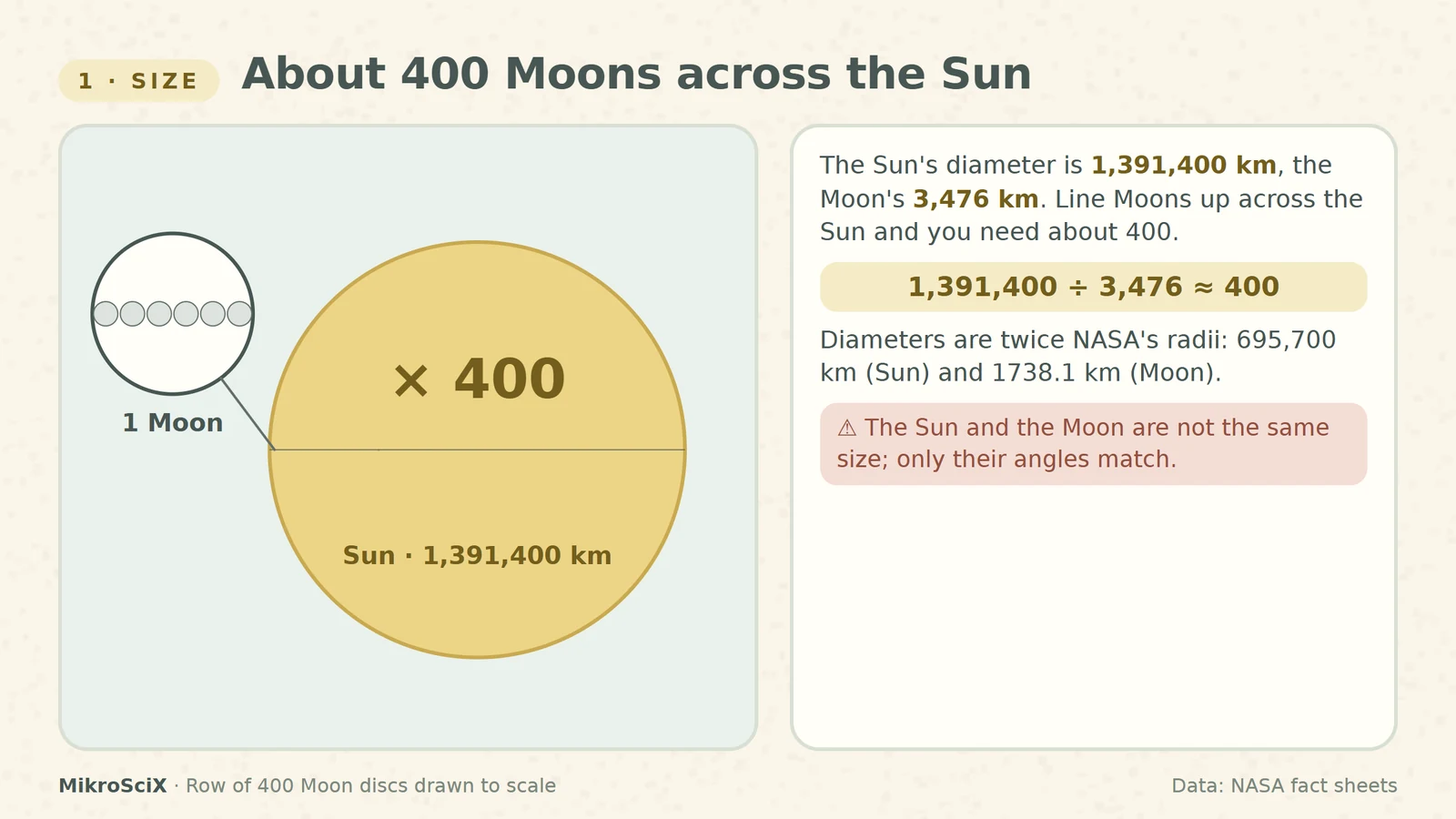
What breaks: saying "the Sun and the Moon are the same size". In volume, the Sun could hold tens of millions of Moons. Only their angles in the sky match.
2. About 390 Earth–Moon distances away
The Moon orbits on average 384,400 km from Earth. The Sun is on average 149.6 million km away.
Check it yourself. 149,600,000 ÷ 384,400 ≈ 389. NASA rounds both ratios to "about 400": the Sun is about 400 times bigger and about 400 times farther away. Our exact numbers, 400 and 389, are close but not equal, and that small difference already matters (section 4).
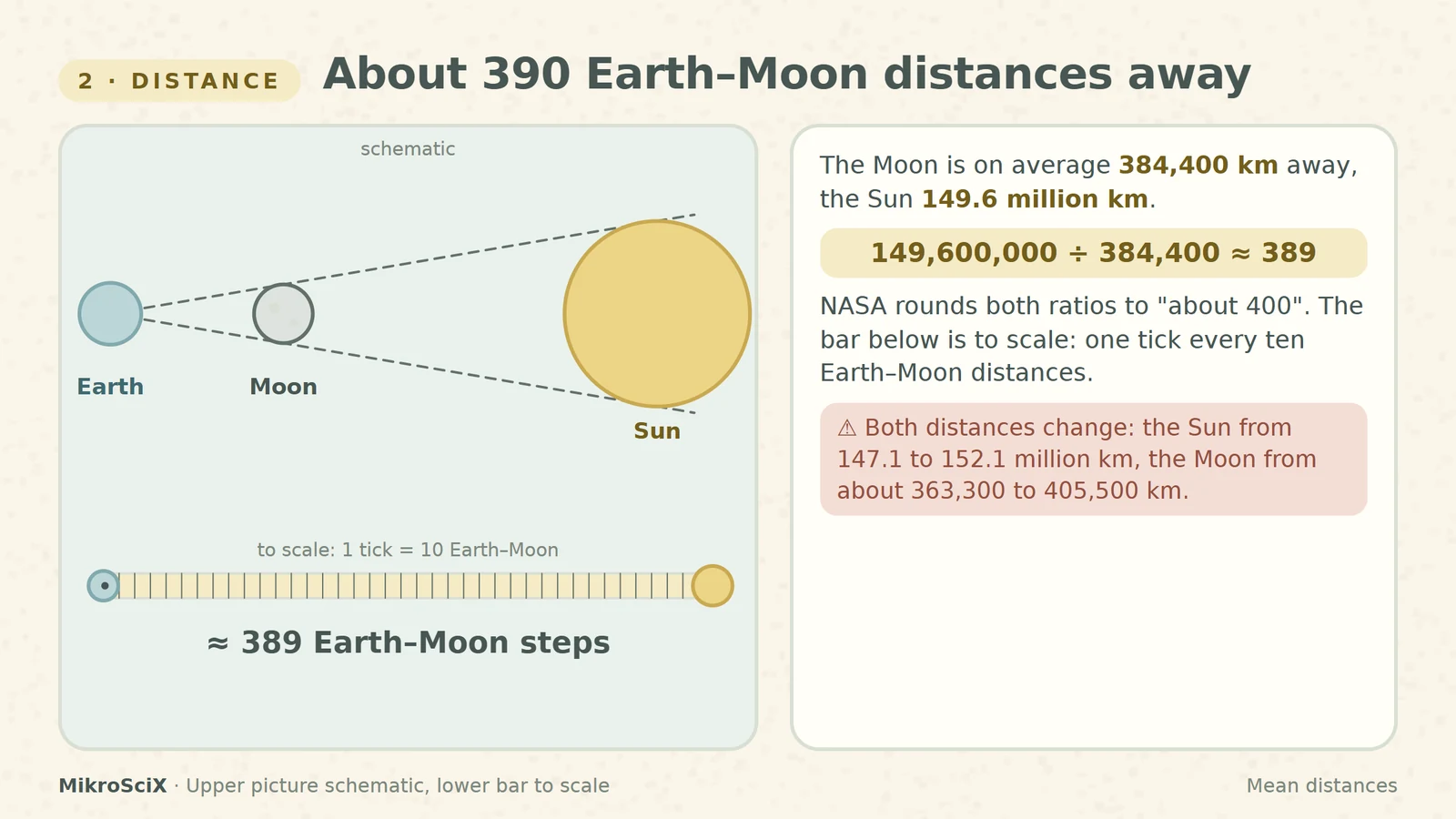
What breaks: treating either distance as fixed. Earth's distance from the Sun runs from 147.1 to 152.1 million km over the year, and the Moon's from about 363,300 km at perigee to about 405,500 km at apogee (mean values).
3. What the eye really sees: an angle
The eye does not measure size; it measures the angle an object fills. For small angles, the angle in radians is the width divided by the distance:
θ ≈ D / d (radians; multiply by 57.3 for degrees)
Check it yourself. Moon at its mean distance: 3476.2 / 384,400 = 0.00904 rad = 0.518°. Sun at its mean distance: 1,391,400 / 149,600,000 = 0.00930 rad = 0.533°. NASA's fact sheets list 1919 arcseconds (0.533°) for the Sun and 1896 arcseconds (0.527°) for the Moon. Both are about half a degree.
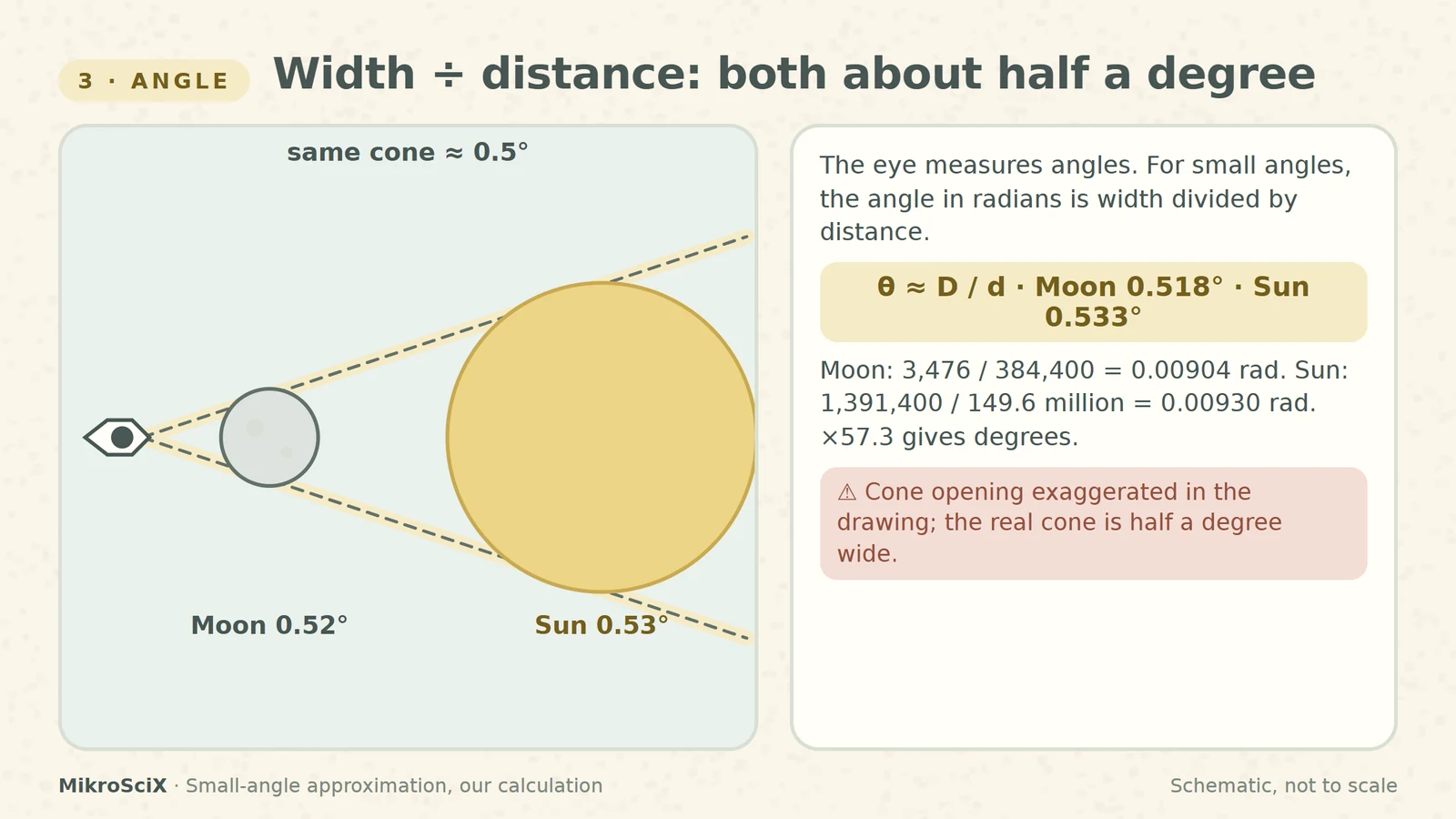
Draw a cone from your eye that is half a degree wide. The Moon fills it at 384,400 km; the Sun fills the same cone at 149.6 million km. A wider object farther away and a narrower object closer by can fill exactly the same angle.
What breaks: the small-angle formula is an approximation, but at half a degree its error is far below the rounding used here.
4. Total or ring: the Moon's distance decides
The Moon's orbit is an ellipse, so its angle changes over each month. Using the mean perigee and apogee from NASA's fact sheet:
- Near (perigee, ≈ 363,300 km): 3476.2 / 363,300 × 57.3 ≈ 0.548°, larger than the Sun at any time of year (0.524° to 0.542°). If an eclipse happens now, the Moon can hide the whole disc: a total eclipse.
- Far (apogee, ≈ 405,500 km): 3476.2 / 405,500 × 57.3 ≈ 0.491°, smaller than the Sun. A bright ring stays around the Moon: an annular eclipse, as NASA describes for a Moon near apogee.
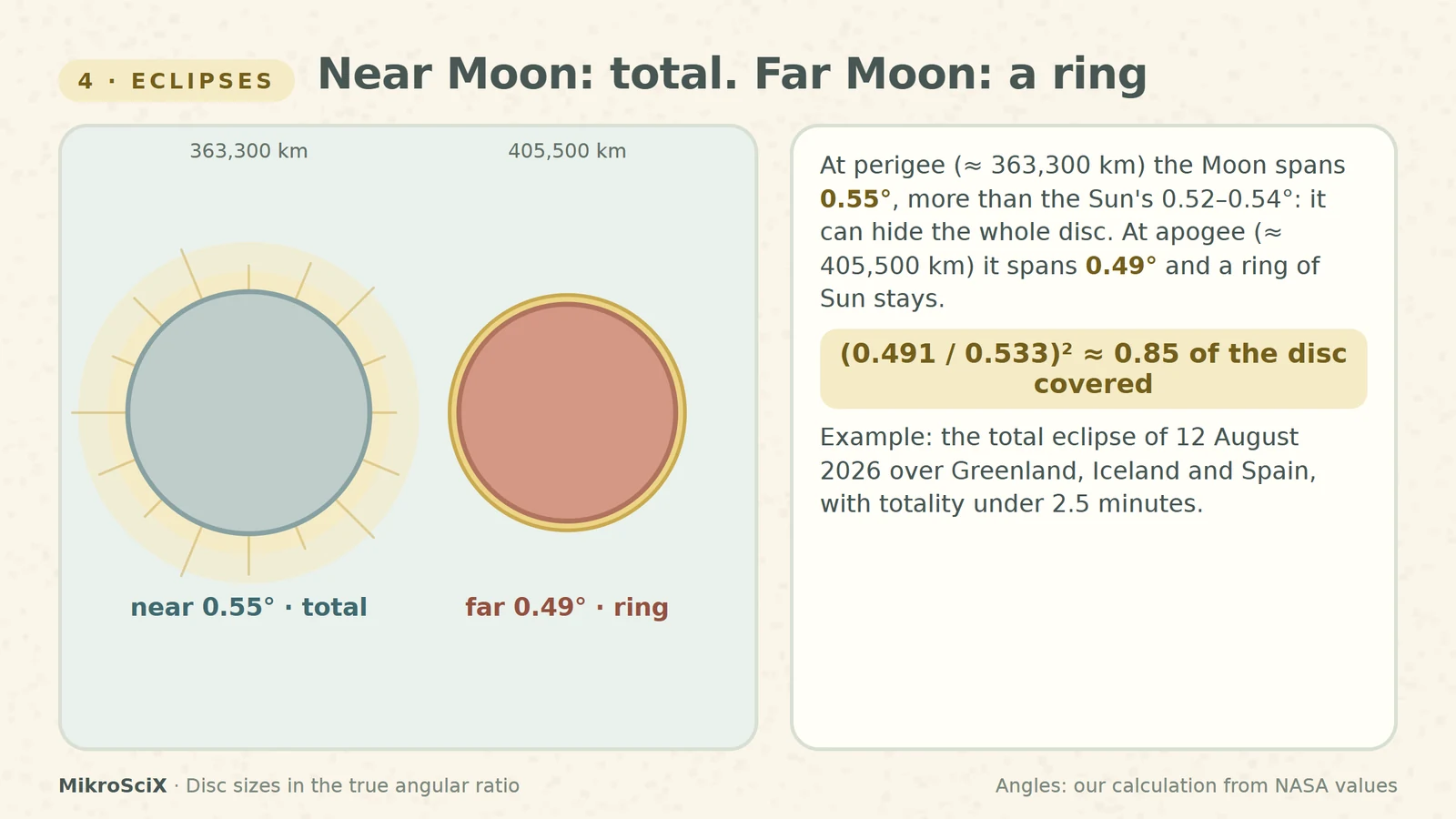
Check it yourself. How much of the Sun does the far Moon cover? Areas scale as angle squared: (0.491 / 0.533)² ≈ 0.85. About 85 % of the disc is hidden, and the remaining 15 % is still blindingly bright, which is why an annular eclipse never turns day into night.
What breaks: thinking the match is exact. The Moon's angle swings by about ±5.5 % around its mean, and the Sun's by about ±2 %. The near-equality is what makes both kinds of eclipse possible.
5. The Moon is leaving: 3.8 cm a year
Apollo 11, 14 and 15 astronauts left arrays of corner-cube reflectors on the Moon. Observatories still fire laser pulses at them and time the echo; the round trip gives the Earth–Moon distance. Analysing 43 years of this lunar laser ranging, Williams, Turyshev and Boggs (2014) found the Moon's orbit growing by 38.08 ± 0.19 mm per year, driven by tides. NASA rounds it to 3.8 cm a year.
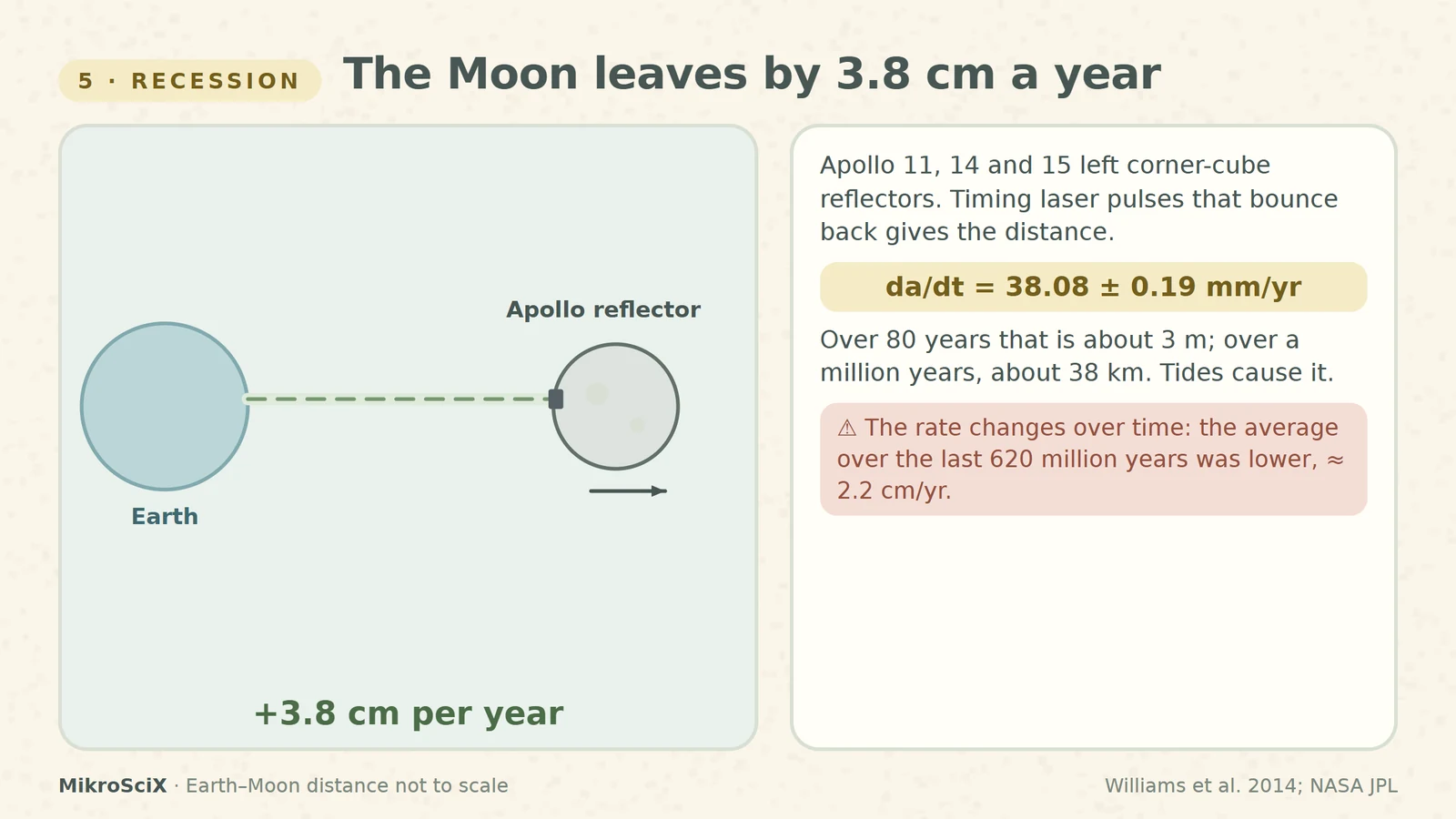
Check it yourself. Over an 80-year lifetime: 80 × 3.8 cm ≈ 3 m. Over a million years: 1,000,000 × 3.8 cm = 38 km. Small steps, but a farther Moon looks smaller.
What breaks: assuming the rate is constant. The same paper cites geological evidence of a lower average rate in the past, about 2.17 cm per year over the last 620 million years. Running today's rate backwards or forwards over hundreds of millions of years gives the wrong answer.
6. The pitfall: total eclipses have an expiry date
As the Moon recedes, even its closest approaches will eventually leave it smaller than the Sun. Jean Meeus, the eclipse calculator quoted by Eos, estimates that total eclipses will begin to flicker out about 620 million years from now and that the very last one will come in about 1.2 billion years. After that, every central eclipse will be a ring.
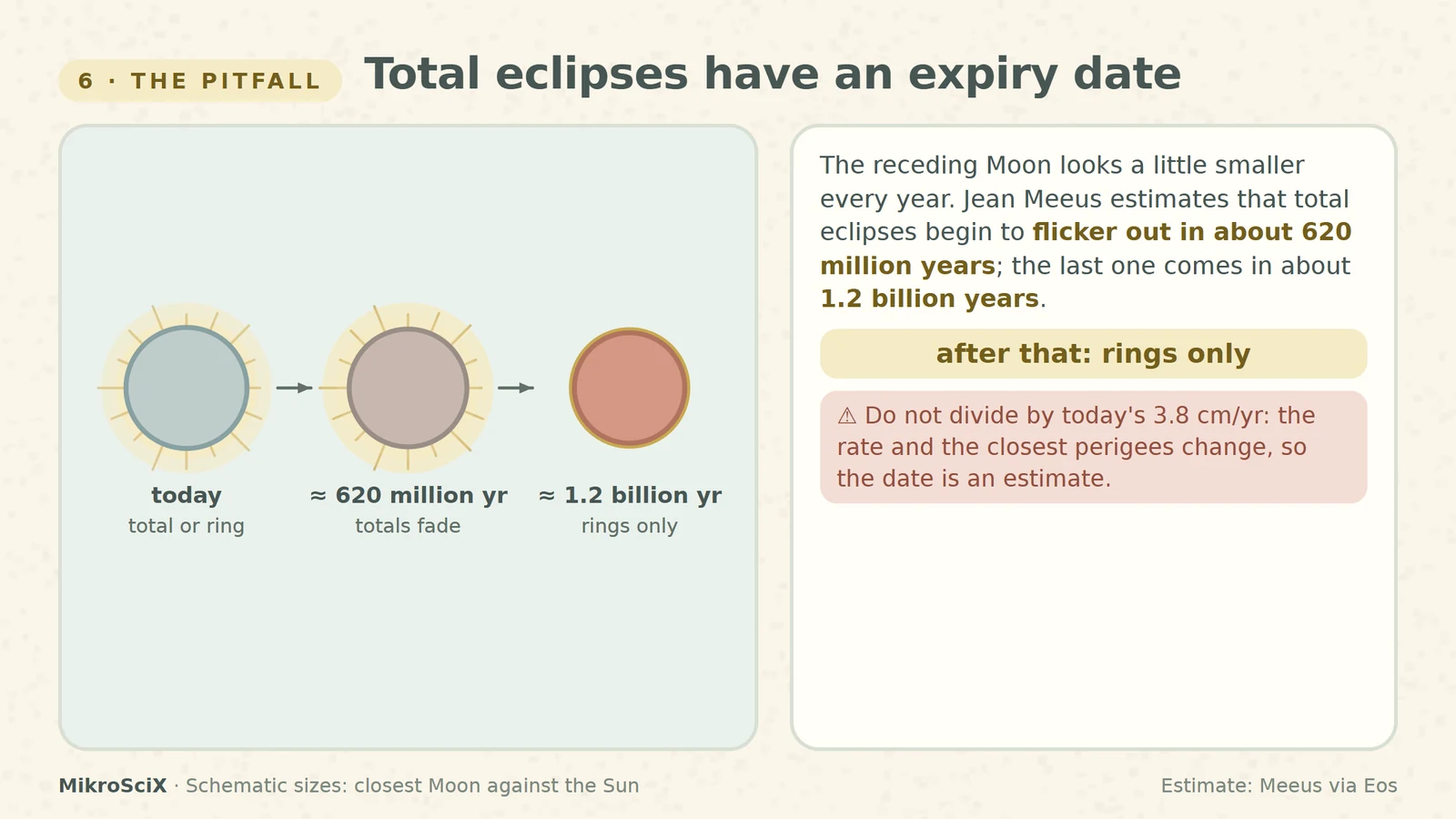
Looking back, the Moon was closer: Eos notes that about 70 million years ago it was a few hundred kilometres nearer and totality lasted a few seconds longer on average. So total eclipses are not a permanent feature of Earth; we happen to live in the era when they occur.
What breaks: dividing the "distance still to go" by 3.8 cm a year. The date depends on how tides evolve with the continents and on the Sun's slow growth, which is why careful estimates disagree. Treat the numbers as estimates, not a countdown.
The Moon fits the Sun because 400 times wider and about 400 times farther cancel to the same half degree, and that match is a passing phase of Earth's history.
Try it yourself
- How far from your eye must a 1 cm coin be to fill the same angle as the Moon (0.00904 rad)?
- At perigee, what fraction of the Sun's disc (0.533°) does a 0.548° Moon cover, and what does that mean for the eclipse?
- At 3.8 cm per year, how much farther away will the Moon be in 10,000 years?
Answers: (1) 1 cm / 0.00904 ≈ 1.1 m. (2) The Moon's disc is larger than the Sun's ((0.548 / 0.533)² ≈ 1.06), so it can cover all of it: a total eclipse is possible. (3) 10,000 × 3.8 cm = 380 m.
Watch the short
Videos don’t load automatically. The videos are hosted on YouTube. Allow YouTube once and every video on the site loads by itself; your choice is remembered. The articles never need consent.
Sources
- NASA NSSDCA — Moon Fact Sheet
- NASA NSSDCA — Sun Fact Sheet
- NASA Science — Why Do Eclipses Happen?
- NASA Science — Total Solar Eclipse on August 12, 2026
- Williams, Turyshev & Boggs (2014), The past and present Earth-Moon system, Planetary Science 3:2
- NASA JPL — The Apollo Experiment That Keeps on Giving
- Eos (AGU) — The End of the Eclipse
Diagrams are schematic except where marked to scale. The angles, the 85 % coverage, the ±5.5 % and ±2 % swings, the coin and the recession examples are our own calculations from the sources' values; the end dates of total eclipses are Jean Meeus's estimates as reported by Eos.