

SOLAR CELL PHYSICS
Light adds no electrons: how a solar cell really makes current, in five steps
Every electron that flows out of a solar cell was already in the silicon. Light only lifts it, the junction only sorts it, and the power is spent in the load. A step-by-step guide for undergraduate and graduate students, with numbers you can check yourself.
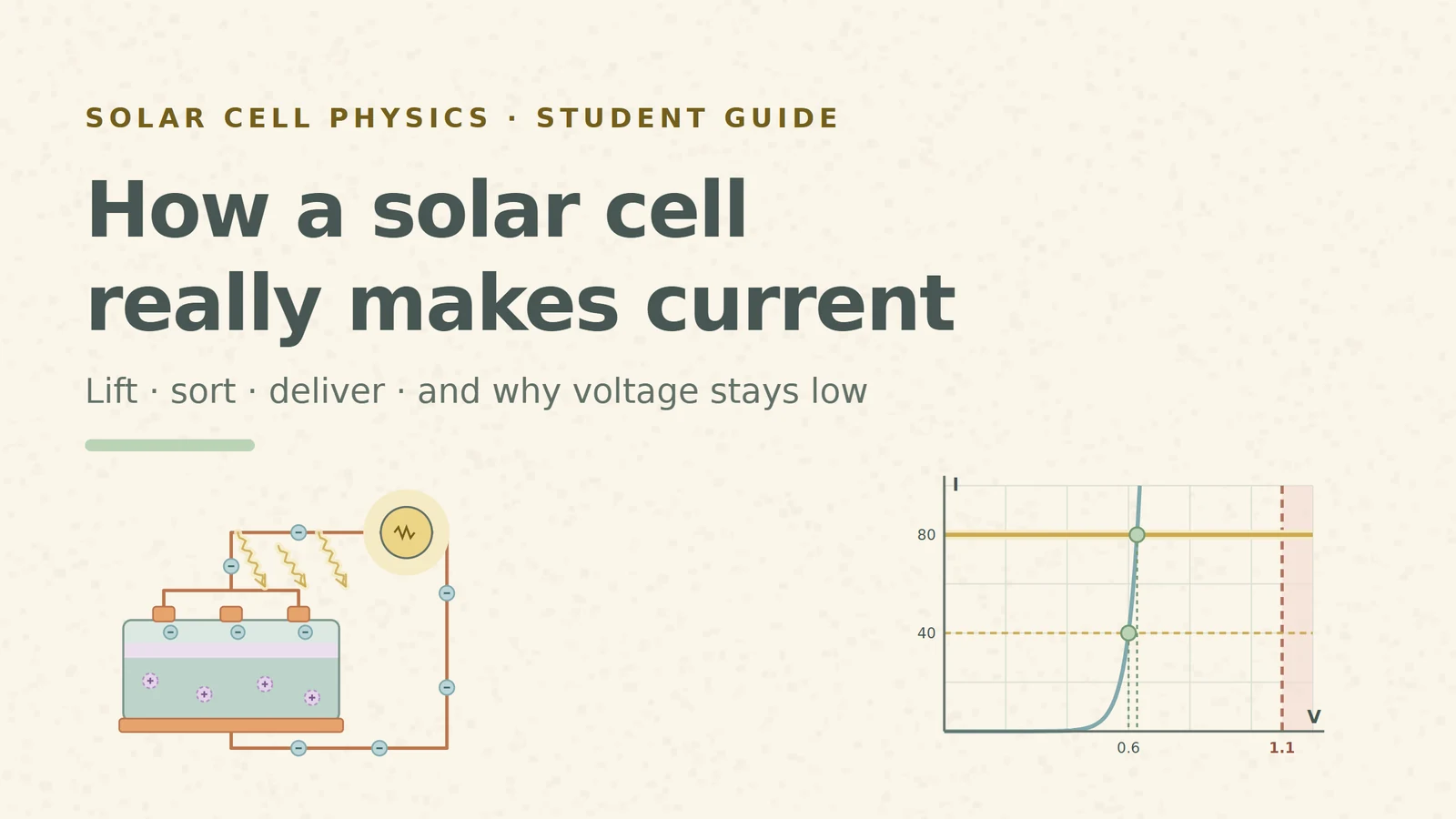
A common picture of a solar cell goes like this: light hits the silicon, turns into electrons, and a built-in field pushes them out like a battery. Almost every part of that picture is wrong. Light does not become electrons; it gives energy to electrons the crystal already has. The field does not push current around the circuit; it sorts charges that reach it. And the energy is not used inside the cell; it is used in whatever you connect to it.
This guide walks through the five steps that actually happen, each with the rule, a number to check yourself and what breaks. Cell-level numbers come from one invented example cell (light current 40 mA, open-circuit voltage 0.60 V, the same example as our solar-cell-parameters and SMU videos). They are teaching values, not measurements.
1. Lift: a photon gives energy to an electron that is already there
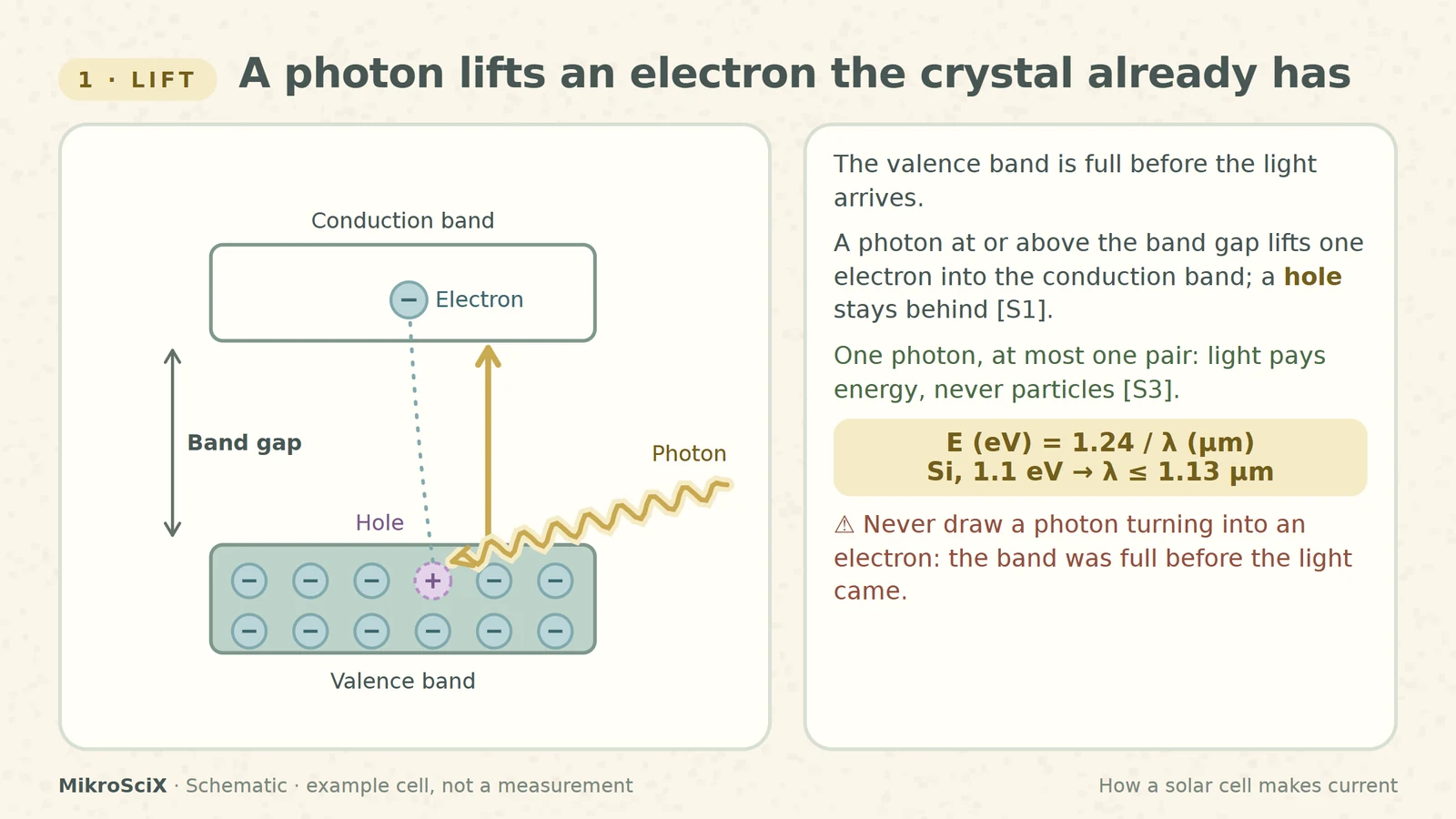
In a semiconductor the electrons that hold the crystal together sit in the valence band. Above it, separated by an energy gap, is the conduction band, where electrons can move freely. The energy needed to raise an electron from one to the other is the band gap [S3]. A photon with energy at or above the gap can be absorbed and excite an electron into the conduction band [S1]. The electron leaves an empty state behind: a hole, which behaves like a positive charge. Absorption therefore always creates a pair: one electron and one hole [S1].
Two details matter. First, the photon is gone after absorption, but no electron has been added to the crystal: one that was bound is now free. Second, one photon frees at most one electron, however energetic it is [S3]. The light pays energy, never particles.
Check it yourself. Photon energy and wavelength are linked by E (eV) = 1.24 / λ (µm) [S10]. Silicon's gap is about 1.1 eV [S3], so the longest wavelength it can use is about 1.24 / 1.1 ≈ 1.13 µm, in the near infrared.
What breaks. Drawing a photon that "turns into" an electron, or an electron that appears out of nowhere. In a correct picture the valence band is full before the light arrives, and the electron that rises leaves a hole where it was.
2. Too weak passes, too strong wastes
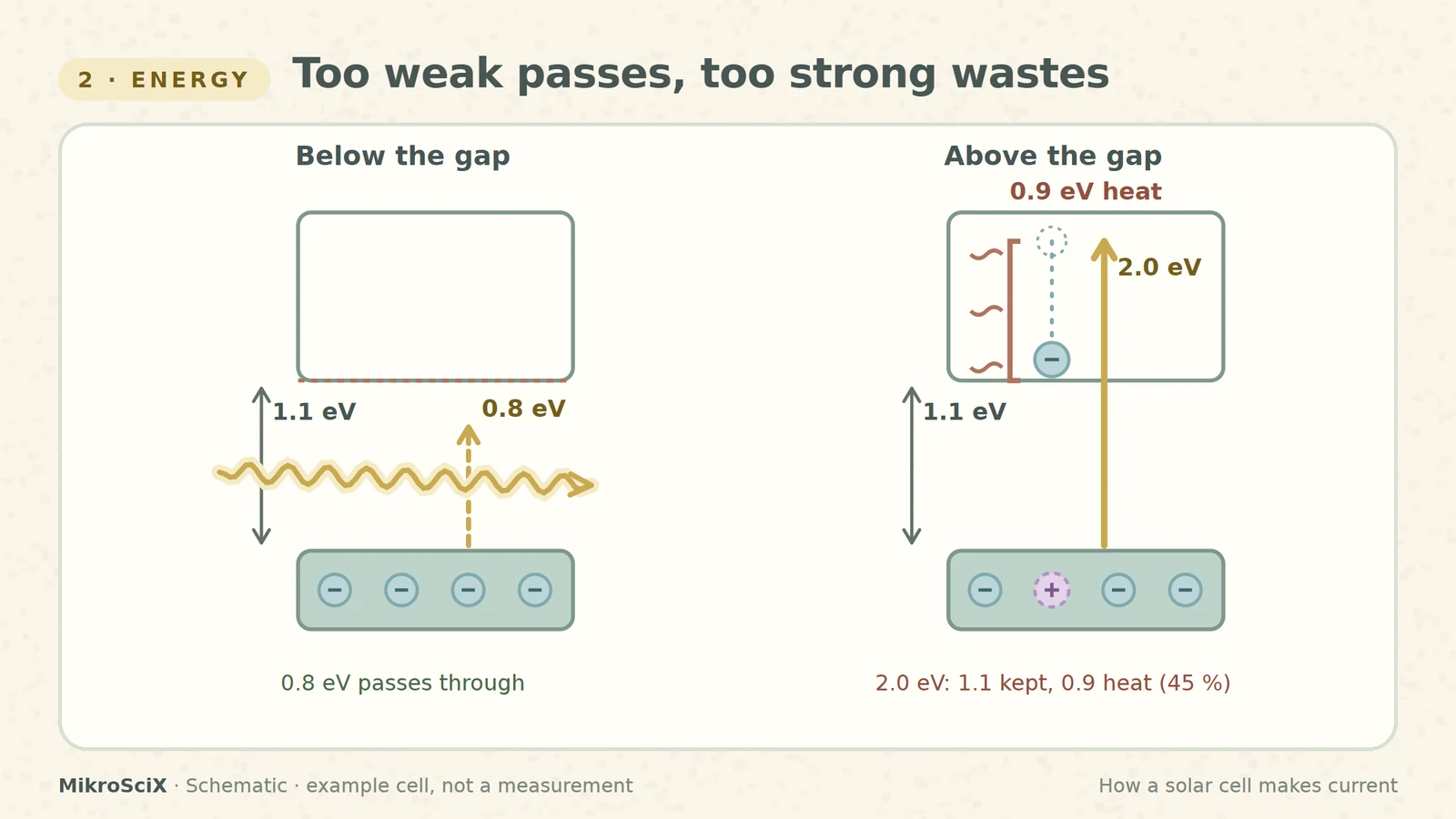
Photons below the gap interact only weakly with the semiconductor and pass through it as if it were transparent [S1]. More of them does not help: a brighter infrared beam below the gap still lifts no one. Photons above the gap are absorbed, but the energy above the gap is lost: the electron quickly relaxes (thermalizes) to the bottom of the conduction band and the excess becomes heat [S1].
Check it yourself. Penn State's example: a 2 eV photon in silicon uses 1.1 eV to lift the electron and dissipates the remaining 0.9 eV as heat [S3], so 0.9 / 2.0 = 45 % of that photon's energy is lost. A 0.5 µm (green) photon carries 1.24 / 0.5 ≈ 2.48 eV: 1.38 eV, about 56 %, becomes heat. A 1.55 µm photon carries only 0.8 eV and passes straight through.
What breaks. These two losses are built into any single absorber: a small gap wastes energy as heat, a large gap lets more light through. Choosing the gap is a compromise [S3]; the full efficiency limit is a topic of its own.
3. Wander, then get sorted
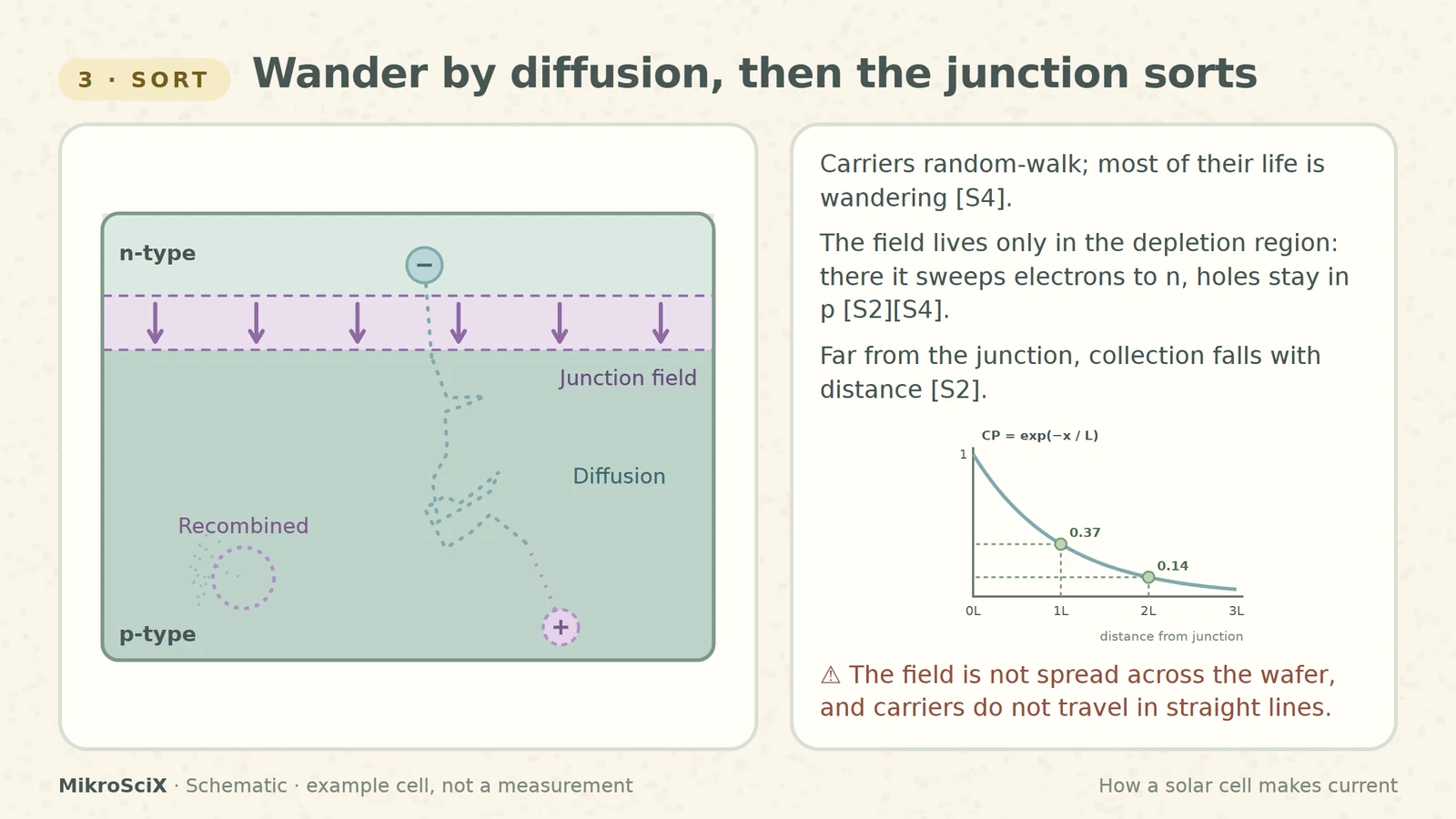
A freshly made electron-hole pair does not know where the contacts are. The carriers move by diffusion, a random walk, and they live only for a limited time before they recombine and the pair is lost [S4]. What saves them is the pn junction: if a carrier reaches it, the junction's electric field sweeps it across. Electrons go to the n side, holes stay on the p side, and once they are spatially separated they can no longer easily recombine [S4][S5].
The field is local: it lives in the narrow depletion region at the junction, not throughout the wafer. Carriers generated inside that region are collected almost certainly; away from it, the chance of collection falls with the distance compared with the diffusion length, the typical distance a carrier wanders before it recombines [S2].
Check it yourself. In the simplest case PVEducation gives the collection probability as CP = exp(−x / L), with x the distance from the junction and L the diffusion length [S2]. A carrier born one diffusion length away is collected with probability e−1 ≈ 0.37; at two diffusion lengths, e−2 ≈ 0.14.
What breaks. Drawing the field across the whole cell, or drawing carriers that travel in straight lines from birth to contact. Most carriers spend most of their life wandering.
4. The field is a sorter, not a battery
If the junction field were an energy source, a cell in the dark would drive a current through a wire. It does not. In the dark the junction is in equilibrium: the drift current caused by the field and the diffusion current flowing the other way are both small and balance, so no net current flows [S6]. The built-in field itself is set up by exactly this balance [S5].
Light changes the situation by adding carriers. The junction sorts them, and that sorting is what lets the energy given by the photons leave the cell as electrical energy instead of heat. The bookkeeping is simple: light pays, the junction sorts, the load spends.
5. Collect, deliver, return
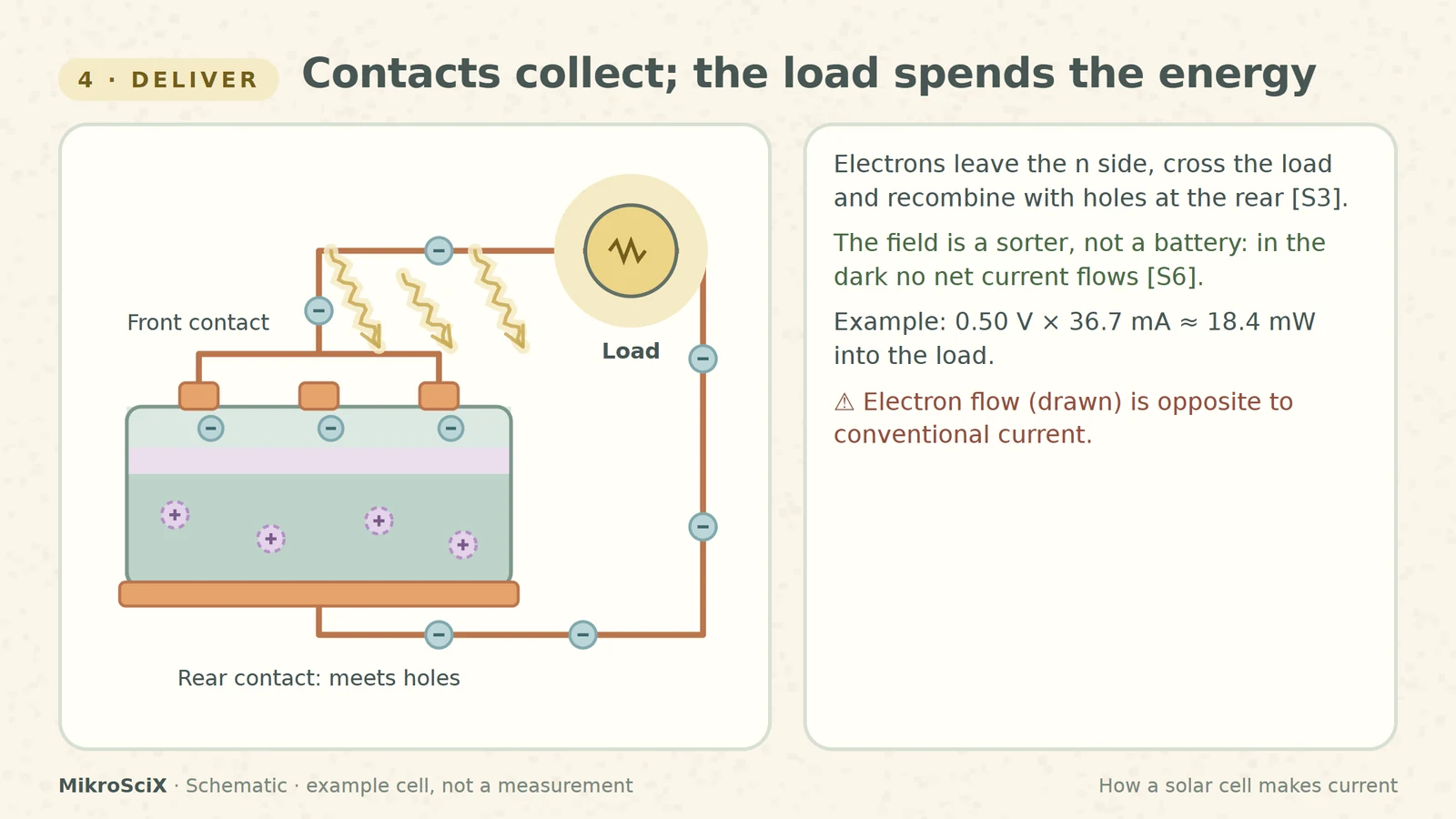
Metal contacts collect the separated carriers [S7]. When an external circuit connects the two sides, electrons flow from the n side through the wire, through the load, to the p side, where they recombine with holes [S3]. That current through the load is the usable energy [S3]. The cell is a converter: it does not store sunlight, and when the light stops, so does the current.
Check it yourself. At 0.50 V our example cell delivers 40 − I0(e12.5 − 1) ≈ 36.7 mA, with I0 = 40 mA / (e15 − 1). The load therefore receives 0.50 V × 36.7 mA ≈ 18.4 mW. How such a point compares with the best possible point (fill factor, efficiency) is covered in the solar-cell-parameters video.
What breaks. Drawing conventional current and electron flow with the same arrows. Electrons leave through the n-side contact; conventional current is drawn in the opposite direction.
Bonus: why twice the light gives almost the same voltage
Separated carriers pile up: electrons on the n side, holes on the p side. This forward-biases the junction and lowers its barrier, so the junction's own forward (diffusion) current grows. With no load connected, the voltage rises until this forward current exactly balances the light current; that voltage is the open-circuit voltage, Voc [S6]. Because the forward current grows exponentially with voltage, Voc = (nkT/q) ln(IL/I0 + 1) grows only logarithmically with light, while the short-circuit current grows in proportion to it [S8][S9].
Check it yourself. With the example cell (thermal-voltage term 0.04 V): 20 mA gives 0.572 V, 40 mA gives 0.600 V, 80 mA gives 0.628 V and 400 mA (ten times the light) only 0.692 V. Each doubling adds 0.04 × ln 2 ≈ 28 mV. For an ideal diode at room temperature (n = 1) the step is about 18 mV [S8].
There is also a hard ceiling. The energy available from a separated pair cannot exceed the band gap, so a silicon cell's voltage cannot exceed about 1.1 V [S3]. Real cells stay well below it because recombination sets I0: PVEducation quotes about 0.69 V for commercial silicon cells and up to 0.764 V for the best ones [S9].
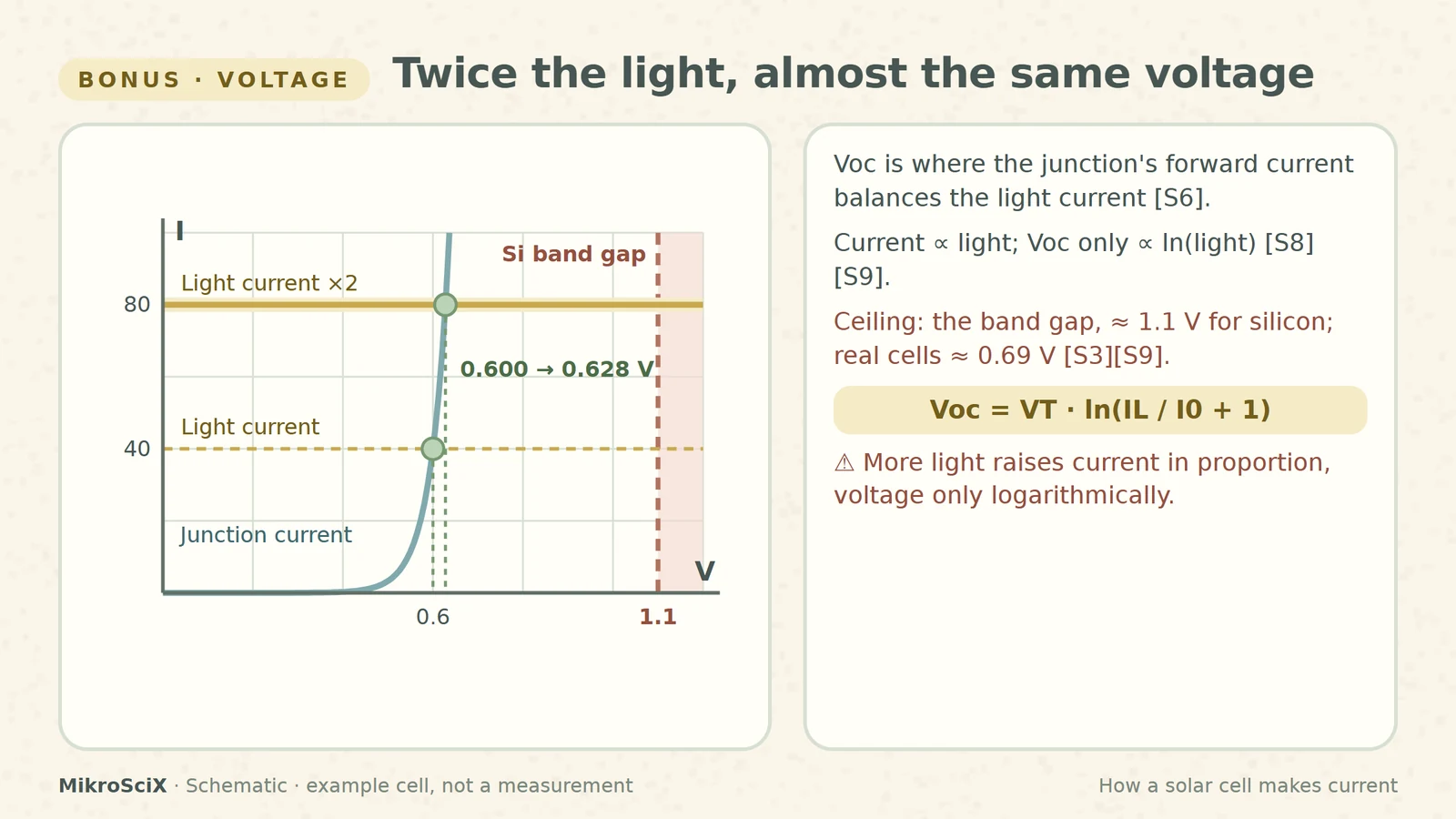
Light lifts electrons the silicon already has, the junction sorts them, the load spends their energy. Current follows the light; voltage is set by the junction and capped by the band gap.
Try it yourself
- A 1.0 µm photon hits silicon (gap 1.1 eV). Is it absorbed band to band? E = 1.24 / 1.0 = 1.24 eV ≥ 1.1 eV: yes, and 0.14 eV becomes heat.
- A pair is born half a diffusion length from the junction. Collection probability in the simple model? e−0.5 ≈ 0.61.
- The example cell under half the light (20 mA). What is Voc? 0.04 × ln(20 / I0 + 1) ≈ 0.572 V, only 28 mV lower.
- Can a single silicon cell reach 1.5 V in very bright light? No: its voltage cannot exceed the band gap, about 1.1 V; for more voltage, connect cells in series.
Watch the short
Videos don’t load automatically. The videos are hosted on YouTube. Allow YouTube once and every video on the site loads by itself; your choice is remembered. The articles never need consent.
Sources
- PVEducation (C. Honsberg & S. Bowden) — Absorption of Light
- PVEducation — Collection Probability
- Penn State EME 812 — Lesson 4: Photovoltaics
- PVEducation — Light Generated Current
- MIT OpenCourseWare 2.627 — Charge Separation Part 1: Diode (lecture 5)
- PVEducation — The Photovoltaic Effect
- U.S. Department of Energy — Solar Photovoltaic Cell Basics
- PVEducation — Effect of Light Intensity
- PVEducation — Open-Circuit Voltage
- PVEducation — Energy of Photon
Diagrams are schematic and not to scale. Cell numbers come from one ideal-diode example (IL 40 mA, VT 0.04 V, Voc 0.60 V) and are illustrative, not measurements.