

HEALTH · ANIMAL PHYSIOLOGY
Why cats purr, and where the 'purring heals bones' idea comes from
A purr is the larynx buzzing about 25 times a second. Cats purr when they are content, but also when they are hurt or frightened. And the popular claim that purring heals bones rests on a matching number, not on a healing study. The mechanism, the evidence and how to read a health claim. For undergraduate and graduate students.
Search "why do cats purr" and most results give the same three answers: cats purr because they are happy, the purr comes from a "neural oscillator" in the brain, and the purr's frequency heals bones. The first is only partly true, the second was challenged in 2023, and the third has never been tested.
This guide follows the purr from the larynx to the headlines. For each step there is a number you can check yourself and a note on what usually goes wrong. The last sections show how a frequency overlap turned into a "healing mechanism", and what kind of evidence would be needed to settle it.
1. What a purr is: a low buzz in the larynx
A purr is made in the larynx, the voice box. Two vocal folds sit across the airway. During a purr they snap shut and open again over and over, and each closing interrupts the airflow for a moment. The basic tone of a domestic cat's purr, its fundamental frequency, is about 25 to 30 vibrations per second (25–30 Hz). Cats keep purring while breathing in and while breathing out, which is why a purr sounds continuous.
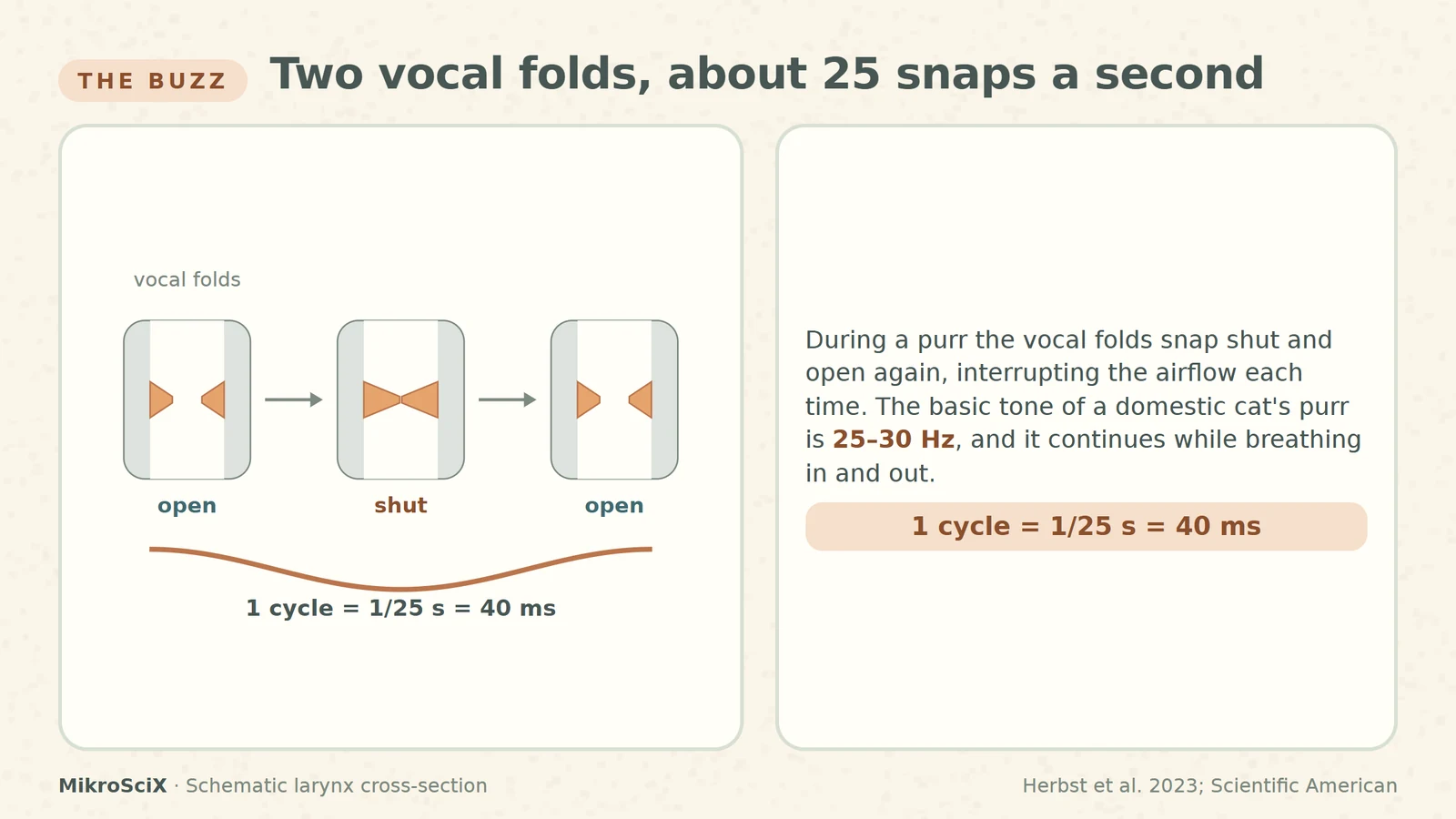
Check it yourself. One cycle at 25 Hz lasts 1/25 s = 0.040 s = 40 ms; at 30 Hz it lasts 1/30 s ≈ 33 ms. So in a single second the folds close about 25 to 30 times: too fast to count by ear, which is why we hear a buzz rather than separate clicks.
What breaks:
- "Cats purr only when breathing out." Purring continues in both directions of breathing.
- "25–150 Hz is the purr frequency." That wider range includes the overtones (section 4). The basic tone is 25–30 Hz.
2. Who drums the beat? Nerves, or the larynx itself
For decades the textbook explanation was the active muscle contraction idea: a rhythm generator in the brain sends nerve bursts at typically 20–30 per second, and the larynx muscles chop the airflow at that rate. Most other mammal sounds, including a cat's meow, work differently: air from the lungs sets the vocal folds into self-sustained vibration, like a flag flapping in the wind (the myoelastic-aerodynamic principle).
In 2023 Christian Herbst and colleagues tested the muscle idea directly. If the purr needs rhythmic nerve signals, a larynx removed from the body should not purr. They mounted the larynges of eight domestic cats on an air supply and blew air through them. All eight vibrated at purring rates, 25–30 Hz, with no nerves and no muscle action. Under the microscope the vocal folds contained pads of connective tissue up to 4 mm across, extra mass that lets the folds vibrate at such a low frequency.
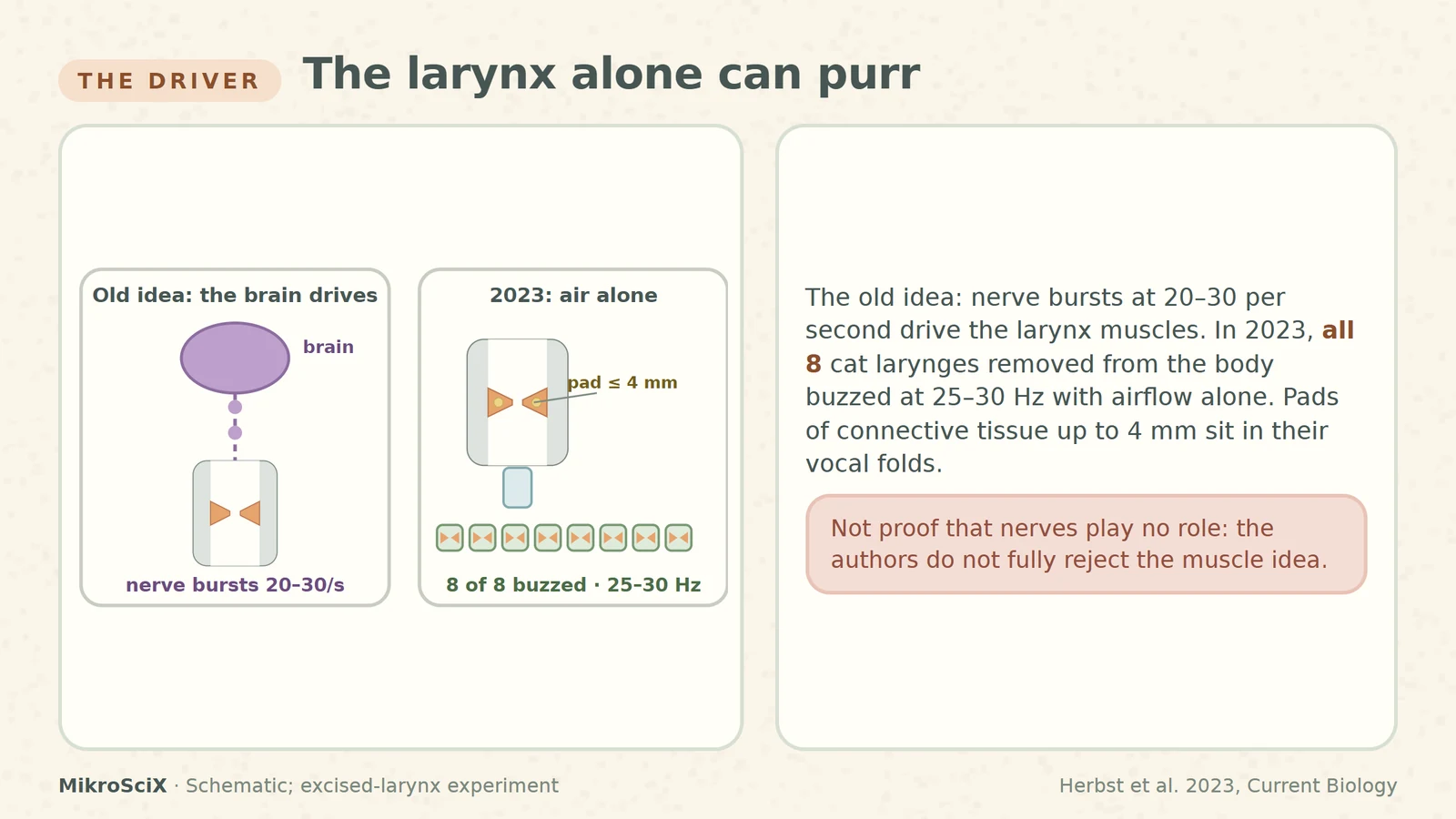
Check it yourself. A nerve burst rate of 20–30 per second gives one burst every 1/30 to 1/20 s, that is every 33 to 50 ms, the same range as the fold cycle in section 1. That match is why the muscle idea looked convincing: it predicted the right rhythm. The 2023 result shows that the larynx can produce the same rhythm on its own.
What breaks:
- "Nerves play no role." The authors write that their data do not fully reject the muscle idea; in a living cat the muscles may still start, stop or shape the purr.
- "The mechanism is settled." The 2023 study is one experiment on excised tissue. It changes the default explanation; it does not close the question.
3. Not just happiness
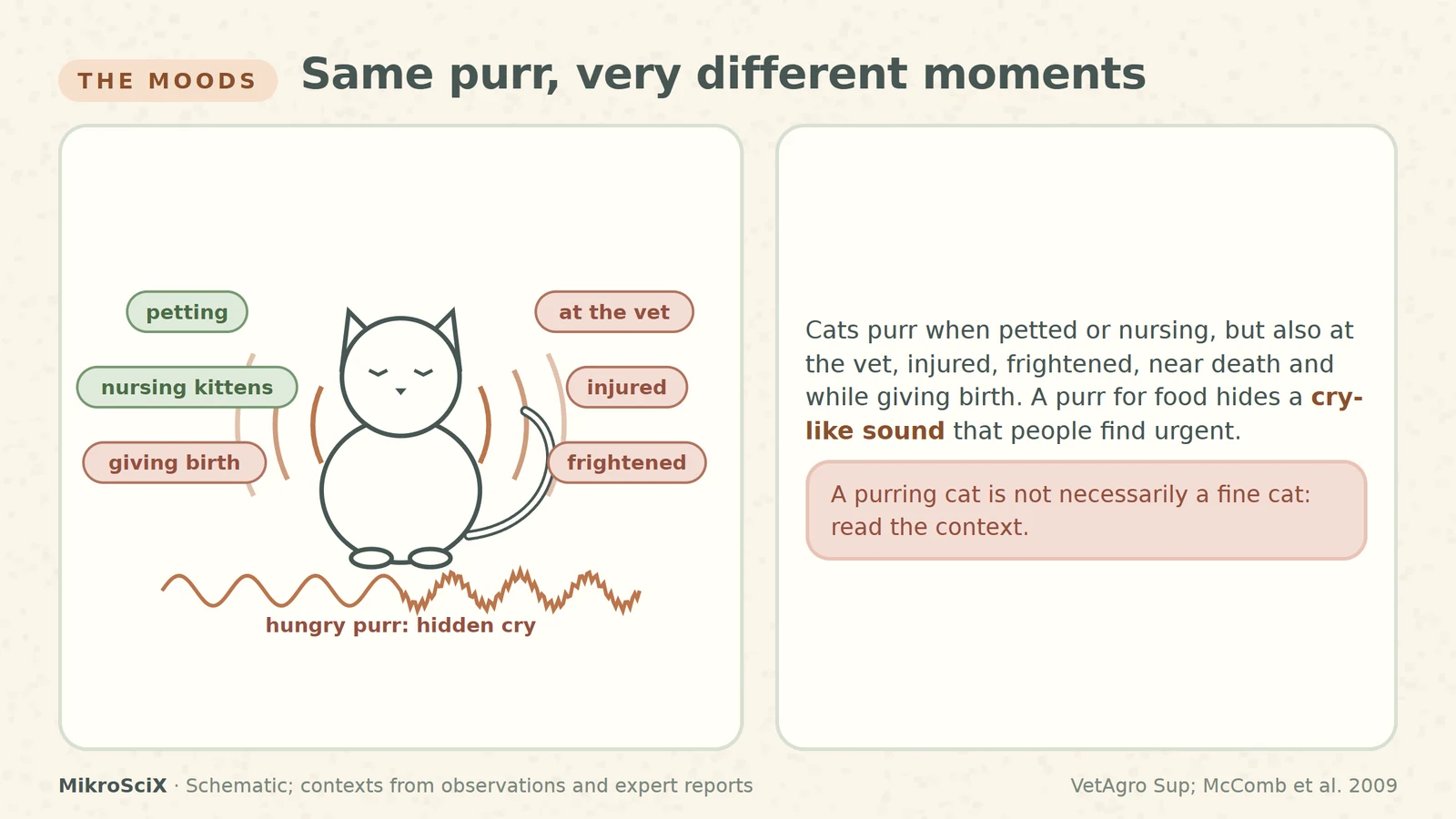
Cats purr while being petted, while being fed and while nursing kittens. But they also purr at the veterinarian, when injured, when frightened, close to death and while giving birth, between contractions. Veterinary behaviour experts list purring among possible signs of pain, although large-scale studies are lacking. The same sound appears at opposite ends of a cat's emotional range.
Purring is also a message to us. In 2009 Karen McComb's group at the University of Sussex recorded cats purring for food. These "solicitation purrs" carry a higher, cry-like sound embedded in the low purr. Listeners, even those with no experience of cats, rated them as more urgent and less pleasant; when the cry component was removed from the recordings, the urgency ratings dropped.
What breaks:
- "A purring cat is fine." Purring alone does not tell you how a cat feels. Read the context: posture, appetite, breathing, the situation.
- "Purring is only for humans." Kittens purr from early on while suckling; the solicitation purr is a later, learned use of the same sound.
4. The purr's frequencies, and where the numbers come from
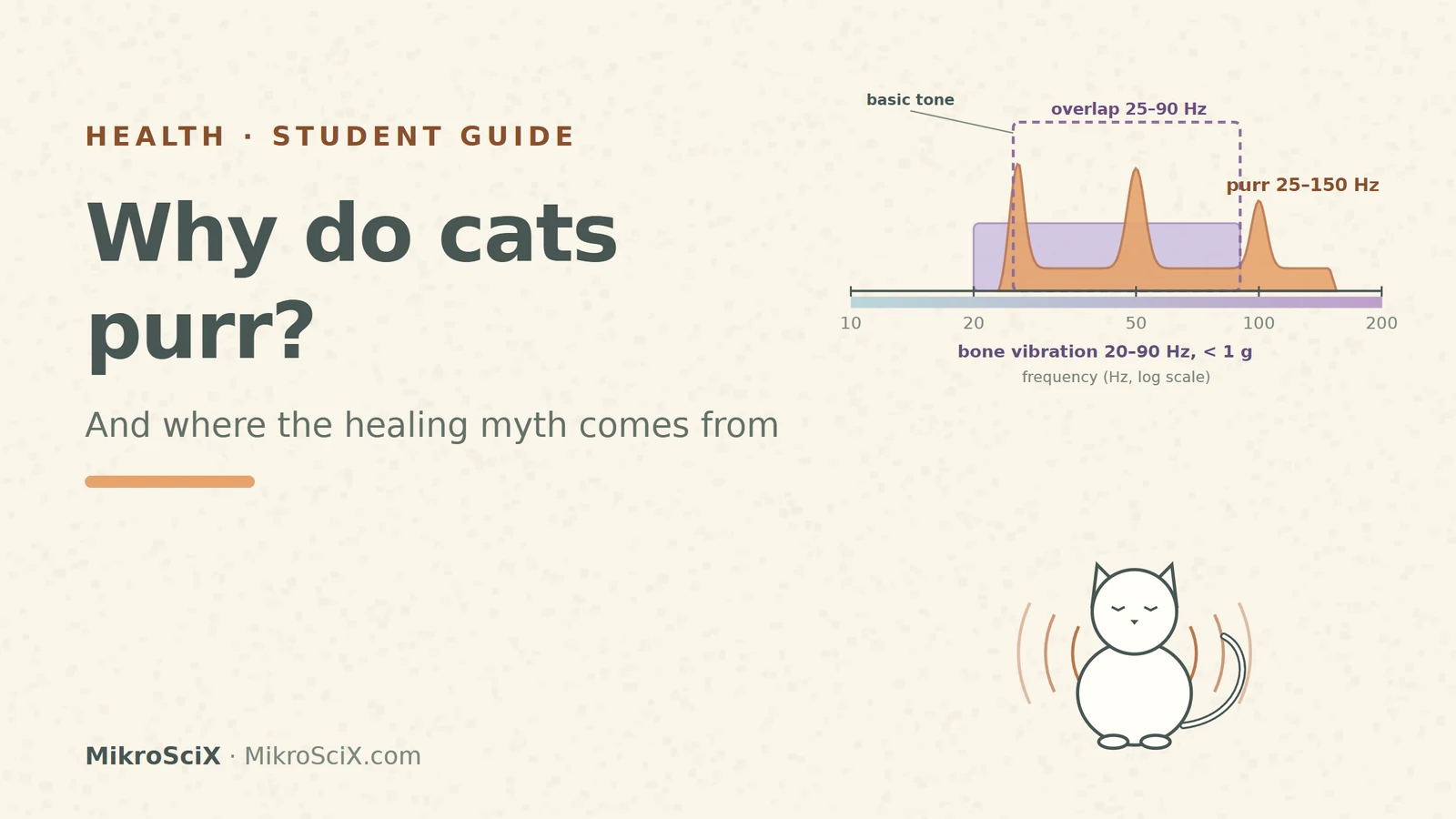
The often-quoted range of 25 to 150 Hz comes from a one-page abstract presented at an Acoustical Society of America meeting in 2001 by Elizabeth von Muggenthaler of the Fauna Communications Research Institute. She recorded 44 felids, including cheetahs, ocelots, pumas, servals and domestic cats. Every animal produced strong frequencies between 25 and 150 Hz; domestic cats had strong components at 25 and 50 Hz and an overtone near 100 Hz.
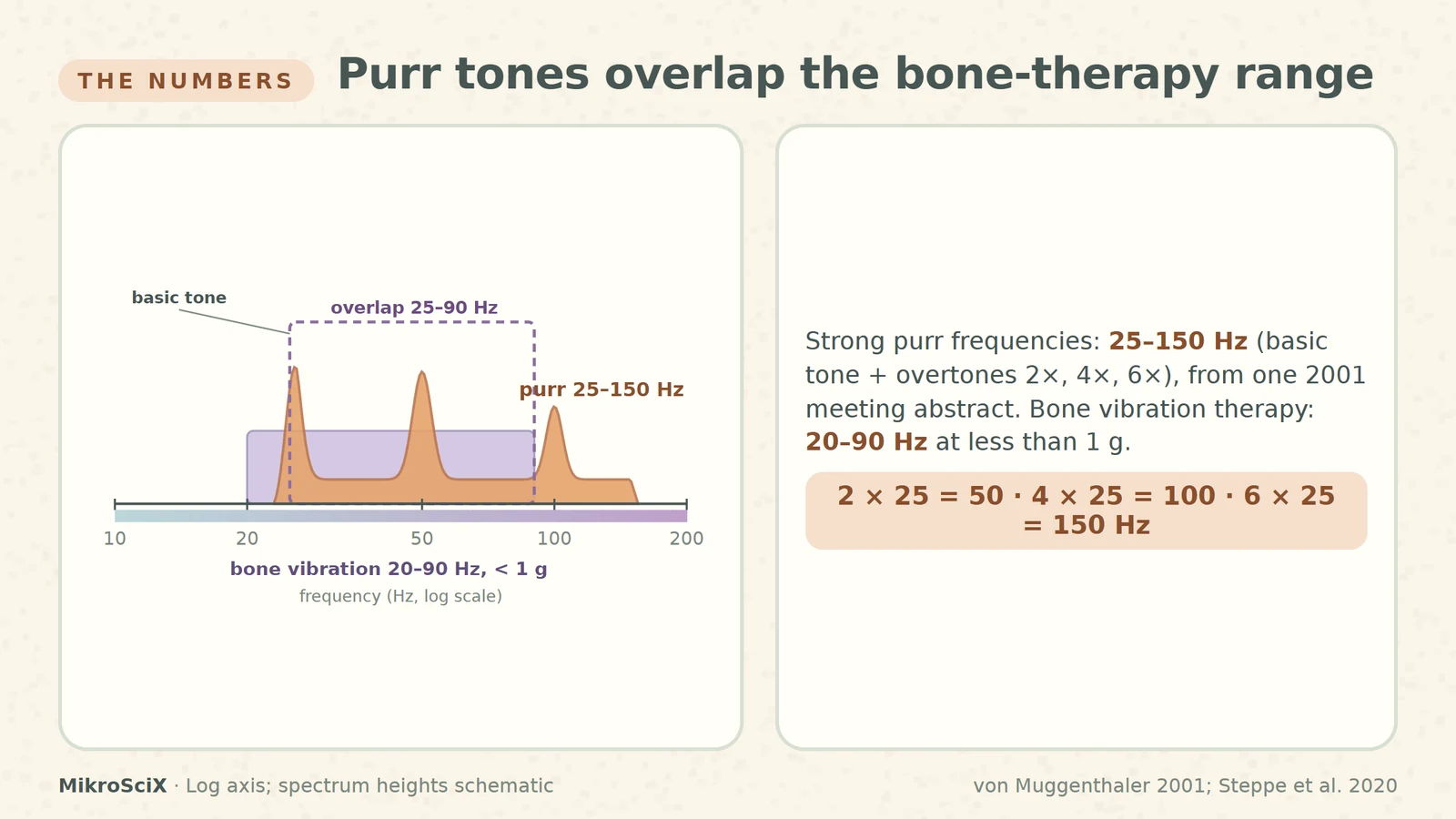
Check it yourself. Overtones of a vibration are whole-number multiples of its basic tone. With a 25 Hz basic tone: 2 × 25 = 50 Hz, 4 × 25 = 100 Hz, 6 × 25 = 150 Hz. So the 25–150 Hz range is the basic tone plus its first overtones, not a sign that cats purr at 150 vibrations per second.
Note the source: the basic 25–30 Hz tone is confirmed by the 2023 peer-reviewed study, but the full 25–150 Hz picture and the 25 and 50 Hz peaks rest on a single conference abstract, which is not a full, peer-reviewed paper. Most web pages repeat these numbers without saying where they came from.
5. The vibration therapy the purr is compared with
The healing idea compares the purr with low-magnitude high-frequency vibration, a treatment in which a patient or animal stands on a platform that vibrates vertically. In a 2020 review, Lena Steppe and colleagues define its range as 20–90 Hz at accelerations below 1 g (1 g = 9.81 m/s²). In most animal studies (small and large animal models) the vibration sped up fracture healing; some found no effect, and in some conditions healing was even delayed. For fracture healing in people the review found no published clinical study, only two registered trials.
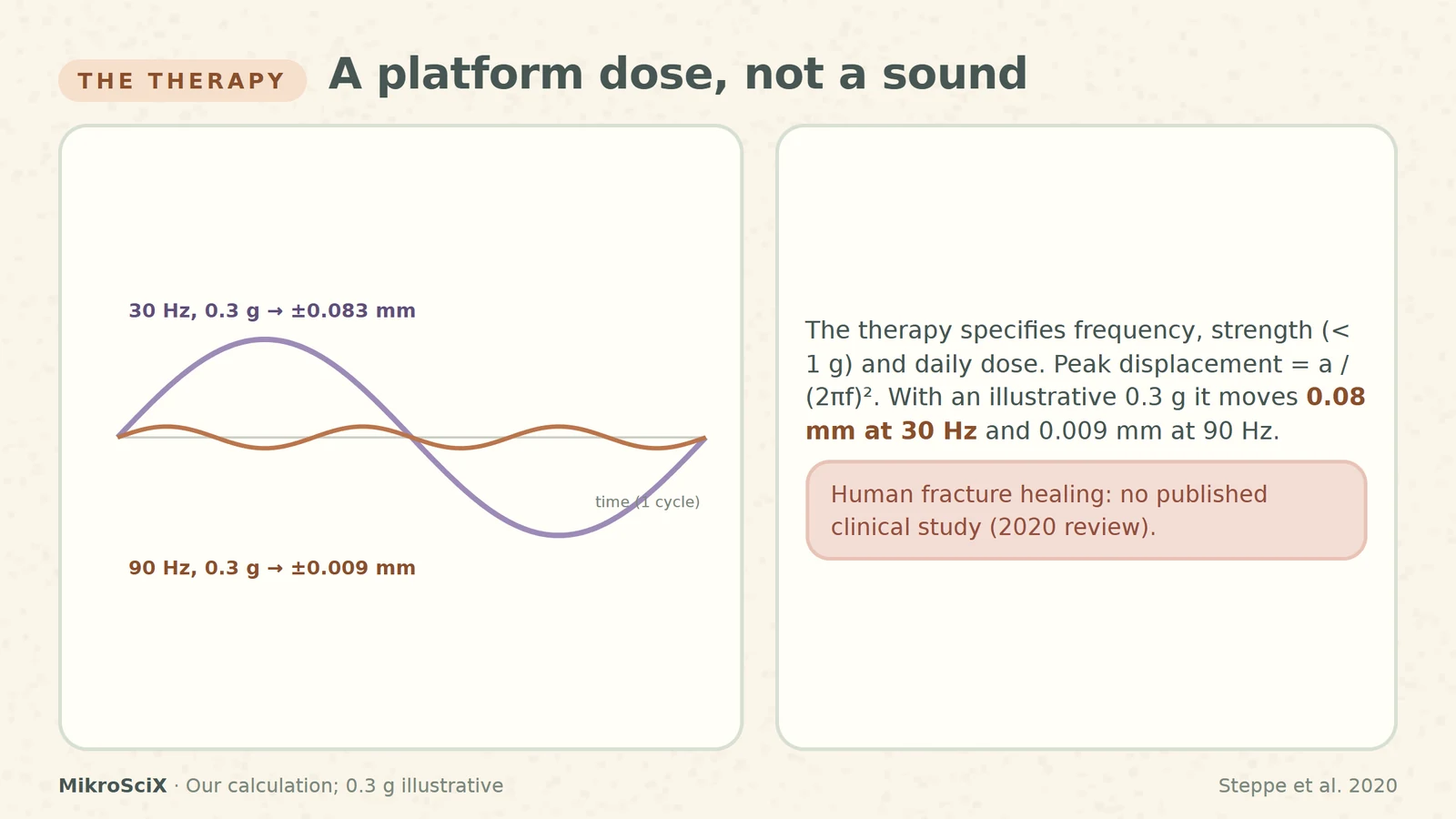
Check it yourself. For a sine vibration, peak displacement = peak acceleration / (2πf)². Take 0.3 g, an illustrative value inside the < 1 g range: a = 0.3 × 9.81 = 2.94 m/s². At 30 Hz, (2π × 30)² = 188.5² ≈ 35,500 s⁻², so the displacement is 2.94 / 35,500 ≈ 8.3 × 10⁻⁵ m, about 0.08 mm. At 90 Hz it is nine times smaller, about 0.009 mm. The therapy is defined by frequency and strength and daily dose, delivered through the skeleton from a platform.
What breaks:
- "Same frequency, same effect." Nobody has measured how strongly a purr shakes the cat's own bones; a sound in the throat is not a controlled platform dose.
- "The therapy is proven in people." Even for the platform itself, human fracture-healing evidence was missing in 2020.
6. From one abstract to "a three thousand year old mystery solved"
The 2001 abstract did not test healing. It listed the purr frequencies and noted that they correspond to frequencies used in treatments for bone growth, pain, swelling and wounds, citing a 1994 surgical paper for 25 and 50 Hz. It ended with a hypothesis: an internal healing mechanism would be useful for an animal that rests a lot.
Newspapers turned the hypothesis into a finding. A New Zealand column in July 2001 opened with "a three thousand year old mystery has been solved" and said that wounded cats purr to strengthen their bones. Pet-care websites have repeated the claim ever since, usually with the 25–150 Hz range and without the word "hypothesis".
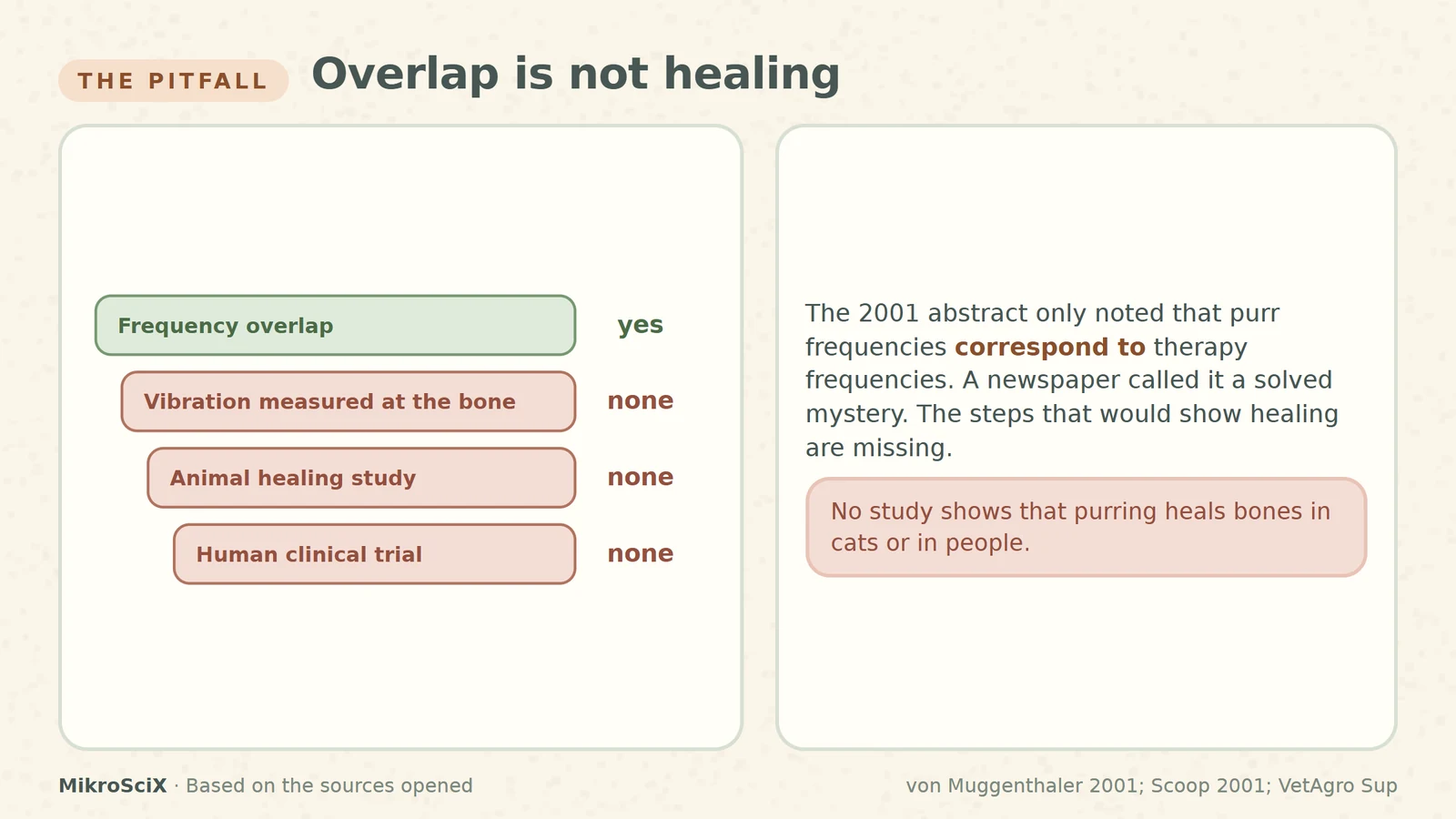
What would it take to show that purring heals? At least: a measurement of the vibration that actually reaches the bone during a purr; a comparison of healing in cats that purr more or less, with other factors controlled; and, for the claim about people, a clinical trial. In the sources we opened, none of these steps exists. VetAgro Sup's animal welfare chair found no large-scale studies and concludes that further research is needed.
A purr is a larynx buzzing at 25–30 Hz. Cats purr in many moods. The healing claim is a frequency overlap, not a result.
How to read a "frequency heals" claim
- Find the original. Is it a full paper, an abstract, or a newspaper paraphrase? Here it was a one-page meeting abstract.
- Check the dose, not just the frequency. Vibration therapy specifies strength (< 1 g), duration and delivery.
- Look for an outcome. A healing claim needs healing measured in the animal or person, against a comparison group.
- Watch the verbs. "Corresponds to", "may", "could" in the source often become "heals" in the headline.
Try it yourself
- A purr has a basic tone of 28 Hz. How long is one fold cycle?
- Which multiples of a 25 Hz basic tone fall inside the 20–90 Hz therapy range?
- A platform vibrates at 90 Hz with a peak acceleration of 0.3 g. What is its peak displacement?
Answers: (1) 1/28 s ≈ 0.036 s = 36 ms. (2) 25, 50 and 75 Hz (1×, 2×, 3×); 100 Hz is already outside. (3) 2.94 / (2π × 90)² = 2.94 / 320,000 ≈ 9.2 × 10⁻⁶ m, about 0.009 mm.
Watch the short
Videos don’t load automatically. The videos are hosted on YouTube. Allow YouTube once and every video on the site loads by itself; your choice is remembered. The articles never need consent.
Sources
- Herbst et al. 2023, Domestic cat larynges can produce purring frequencies without neural input, Current Biology 33:4727 (DOI 10.1016/j.cub.2023.09.014)
- von Muggenthaler 2001, The felid purr: A healing mechanism?, J. Acoust. Soc. Am. 110:2666 (meeting abstract)
- Scientific American, Why do cats purr? (with Leslie A. Lyons, UC Davis)
- VetAgro Sup Animal Welfare Chair, A purring cat is a happy cat: true or false?
- McComb et al. 2009, The cry embedded within the purr, Current Biology 19:R507 (University of Sussex release)
- Steppe et al. 2020, Influence of Low-Magnitude High-Frequency Vibration on Bone Cells and Bone Regeneration, Front. Bioeng. Biotechnol. 8:595139
- Scoop, Howard's End: 20-50 Hertz Of Happiness (4 July 2001)
Diagrams are schematic and not to scale; the spectrum heights are schematic. The fold-cycle times, the overtone multiples and the displacement examples are our own calculations from the sources' values; 0.3 g is an illustrative value inside the < 1 g therapy range. Not veterinary or medical advice.