

ANIMAL BEHAVIOUR
Why do dogs eat grass? What surveys of 1,571 dogs actually found, and what is still unknown
Almost every dog eats grass, and the usual explanation is that it feels sick and wants to vomit. The largest owner survey says otherwise: only 8 % of plant-eating dogs often looked ill beforehand and only 22 % regularly vomited afterwards. Here is what the studies measured, what they did not, and when grass eating deserves attention.
“Why does my dog eat grass?” is one of the questions dog owners ask most often, and the answer they usually hear is confident: the dog has an upset stomach and eats grass to make itself vomit. It is a tidy story, but it was never tested until researchers started counting. This guide walks through what they counted: how common grass eating is, whether dogs look ill before it, whether they vomit after it, which explanations remain, when it is worth a vet visit, and one risk that has nothing to do with the grass itself.
A word on the evidence first. Most of the numbers below come from owner surveys and from one research group's observations. They are the best data available, but they are not clinical trials, and we keep their limits next to every number.
1. How common is it?
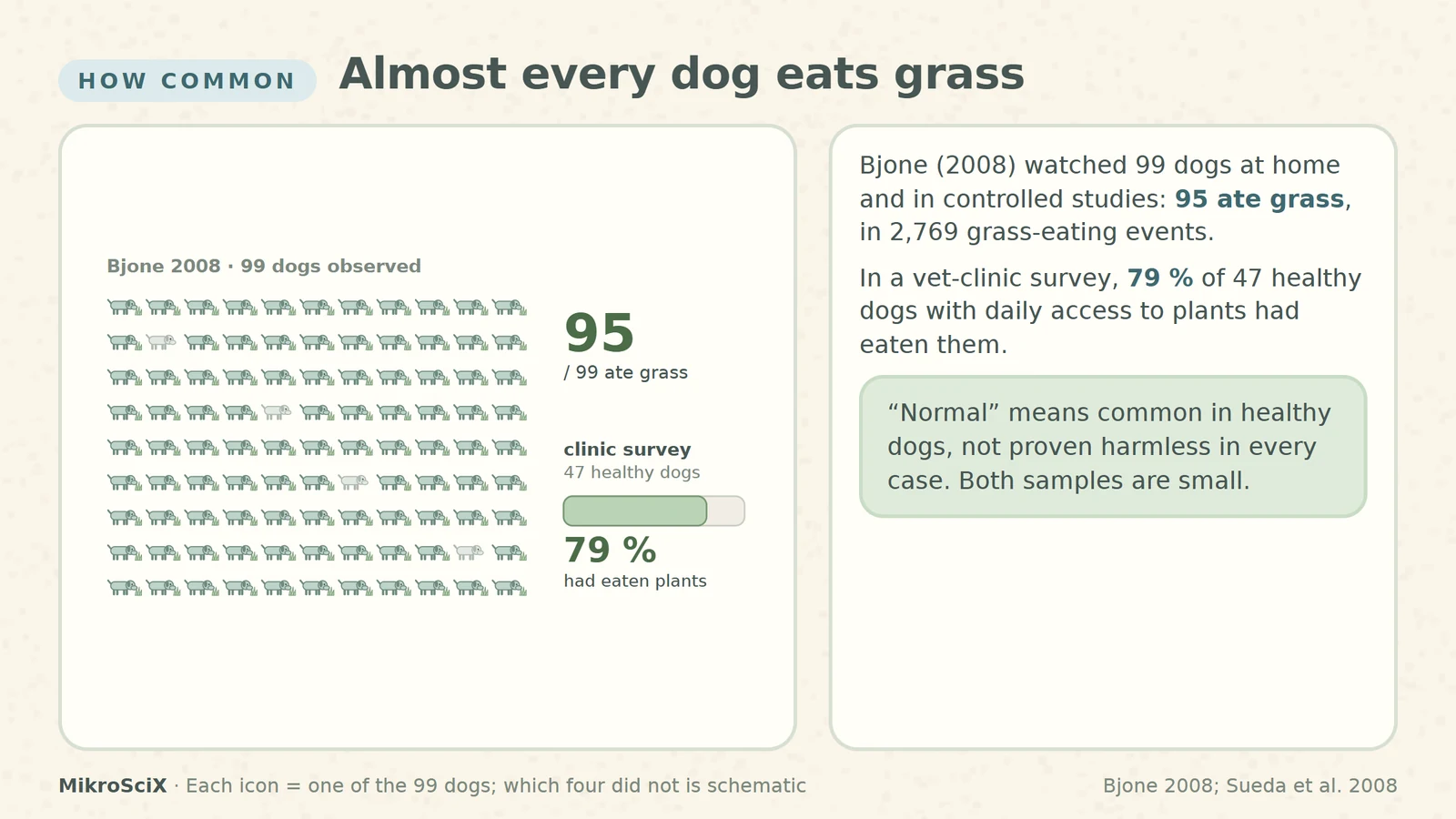
Very. In a PhD study at the University of New England in Australia, Bjone (2008) observed dogs at home and in controlled studies: 95 of 99 dogs ate grass, across 2,769 recorded grass-eating events. She concluded that grass eating is innate, something dogs do without having to learn it.
A separate study by Sueda, Hart and Cliff (2008) at the University of California, Davis, asked the owners of 47 healthy dogs that had daily access to plants. 79 % of those dogs had eaten grass or other plants. In their much larger internet survey of plant-eating dogs, 68 % of the dogs ate plants daily or weekly: for most of them this is a routine behaviour, not a rare event.
Check it yourself: 95 / 99 = 0.96, so 96 % of the observed dogs ate grass. For the clinic survey, 0.79 × 47 ≈ 37, so about 37 of the 47 dogs had eaten plants.
What breaks: both samples are small, and “normal” here means common in healthy dogs. It does not mean that grass eating has been proven harmless in every dog and every situation.
2. Do dogs eat grass because they feel sick?
If grass were a remedy for an upset stomach, most grass-eating dogs should look unwell before they start. The UC Davis team tested this with an internet survey answered by the owners of 1,571 plant-eating dogs. Only 8 % of the dogs frequently showed signs of illness before eating plants. The other 92 % rarely did.
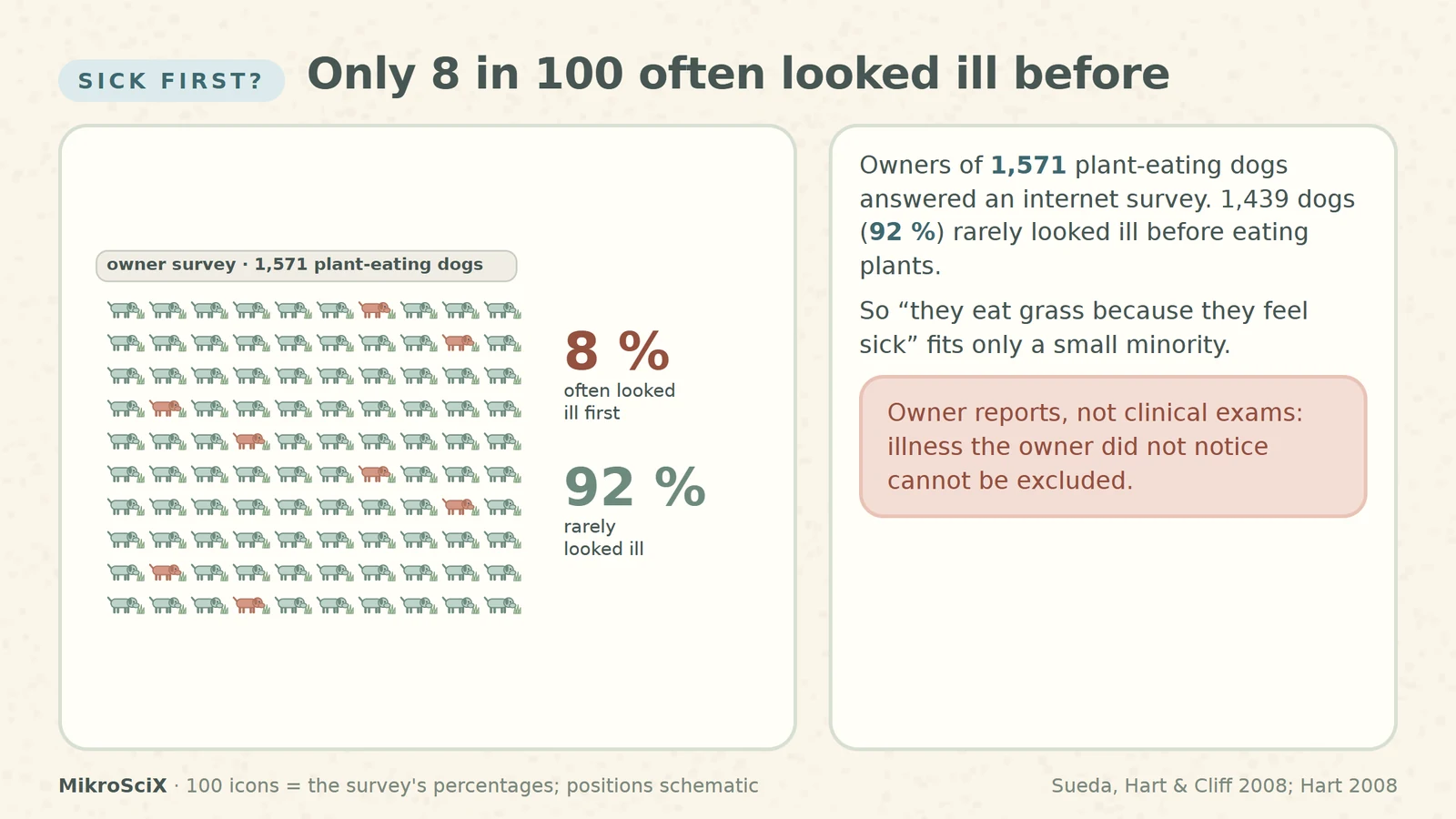
Check it yourself: the paper reports 1,439 dogs that rarely looked ill. 1,439 / 1,571 = 0.916, so 91.6 %, which rounds to 92 %. The remaining 132 dogs are 8.4 %, which is the 8 % in the results and in Hart's 2008 summary (the paper's abstract rounds it to 9 %).
What breaks: these are owner reports, not examinations by a vet. A mild stomach upset that the owner did not notice cannot be ruled out. The survey also reached owners who chose to answer and whose dogs already ate plants, so it describes plant-eating dogs, not all dogs.
3. Do they eat it to vomit?
The second half of the popular story is that the grass makes the dog throw up, and that this is the point. In the same survey, only 22 % of the dogs regularly vomited after eating plants (within about an hour); 78 % rarely did. Bjone's observations point the same way: she saw a very low incidence of vomiting compared with how often the dogs ate grass.
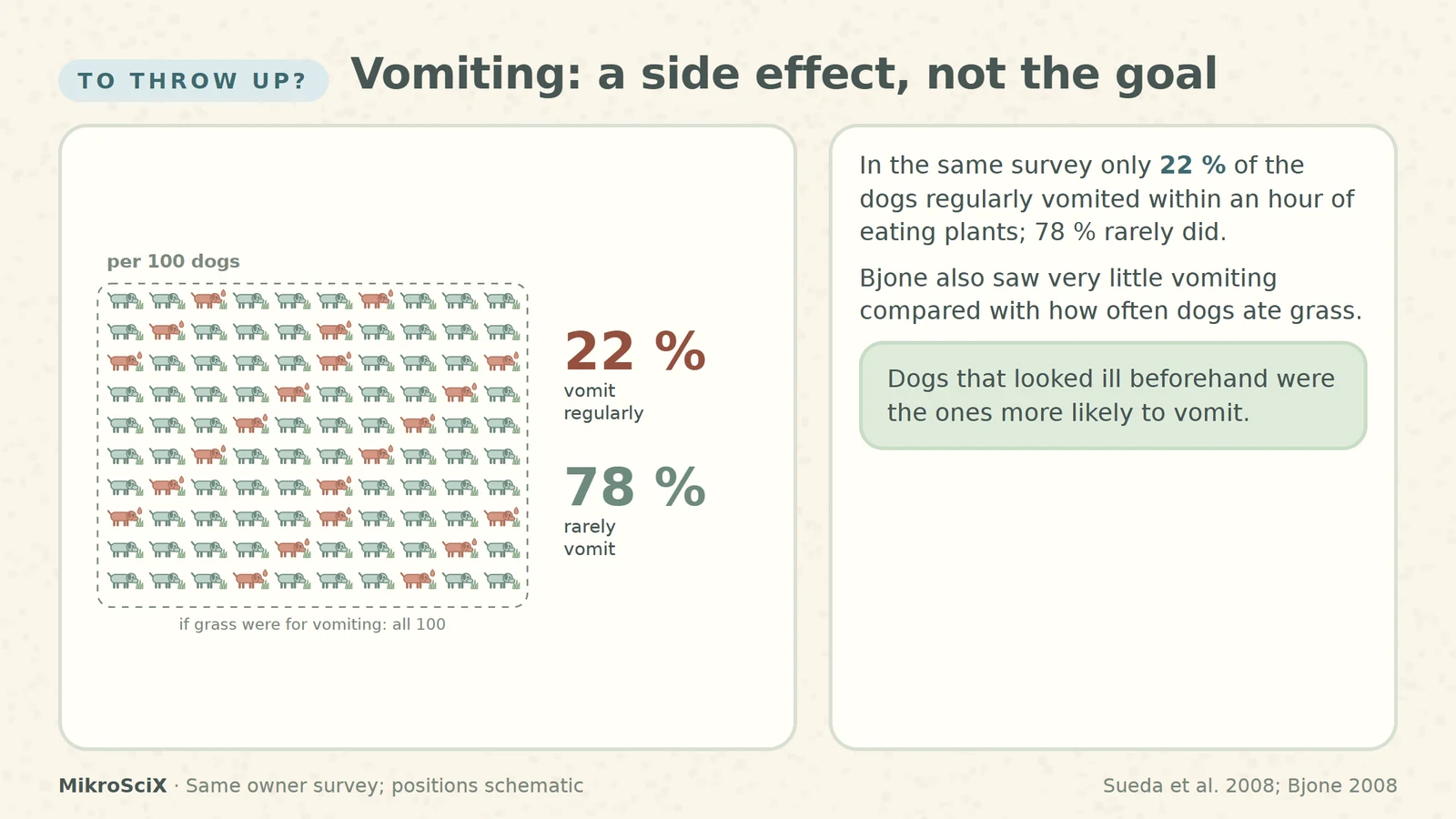
There is a telling detail. The dogs that looked ill beforehand were the ones more likely to vomit afterwards. That fits a simpler reading: vomiting is linked to the dog already being unwell, and for most dogs it is an occasional side effect of eating plants rather than the reason for it.
Check it yourself: 1,225 of the 1,571 dogs rarely vomited: 1,225 / 1,571 = 0.780, or 78.0 %. That leaves 346 dogs, 22.0 %, that vomited regularly.
What breaks: “regularly” is the owner's judgement, and the survey cannot tell us what happens inside the stomach. It shows that vomiting is the exception, not that grass never causes it.
4. So why do they do it? Hypotheses, not proof
Once “sick” and “to vomit” are set aside for most dogs, several explanations remain. None of them is proven, and they are not mutually exclusive.
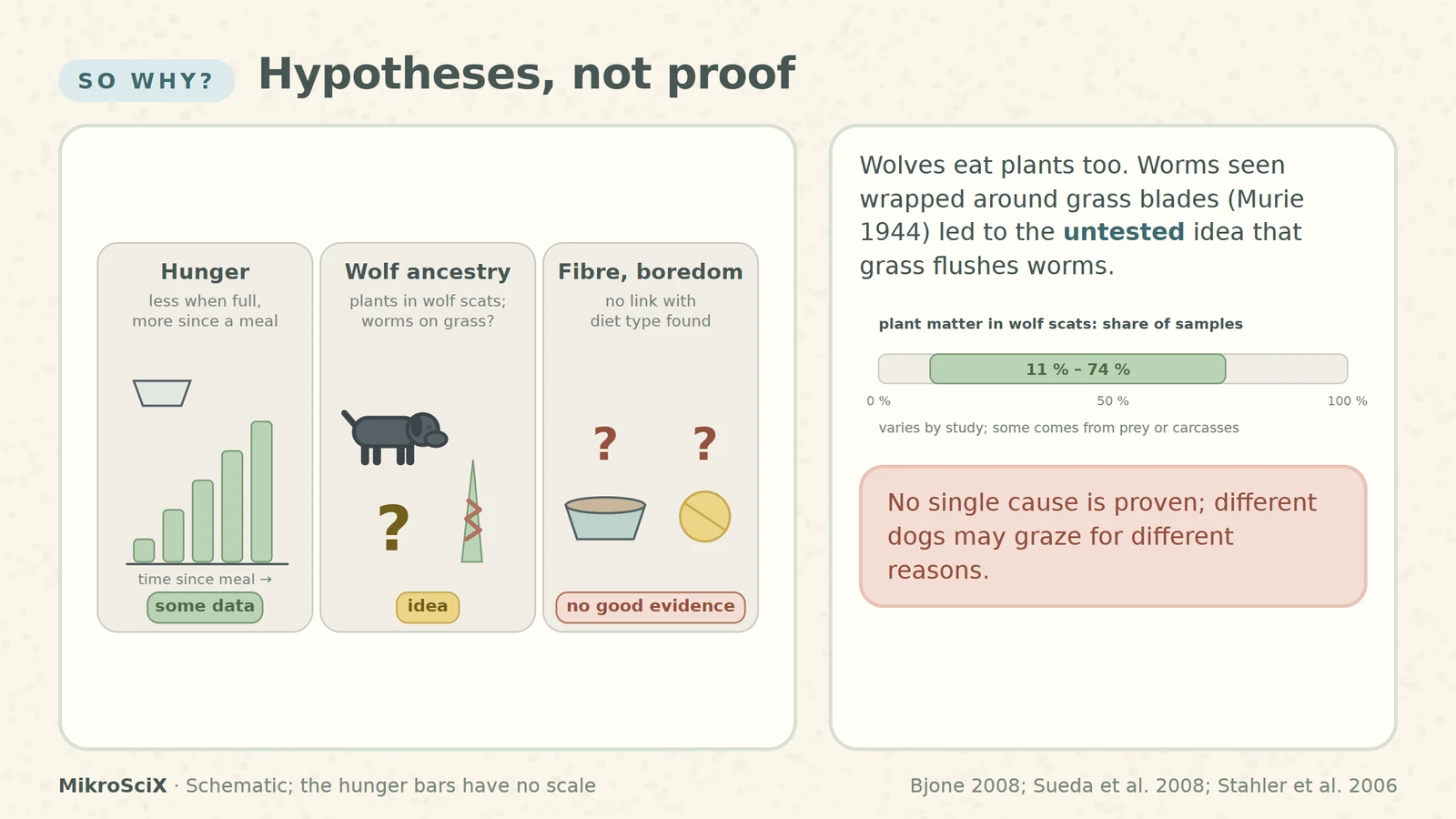
Hunger, or grass as food. Bjone found that dogs were less likely to eat grass when they were satiated, and that they spent more time eating grass the longer it had been since their daily meal. That supports grass as a possible food source, from one research group's controlled studies with a small number of dogs. It is some evidence, not a proven cause.
An inherited wild behaviour. Wild wolves eat plants too. Plant matter turns up in wolf scats in about 11 % to 74 % of samples, depending on the study, and summer scats of Yellowstone wolves show a varied diet that includes vegetation. Murie (1944) saw worms wrapped around grass blades, and that observation led Sueda and Hart to the idea that eating grass helps wild canids flush out intestinal worms. In dogs this idea is untested, and Bjone found that dogs did not eat grass to self-medicate a natural worm burden. Some grass in wolf scats also comes from prey or carcasses rather than from deliberate grazing.
Fibre and boredom. Both are popular answers. The surveys found no link between the type of diet, or how much fibre it contained, and how often dogs ate plants. Sueda and colleagues still call for a detailed study of fibre, vitamin and mineral deficiencies, so fibre is not ruled out; it simply lacks good evidence. Boredom appears in owner advice, such as the American Kennel Club's, but it was not tested in the studies used here.
What breaks: the most common mistake is to present any one of these as the answer. The honest summary from the researchers is that grass eating is mostly a normal, probably inherited behaviour whose purpose is still unknown. Different dogs may graze for different reasons.
5. When does it deserve attention?
Occasional grass eating in a dog that seems well is normal. Persistent or excessive grass eating, or grass eating together with vomiting, diarrhoea, weight loss or lethargy, should be checked by a vet. That matches the survey finding above: the dogs that looked ill before eating plants were the ones more likely to vomit afterwards, so the signs of illness, not the grass, are what matter.
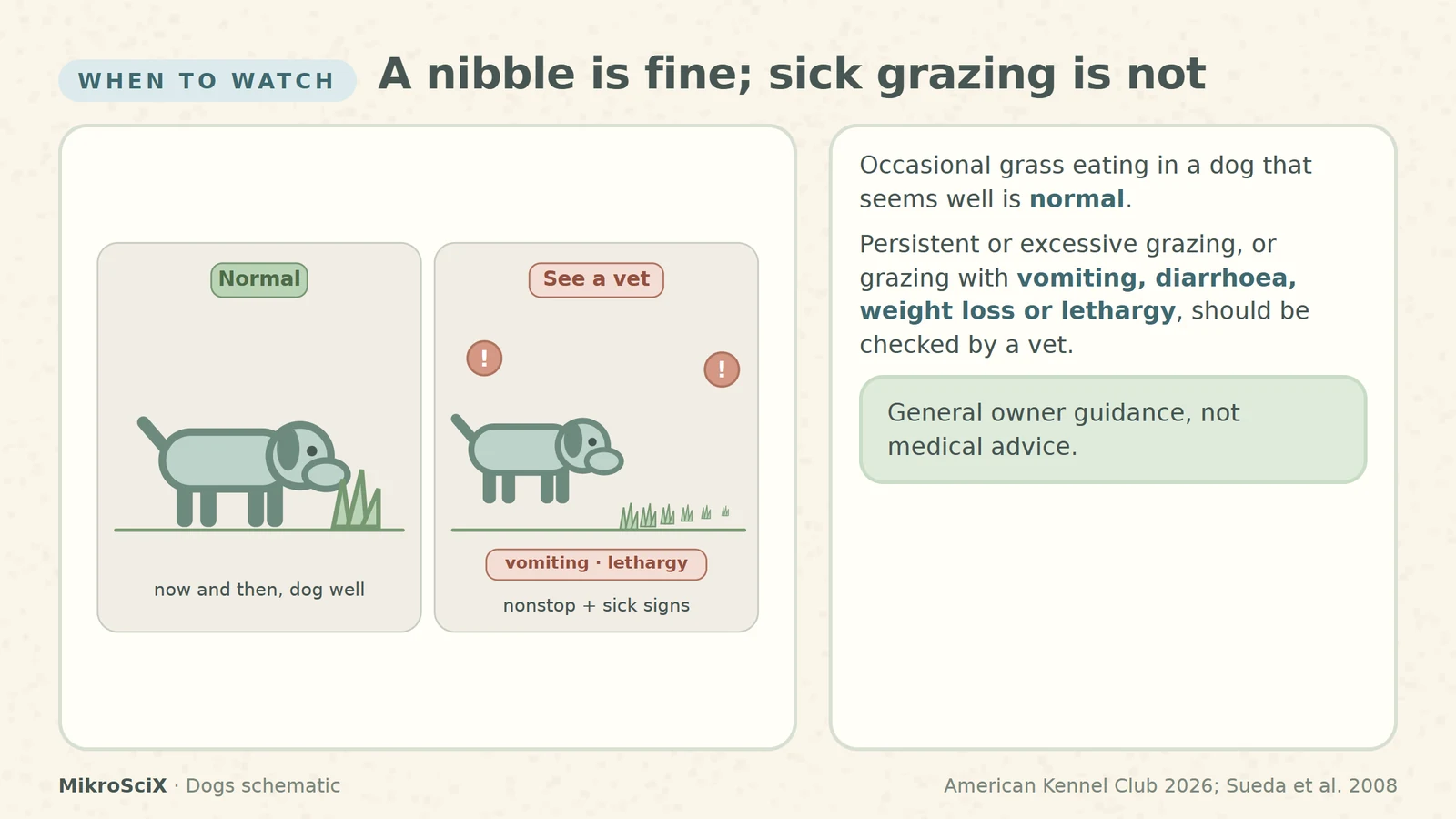
What breaks: this is general owner guidance, not medical advice. A vet will look at the whole dog, not at the grass.
6. The real risk may be on the grass
There is one risk that has nothing to do with why dogs graze. Knapp and colleagues (2013) measured lawn herbicides in the urine of pet dogs in Indiana households. After a lawn treatment, herbicides were found in dogs' urine in 19 of 25 households. They were also found in 14 of 25 households before treatment, and in 4 of 8 households whose lawns had not been treated at all, which suggests drift from neighbouring lawns. Dogs are exposed by contact with treated grass, not only by eating it.
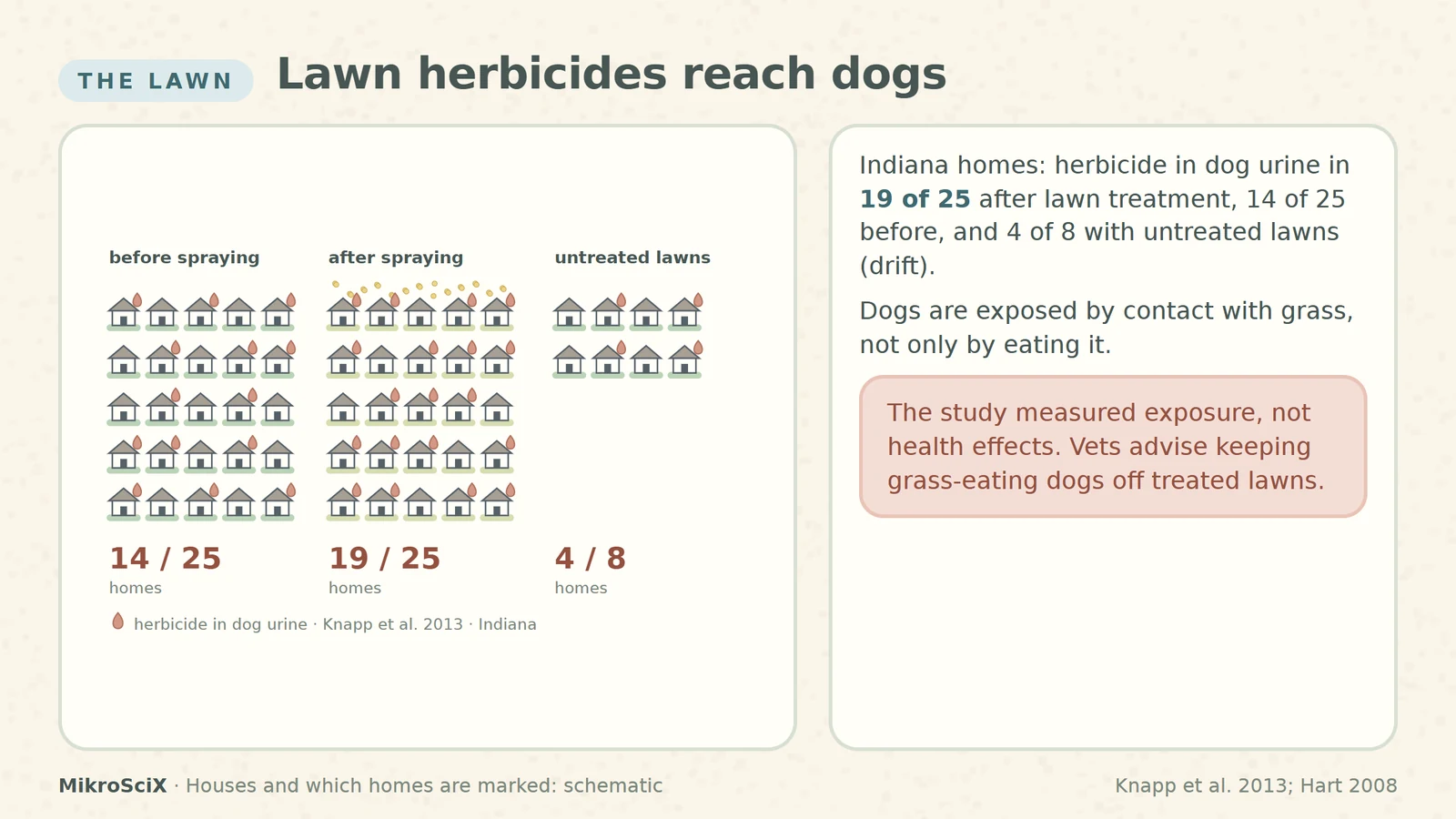
Check it yourself: 19 / 25 = 76 % of homes after treatment, 14 / 25 = 56 % before, and 4 / 8 = 50 % of untreated homes. The rise after treatment is clear, but exposure was common even without it.
What breaks: the study measured exposure, not harm. It did not measure the health effects of these doses, so it does not show that the dogs were made ill. The practical advice from vets is simple anyway: keep grass-eating dogs away from chemically treated lawns.
How to read claims about dogs and grass
- Ask who measured it: owner survey, observation or clinical exam? The 8 % and 22 % are owner reports.
- Ask what the denominator is: “of 1,571 plant-eating dogs” is not “of all dogs”.
- Separate exposure from harm: a chemical found in urine shows contact, not disease.
- Distrust single causes: hunger, ancestry, fibre and boredom are hypotheses, and several may be true for different dogs.
Grass eating is common and mostly normal: most dogs neither look ill before it nor vomit after it, its purpose is still unknown, and the clearest risk is a sprayed lawn, not the grass itself.
Try it yourself
- If the survey's 22 % held for a group of 50 plant-eating dogs, how many would you expect to vomit regularly after eating grass?
- A friend says: “My dog eats grass because its food lacks fibre.” What does the evidence say?
- Herbicide was found in dog urine in 14 of 25 homes before spraying and 19 of 25 after. Why can you not conclude that spraying made 19 dogs ill?
Answers: (1) 0.22 × 50 = 11 dogs, assuming the survey proportion applies to that group. (2) The surveys found no link between diet type or fibre and how often dogs eat plants; fibre has not been studied in detail, so it is unproven rather than ruled out. (3) The study measured exposure (herbicide in urine), not health effects; and herbicide was already present in many homes before spraying, partly from drift.
Sources
- Sueda, Hart & Cliff (2008) — Characterisation of plant eating in dogs, Applied Animal Behaviour Science 111, 120–132
- Hart (2008) — Why do dogs and cats eat grass? Veterinary Medicine, December 2008, 648–649 (dvm360)
- Bjone (2008) — Grass-Eating Behaviour in the Domestic Dog, Canis familiaris, PhD thesis, University of New England
- Knapp, Peer, Conteh et al. (2013) — Detection of herbicides in the urine of pet dogs following home lawn chemical application, Science of the Total Environment 456–457, 34–41
- Stahler, Smith & Guernsey (2006) — Foraging and feeding ecology of the gray wolf: lessons from Yellowstone National Park, The Journal of Nutrition 136, 1923S–1926S
- American Kennel Club (2026) — Why Does My Dog Eat Grass?
The 8 %, 22 %, 68 % and 79 % are owner-survey results (Sueda et al. 2008); 95 of 99 is Bjone's observation (2008). The divisions (95/99, 1,439/1,571, 1,225/1,571, 19/25 …) and the exercise answers are our arithmetic. Dog, wolf and house drawings are schematic, and which icons are highlighted is not data. General information, not veterinary advice.