

THERMODYNAMICS
Does hot water freeze faster than cold? The Mpemba effect, definitions and supercooling
Sometimes yes, often no. Whether hot water "wins" depends on what you call frozen, on how you cool it, and on the random way each sample of water starts to turn into ice. Here is what careful experiments, including a 2026 study with 176 measurements, actually found.
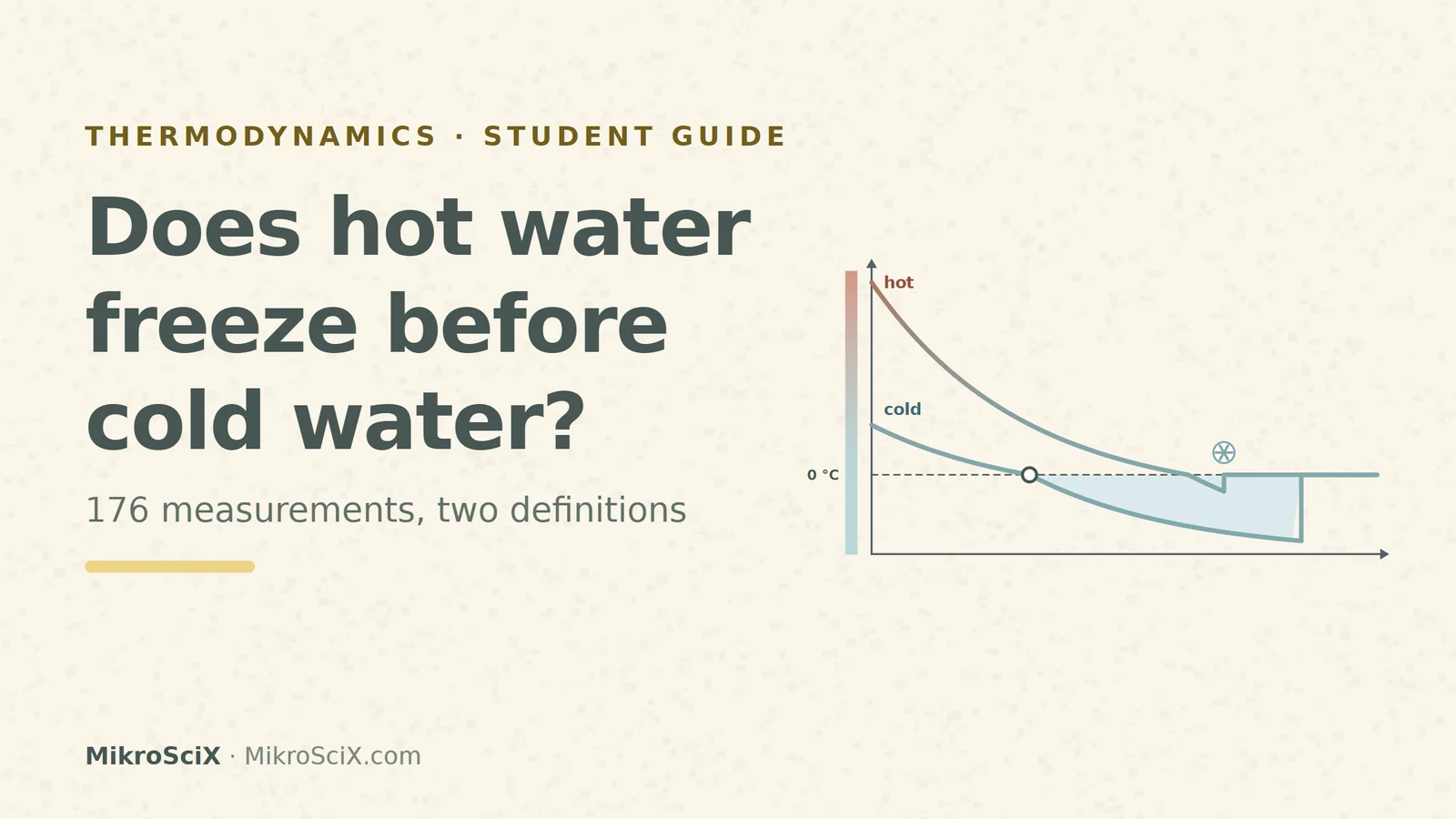
Put two identical cups in a freezer, one with hot water and one with cold. Which one freezes first? Almost everyone answers "the cold one", and yet the opposite claim has been around for more than two thousand years. Aristotle wrote that water which has been warmed beforehand freezes more quickly. Francis Bacon and René Descartes repeated versions of it.
The modern name comes from Tanzania. As a schoolboy, Erasto Mpemba was making ice cream and, short of freezer space, put his boiled mixture in while it was still hot. An hour and a half later his had frozen and a classmate's cold mixture had not. He kept asking why, and in 1969 he published a short paper about it with the physicist Denis Osborne. Since then the "Mpemba effect" has been tested, explained, disputed and re-tested many times. This guide is for students who want to know what is solid and what is still open.
1. Why it sounds impossible
In a freezer, heat flows from the water into colder air and shelves. A simple model is Newton's law of cooling: the temperature difference between the water and its surroundings shrinks exponentially, T − T_f = (T₀ − T_f) · e^(−t/τ), where T_f is the freezer temperature and τ a time constant set by the container and the air flow.
Hot water does lose heat faster at the start, because its temperature difference is larger. But Burridge and Linden point out the catch: to freeze, the hot sample must first cool down to where the cold sample started. From then on, if everything else is equal, it should take just as long as the cold one. So in total it should take longer. For hot water to win, the two samples must differ in something other than their starting temperature, or must cool in a different way.
Check it yourself: the time to reach 0 °C in this model is t = τ · ln[(T₀ − T_f) / (0 − T_f)]. With T_f = −16.5 °C, a cup starting at 21.8 °C needs ln(38.3 / 16.5) = 0.842 time constants; a cup at 84.7 °C needs ln(101.2 / 16.5) = 1.814. The hot cup should take 1.814 / 0.842 ≈ 2.2 times as long.
What breaks:
- τ is not constant. Evaporation, convection and the contact with the shelf all change as the water cools, and they change differently for hot and cold samples.
- Freezing is not cooling. Newton's law only describes the liquid. Reaching 0 °C does not mean ice appears, as the next sections show.
2. "Freezes first" has more than one meaning
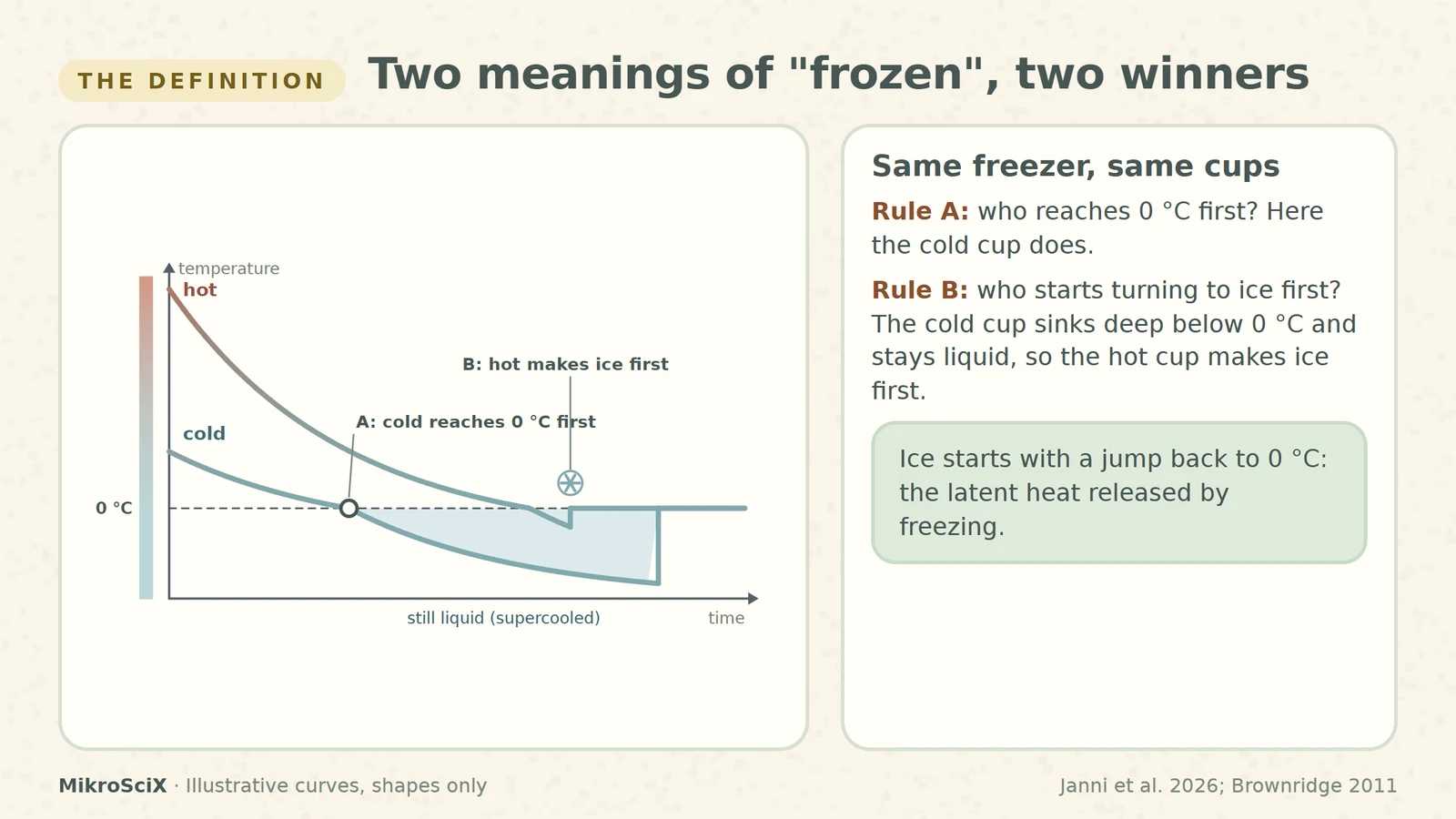
There is no single accepted definition of the Mpemba effect. Some experiments time the moment a sample first reaches 0 °C. Others time the moment ice starts to form, which shows up on a thermometer as a sudden jump back to 0 °C as the latent heat of freezing is released. Others again wait until the sample is solid. These are different races, and they can have different winners.
A 2026 paper from the University of Minnesota (Janni, Botero Ampudia and Dahlberg, RSC Applied Interfaces) makes the point with numbers. The team measured cooling curves of deionized and tap water in lidded tins and open beakers on different trays. Out of 176 measurements, they counted 46 instances of the Mpemba effect under one definition and 58 under the other: an initially hot sample reaching 0 °C before a cold one, or a cold sample supercooling and starting its phase transition after a hot one. Their cooling curves fitted Newton's law well, and they attribute the observations to fluctuating convective air currents and to sample-to-sample differences in supercooling. The largest differences were seen with tap water, which suggests that dissolved ions may matter.
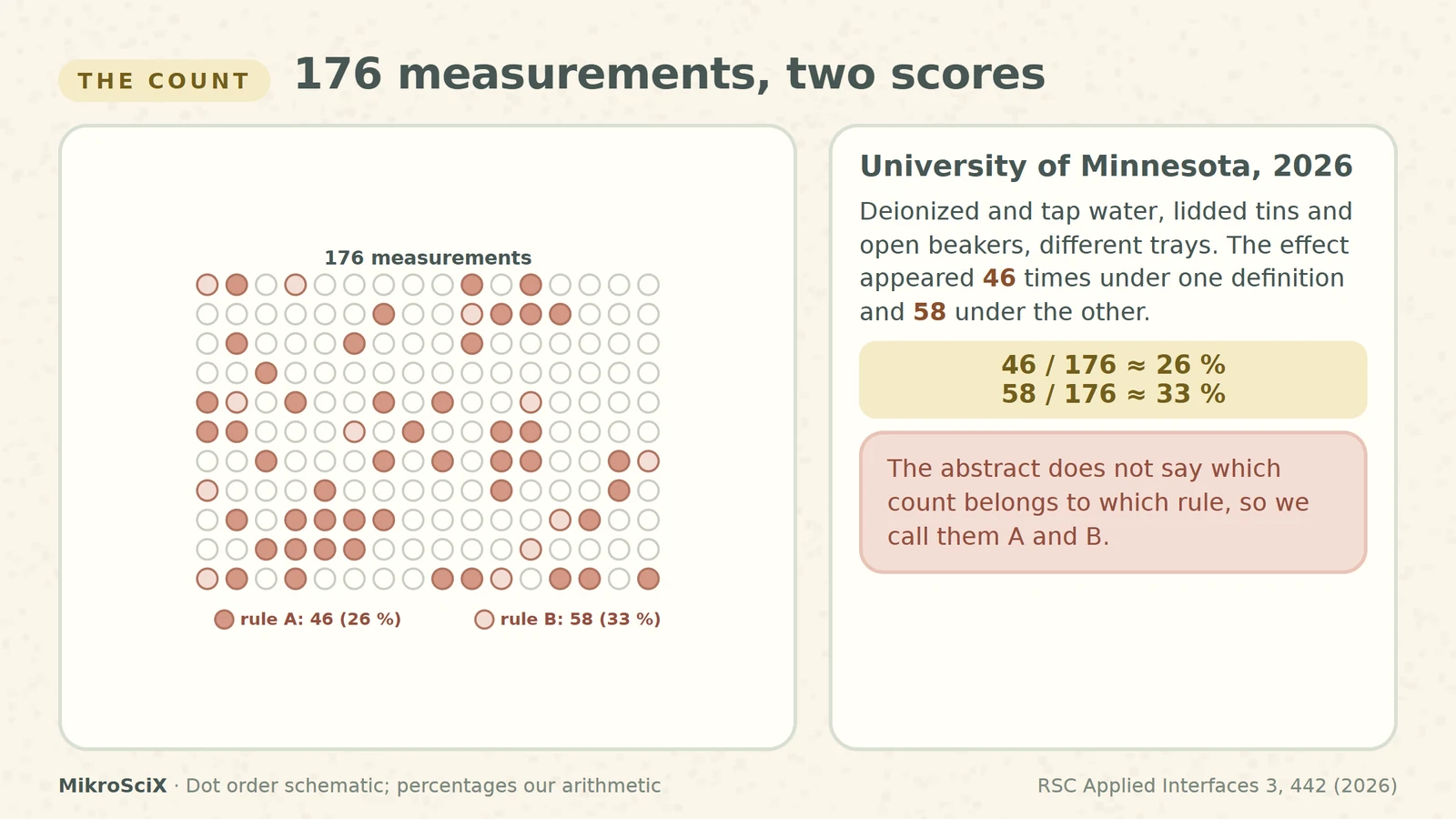
Check it yourself: 46 / 176 ≈ 0.26 and 58 / 176 ≈ 0.33. Depending on the definition, roughly a quarter or a third of the measurements showed the effect. Not always, not never.
What breaks:
- Which count is which. The paper's abstract does not tie the two numbers to the two definitions, so we do not either.
- Thermometer position. Brownridge notes that the shape of a cooling curve above freezing is very sensitive to where the thermocouple tip sits; a few millimetres can matter.
3. Supercooling: the hidden lottery
Pure, still water rarely freezes at 0 °C. It usually supercools: it drops below 0 °C and stays liquid until an ice crystal nucleates somewhere, on an impurity or on the container wall. At that moment the temperature jumps back to 0 °C and stays there while the water freezes.
James Brownridge, at Binghamton University, spent more than ten years and several thousand freeze–thaw cycles on this. His key finding: two samples of the same water often have different spontaneous freezing temperatures, and heating a sample may raise, lower or not change its freezing temperature. If the cold sample supercools deeply and the hot one starts freezing a few degrees below zero, the hot one can make ice first even though it reached 0 °C later. To show it, he chose two vials whose mean freezing temperatures differed by about 5.5 °C, heated the one that froze warmer, and saw hot water freeze first 28 times in 28.
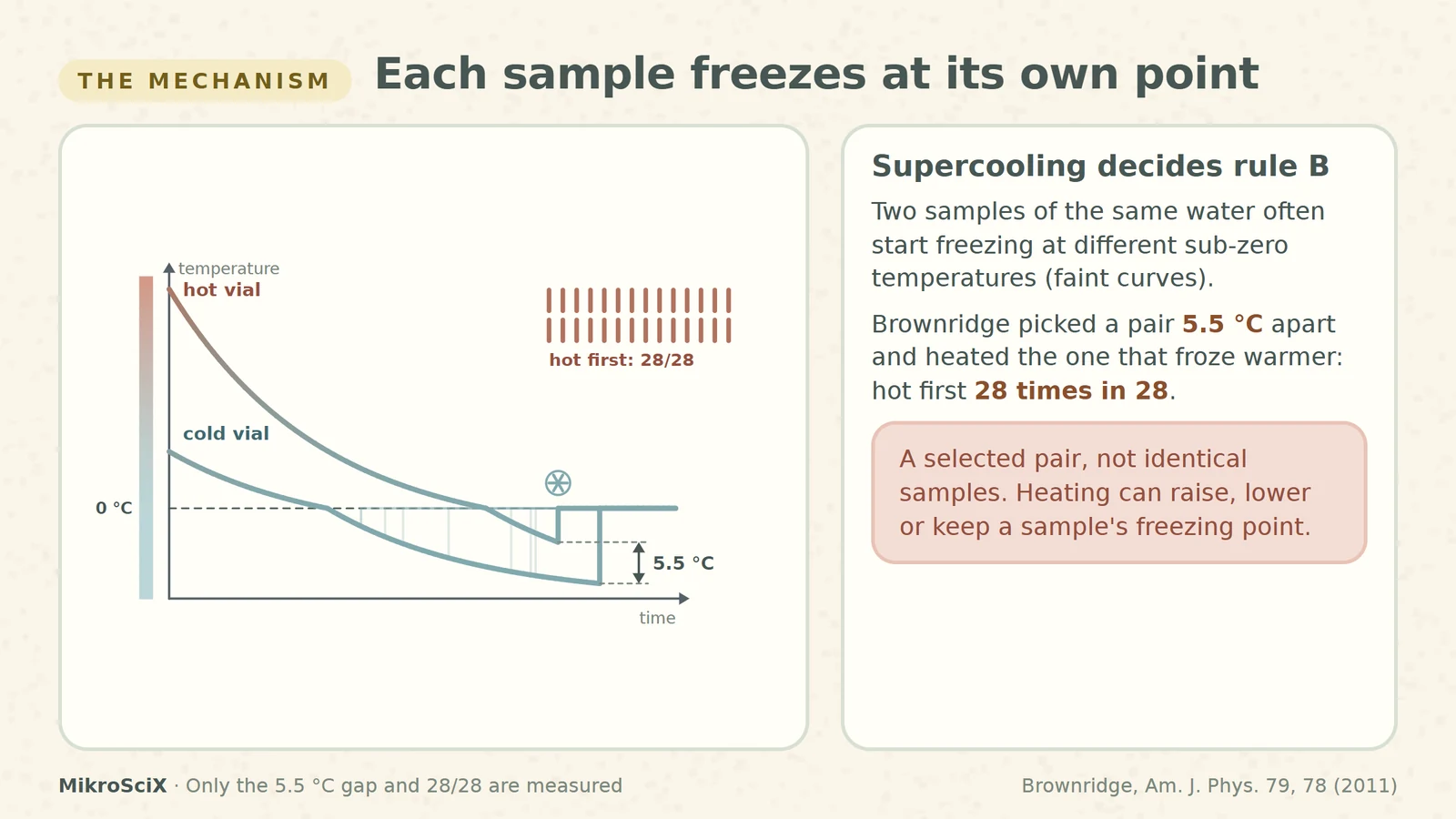
Check it yourself: if the order were pure chance (½ each time), 28 hot-first results in a row would happen with probability 0.5²⁸ ≈ 3.7 × 10⁻⁹. The result is not luck: the pair really differed, in its freezing points.
What breaks:
- A selected pair. Brownridge's 28 of 28 used vials picked for their different freezing points. It explains how hot water can win; it does not show that identical samples usually do.
- Freezer temperature. A 2025 preprint by Klimov and Finkelstein (not yet peer reviewed) reports that the effect appeared only when the freezer was close to the nucleation temperature, where freezing times scatter widely because nucleation is random.
4. The usual suspects
Explanations offered over the years fall into four groups, the same four named by the winning entry of a 2012 Royal Society of Chemistry competition:
- Evaporation. Hot water loses mass and heat from its surface, so less water is left to freeze. Descartes credited evaporation, although his narrow-necked flask would have limited it.
- Convection. Temperature differences drive currents in the water and in the freezer air. They are different for hot and cold samples, and the 2026 study points to fluctuating air currents.
- Dissolved gases and ions. Heating drives gas out of water, and ions change both heat transfer and nucleation. Tap water gave the largest effects in 2026.
- Supercooling. Section 3.
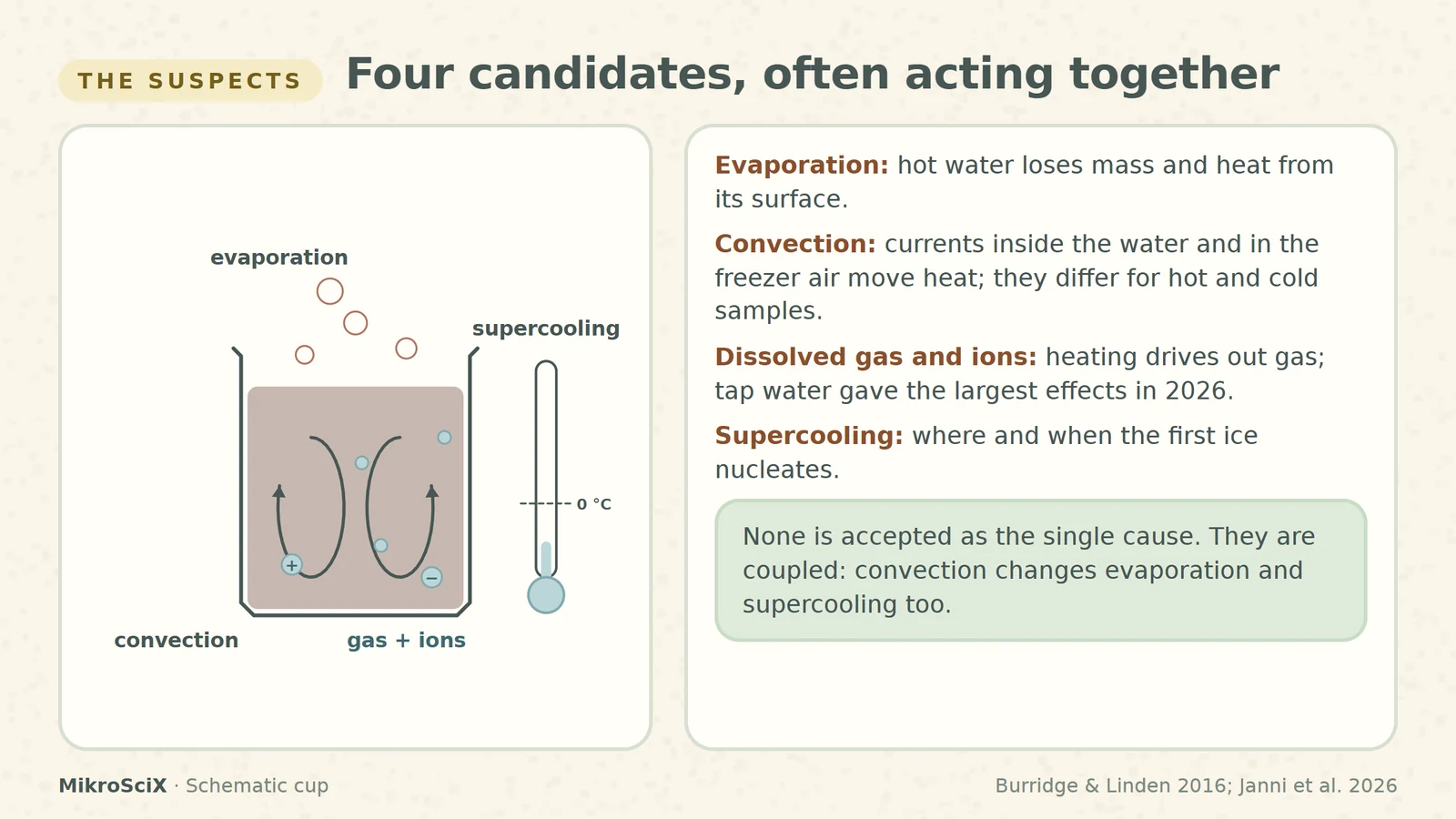
Burridge and Linden stress that these are coupled. Convection changes how long a parcel of water touches an impurity or the container wall, which changes how deep it supercools. Evaporation changes dissolved gases. So the question "which mechanism?" may have no single answer.
What breaks: molecular explanations based on hydrogen bonding have been proposed, but Burridge and Linden note they would need water's measured thermal properties to depend on its history, which has not been shown.
5. The careful counter-example
In 2016 Henry Burridge and Paul Linden repeated the Mpemba–Osborne style of experiment under controlled conditions: 400 g of boiled water in glass beakers on 5 cm of polystyrene, in a chest freezer cycling between −18 and −15 °C, with a calibrated thermocouple fixed at the centre of each sample. Starting at 21.8, 57.3 and 84.7 °C, the samples first reached 0 °C after 6397, 9504 and 10812 s: about 1 h 47 min, 2 h 38 min and 3 h 00 min. The hotter the start, the longer the wait.
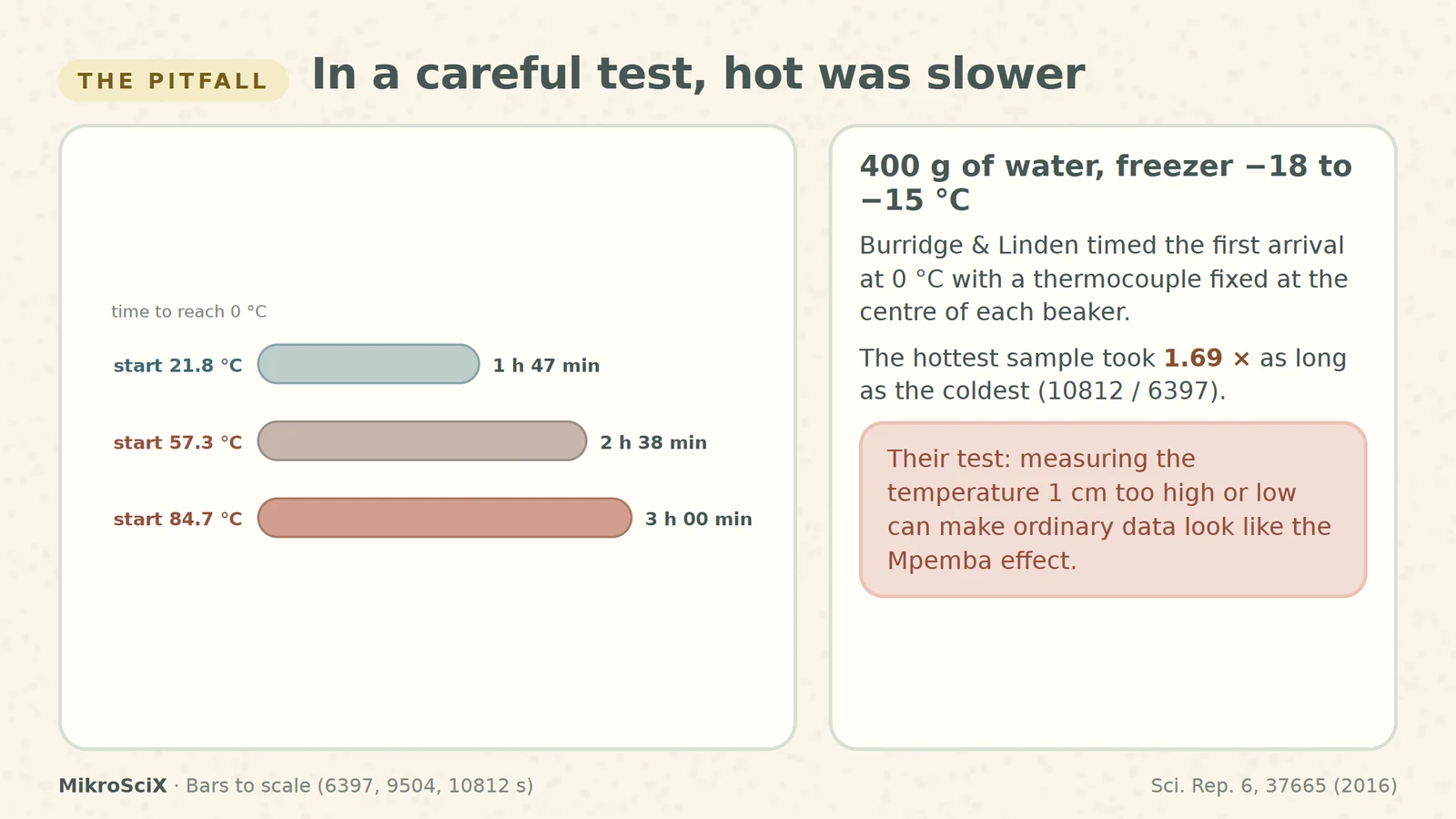
They also re-analysed published data. Most reported observations of the effect were marginal, and many came from studies that did not report the height at which temperature was measured. In their own tank experiments, reading the temperature from a position just 1 cm off would have produced data that looked like the Mpemba effect. Their conclusion was that they found no evidence for meaningful observations of it, for their definition: the time to reach 0 °C.
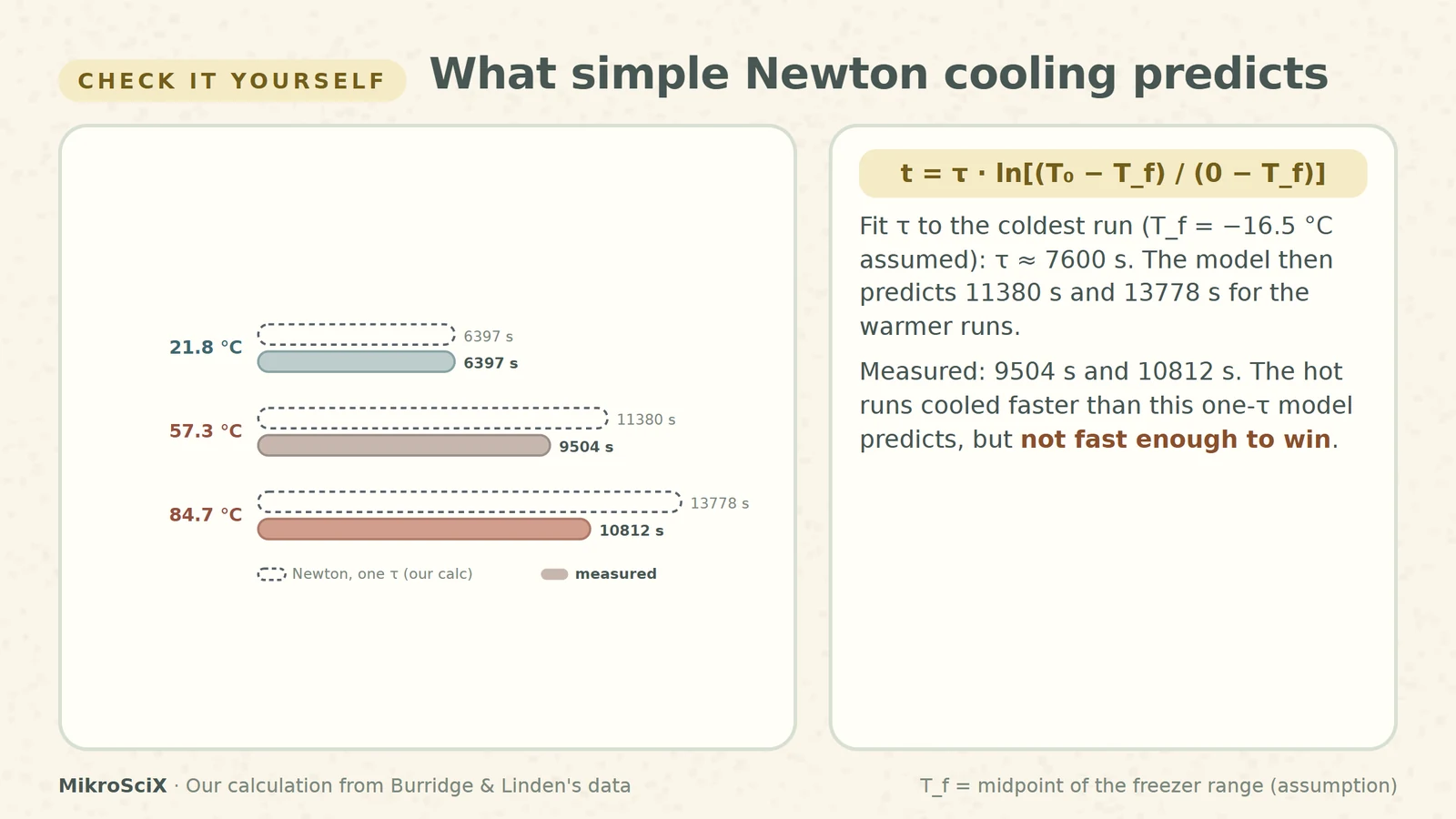
Check it yourself: fit τ to their coldest run with T_f = −16.5 °C (the middle of the freezer's range, our assumption): τ = 6397 / 0.842 ≈ 7600 s. The model then predicts 7600 × ln(73.8 / 16.5) ≈ 11380 s for 57.3 °C and 7600 × 1.814 ≈ 13778 s for 84.7 °C. Measured: 9504 and 10812 s. The hot runs cooled faster than this one-τ model predicts, but still nowhere near fast enough to beat the cold run.
How to read the next headline
- First to what? 0 °C, first ice, or solid ice?
- Identical samples? Same water, same container, same volume after heating, same place in the freezer?
- Where was the thermometer? And was it at the same height in both samples?
- How many runs? One kitchen test is an anecdote; supercooling alone can flip a single result.
Hot water can freeze first under some conditions, mostly through supercooling, but it does not do so reliably. The Mpemba effect is neither proven nor debunked: it is a question about definitions and control.
Try it yourself
- Using the Newton model above (T_f = −16.5 °C), how many times longer than the 21.8 °C sample should the 57.3 °C sample take to reach 0 °C? Compare with the measured ratio.
- Under the more generous of the two definitions, what share of the 176 Minnesota measurements showed the effect?
- Why does Brownridge's 28 of 28 not prove that hot water usually freezes first?
Answers: (1) ln(73.8 / 16.5) / ln(38.3 / 16.5) = 1.498 / 0.842 ≈ 1.78 predicted; measured 9504 / 6397 ≈ 1.49. (2) 58 / 176 ≈ 33 %. (3) The two vials were chosen because their freezing temperatures differed by about 5.5 °C, and the one that froze warmer was the one heated.
Watch the short
Videos don’t load automatically. The videos are hosted on YouTube. Allow YouTube once and every video on the site loads by itself; your choice is remembered. The articles never need consent.
Sources
- Janni, Botero Ampudia & Dahlberg (2026) — An experimental investigation of the Mpemba effect, RSC Applied Interfaces 3, 442–449
- Burridge & Linden (2016) — Questioning the Mpemba effect: hot water does not cool more quickly than cold, Scientific Reports 6, 37665
- Brownridge (2011) — When does hot water freeze faster then cold water? A search for the Mpemba effect, Am. J. Phys. 79, 78 (preprint)
- Mpemba & Osborne (1969) — Cool?, Physics Education 4, 172
- Jeng (2006) — The Mpemba effect: When can hot water freeze faster than cold?, Am. J. Phys. 74, 514 (preprint)
- Klimov & Finkelstein (2025) — The Mpemba Effect in Pure Water Has a Stochastic Origin, arXiv 2508.05607 (preprint, not peer reviewed)
The Minnesota paper's full text could not be opened; only its abstract is used. Percentages, the Newton fit (freezer temperature −16.5 °C assumed) and the 0.5²⁸ probability are our own arithmetic. Cooling curves are schematic.