

SUPERCONDUCTIVITY · EPISODE 1
Superconductivity: zero resistance, a field pushed out, and the cold that decides everything
What a superconductor is, from the outside: the two signatures that define it, the experiments that showed them, the numbers you can check yourself, and why temperature decides where superconductors are used. For undergraduate and graduate students.
Cool some metals far enough and something strange happens: their electrical resistance does not just get small, it disappears. A current started in a closed ring of such a material keeps going with no battery attached. Put the same material in a weak magnet's field and, as it cools, it pushes that field out of its interior.
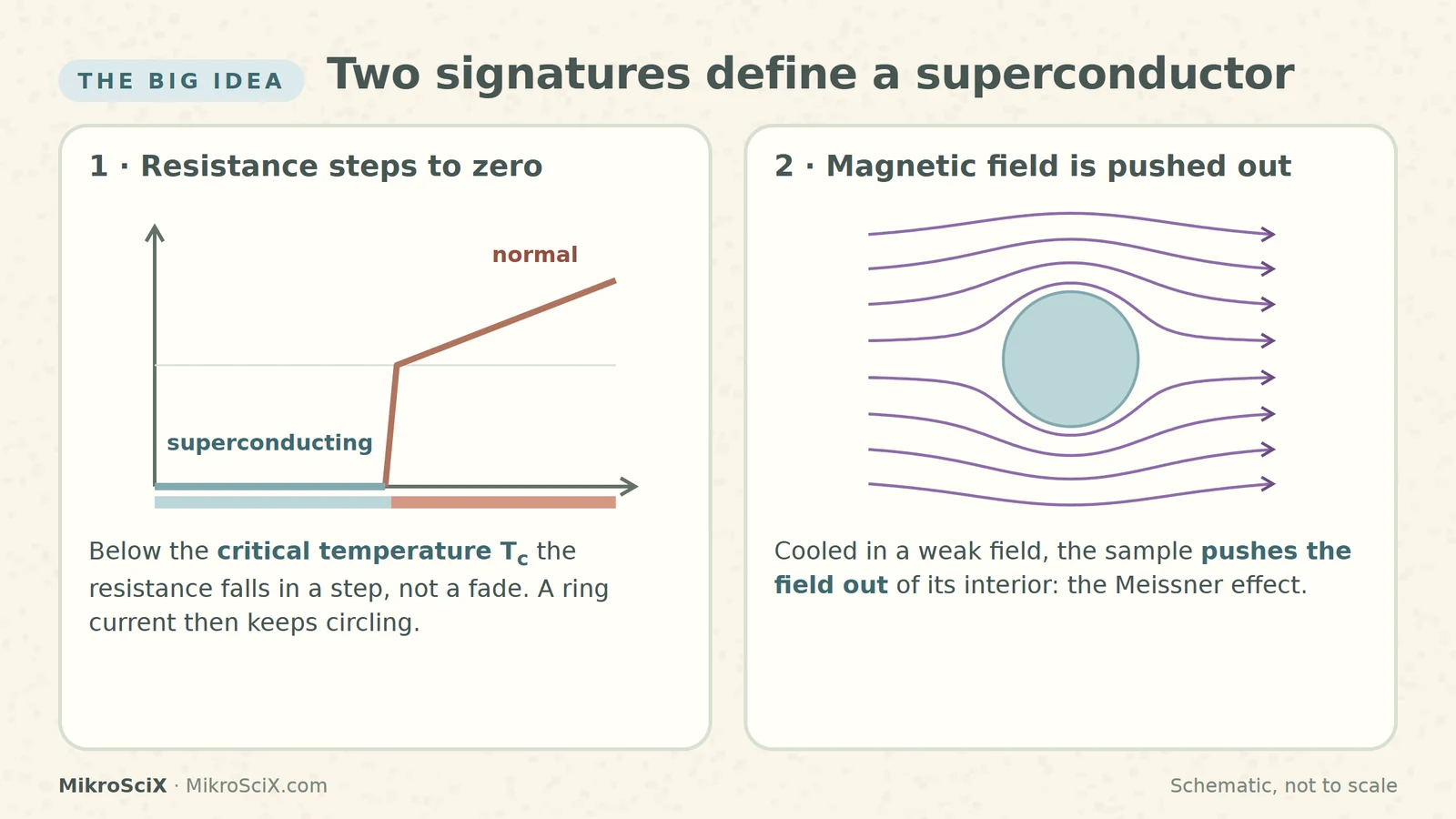
These two behaviours, zero resistance and expulsion of magnetic field, are the two defining signatures of a superconductor. This article stays on the surface: what you can observe and measure from the outside. Why it happens (Cooper pairs and the BCS theory) is a story for a later episode of this series.
1. Leiden, 1911: the resistance that stopped
In Leiden, Heike Kamerlingh Onnes and his team used liquid helium to measure how the resistance of metals behaves near absolute zero. On 8 April 1911 the notebook recorded the result for a mercury sample in three words: mercury, practically zero.
The famous curve that followed shows something unexpected: the resistance does not fade gradually toward zero. At about 4.2 K it drops in a step. Within 0.01 K, it falls from about 0.1 Ω to an unmeasurably small value, below 10⁻⁶ Ω.
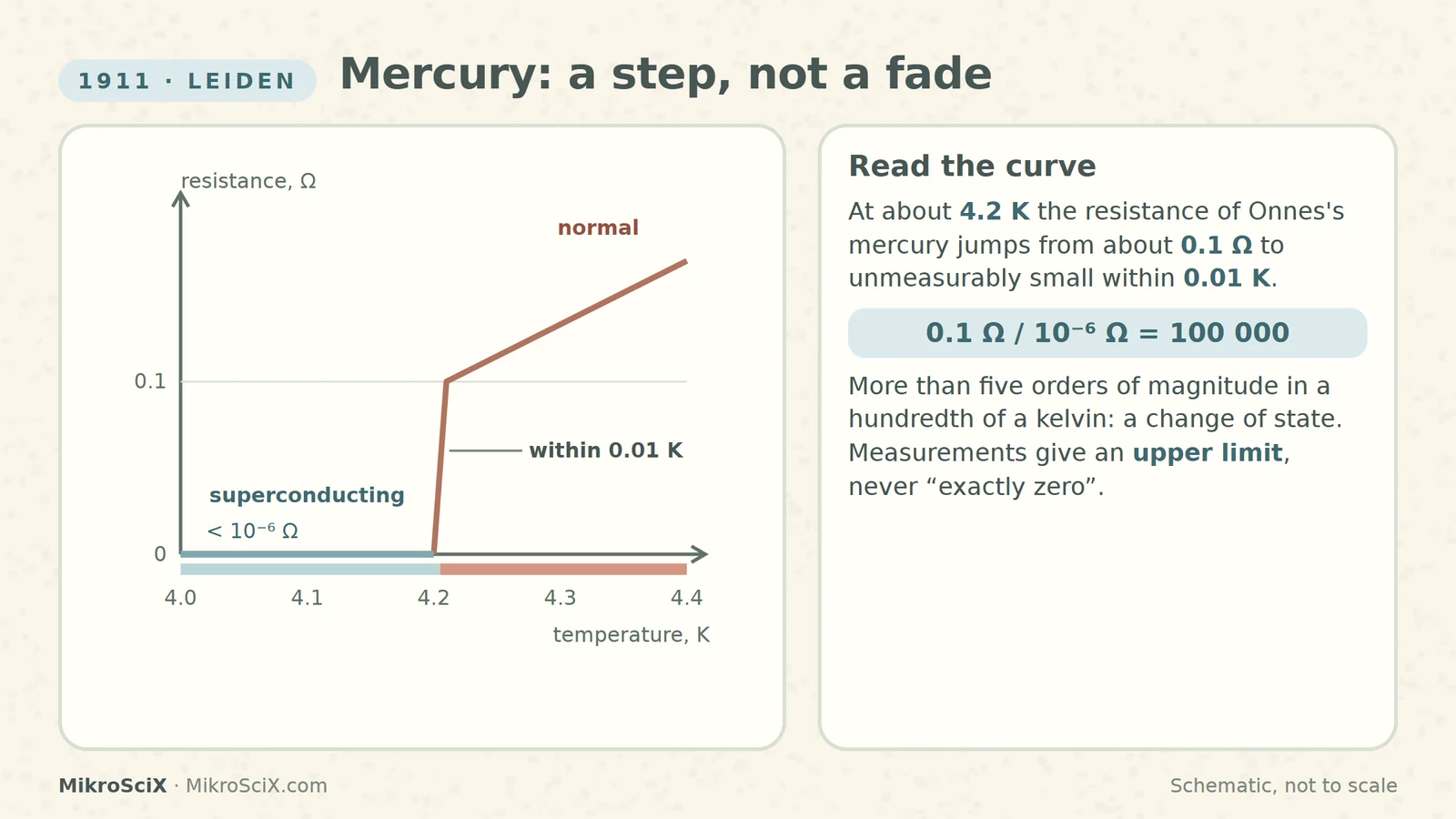
Check it yourself. 0.1 Ω divided by 10⁻⁶ Ω is 100 000. A drop of more than five orders of magnitude over a hundredth of a kelvin is not a material getting slightly better at conducting; it is a change of state. The temperature where it happens is the critical temperature, Tc.
What breaks:
- "Exactly zero" is not a measurement. Every instrument has a floor. Onnes could only say "below 10⁻⁶ Ω". Experiments give upper limits on resistance, which is why the next experiment matters.
- Tc belongs to a material. Mercury is about 4.2 K, niobium-titanium 9.3 K, YBCO up to 93 K. There is no single "superconducting temperature".
2. A ring that keeps its current for years
How do you test whether a resistance is truly tiny when your voltmeter cannot see it? Stop pushing current through the sample and let it push itself. Induce a current in a closed ring and watch its magnetic field. In any ring with resistance R and inductance L, the current decays exponentially:
I(t) = I₀ · e−Rt/L, with time constant τ = L/R.
The energy goes into heat, as electrons scatter off lattice vibrations and impurities. In a small copper ring τ is a small fraction of a second. In superconducting rings, persistent-current experiments found no detectable decay over periods extending to several years. A lower limit on τ turns directly into an upper limit on R.
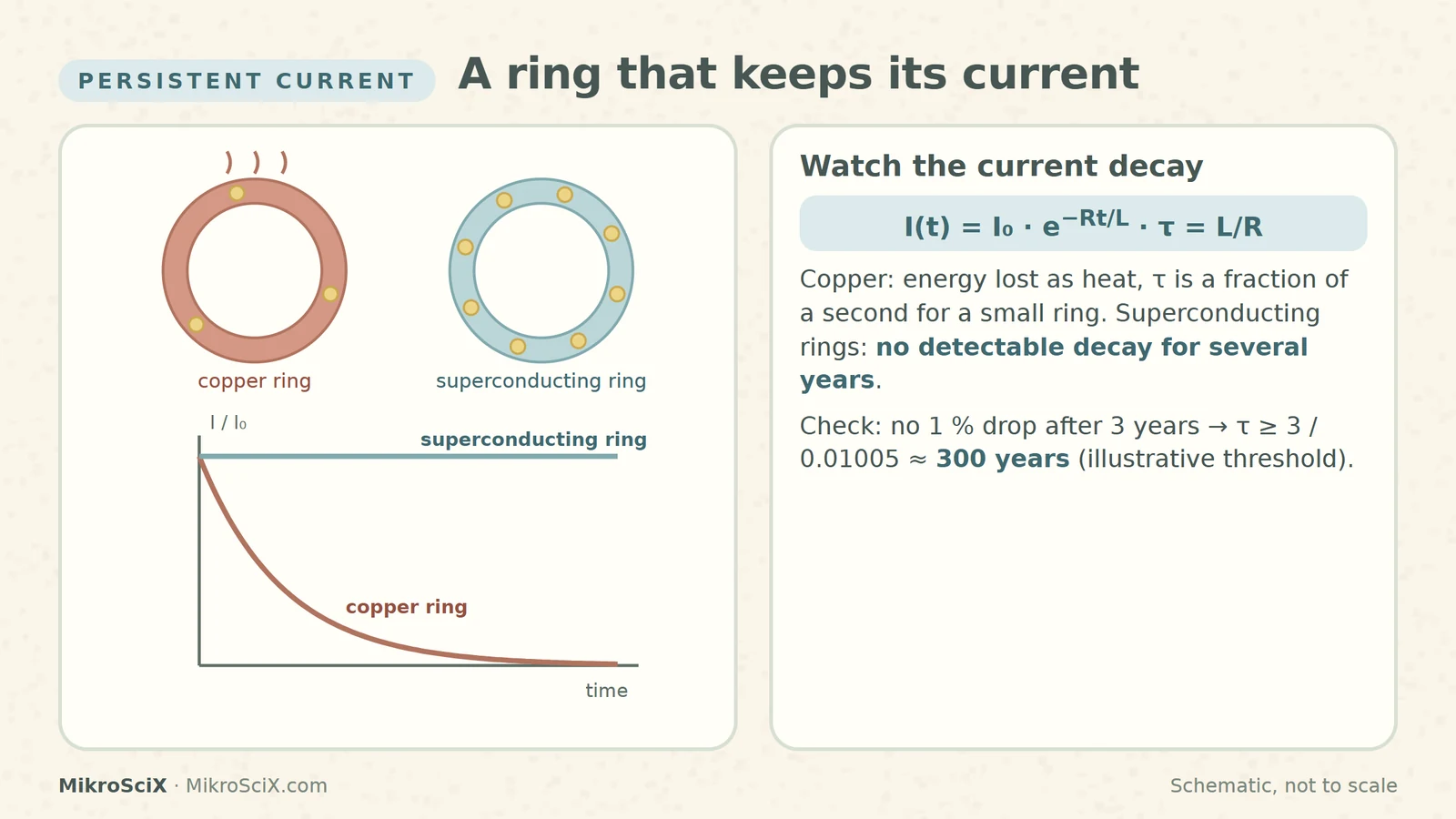
Check it yourself (illustrative numbers). Suppose your field sensor would notice a 1 % drop and, after 3 years, there is none. Then e−t/τ ≥ 0.99, so t/τ ≤ 0.01005 and τ ≥ 3 / 0.01005 ≈ 300 years. A copper ring with L = 0.1 µH and R = 1 mΩ has τ = 10⁻⁷ / 10⁻³ = 10⁻⁴ s = 0.1 ms. The same measurement idea separates the two by more than eleven orders of magnitude.
What breaks:
- Longer watching gives a better limit, never a proof. The result is still "less than", which is why researchers say "no measurable decay".
- Too much current ends it. Superconductivity survives only below a critical current and a critical field as well as below Tc. Above them, the ring turns normal and the current dies like in copper.
3. The second signature: the field is pushed out
Zero resistance alone is not the whole definition. Put a sample in a weak, steady magnetic field above Tc: the field passes straight through it. Now cool it through Tc without touching the magnet. The superconductor actively pushes the field out of its interior. The field lines bend around it. This is the Meissner effect, and it is a property of the superconducting state itself.
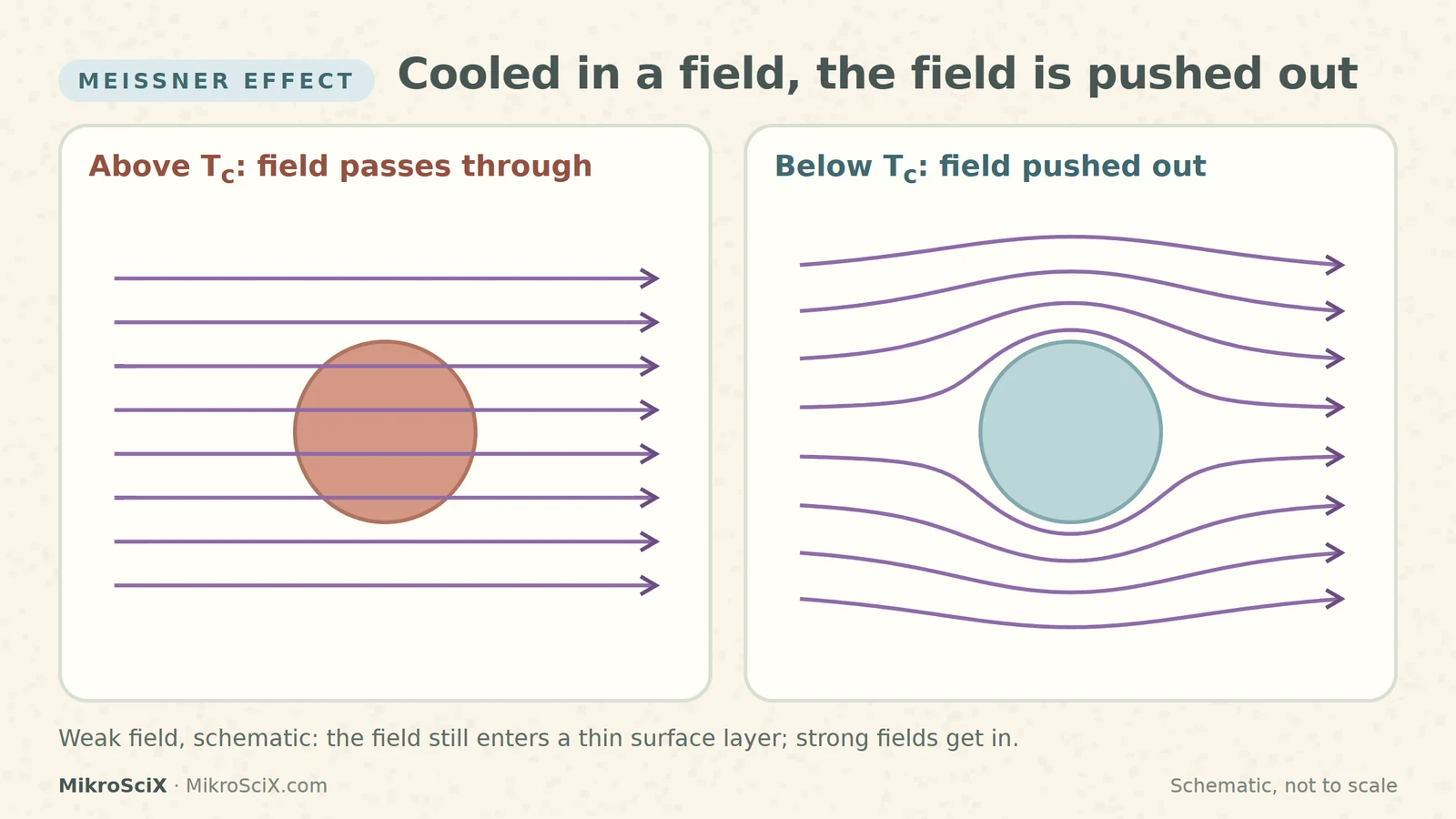
Why call it a separate signature? A material that only had zero resistance would simply keep whatever field it had inside when it was cooled: no change in field, no induced current, nothing pushed out. A superconductor does push it out. How you can tell these two cases apart in the lab, and why the order of cooling and switching on the field matters, is the subject of the next episode.
What breaks:
- "No field inside" has a thin exception. The field still enters a very thin surface layer. Drawings with a sharp boundary are schematic.
- Strong fields get in. Above a critical field the effect is lost; in type II superconductors the field enters in threads above a lower critical field. The clean picture holds for weak fields.
4. "High temperature" is still very cold
Before 1987, superconductors needed liquid helium (about 4 K), which is scarce and expensive. In 1987, Wu, Chu and colleagues reported a stable, reproducible superconducting transition between 80 and 93 K in a Y-Ba-Cu-O compound, now called YBCO. That is above the 77 K at which liquid nitrogen boils, and liquid nitrogen is cheap and easy to handle. These materials were soon called "high-temperature" superconductors.
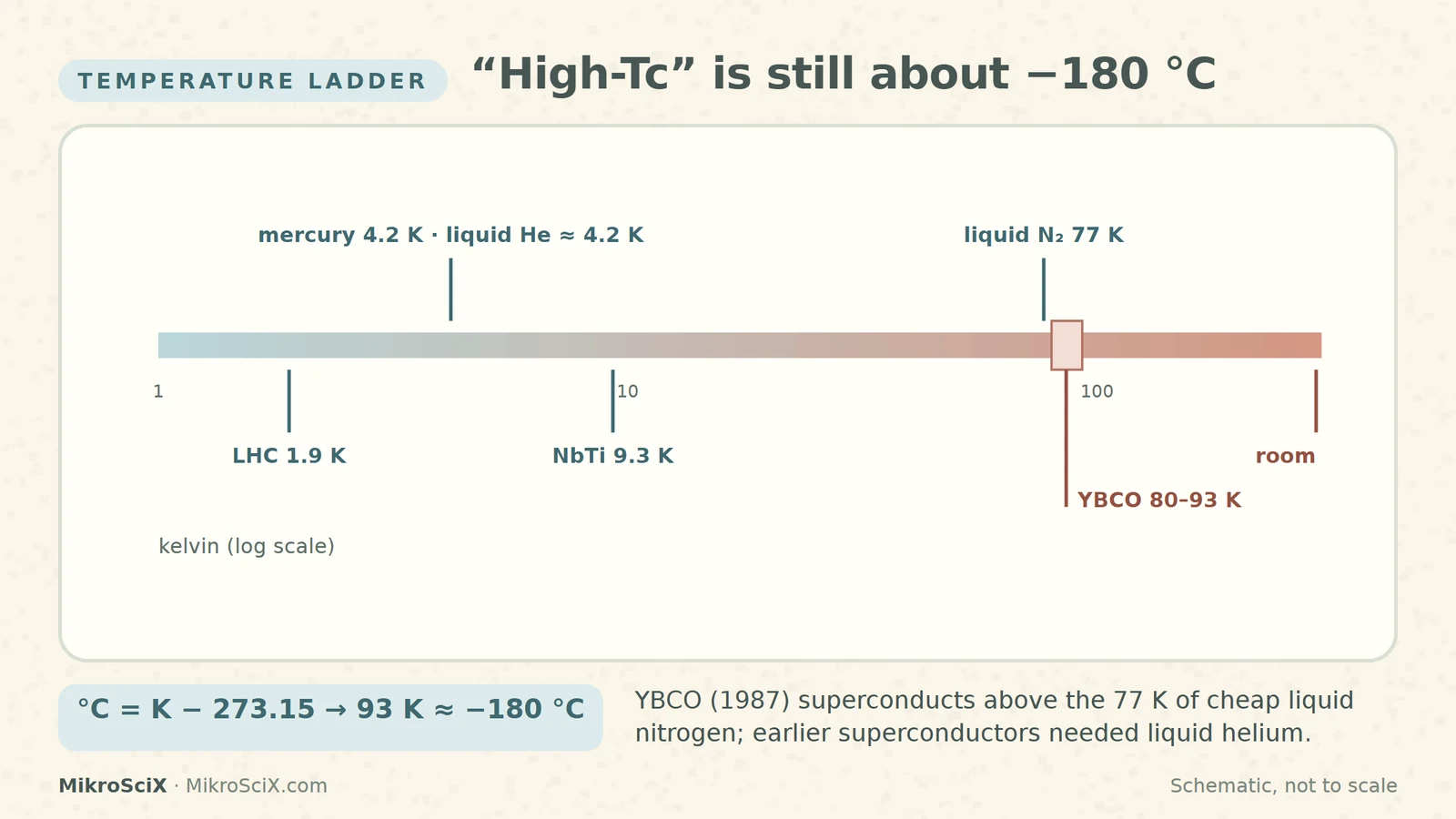
Check it yourself. °C = K − 273.15. So 93 K = 93 − 273.15 = −180.15 °C, about −180 °C. Liquid nitrogen: 77 − 273.15 = −196.15 °C. Mercury's 4.2 K: −268.95 °C. "High temperature" means high compared with liquid helium, not compared with your kitchen.
What breaks:
- The margin is thin. 93 − 77 = 16 K at the upper end of the reported band, but only 80 − 77 = 3 K at its lower end. A sample has to be good to work reliably in liquid nitrogen.
- One sample is not the material. The 1987 paper reports a range for its mixed-phase samples, which is why a band, not one number, is the honest summary.
5. Where the cold pays off: magnets that never switch off
The most common superconducting device is a large electromagnet. A routine clinical whole-body MRI scanner uses a coil of niobium-titanium (NbTi) wire in a bath of liquid helium at 4.2 K. Why helium and not nitrogen? NbTi's critical temperature is only 9.3 K. Because the coil has no resistance, its current does not fade, and the field in the patient tunnel stays steady.
The Large Hadron Collider at CERN uses the same material, chilled further to 1.9 K by a closed liquid-helium circuit; its main magnets produce 8.33 T to steer the beams around a 27 km ring.
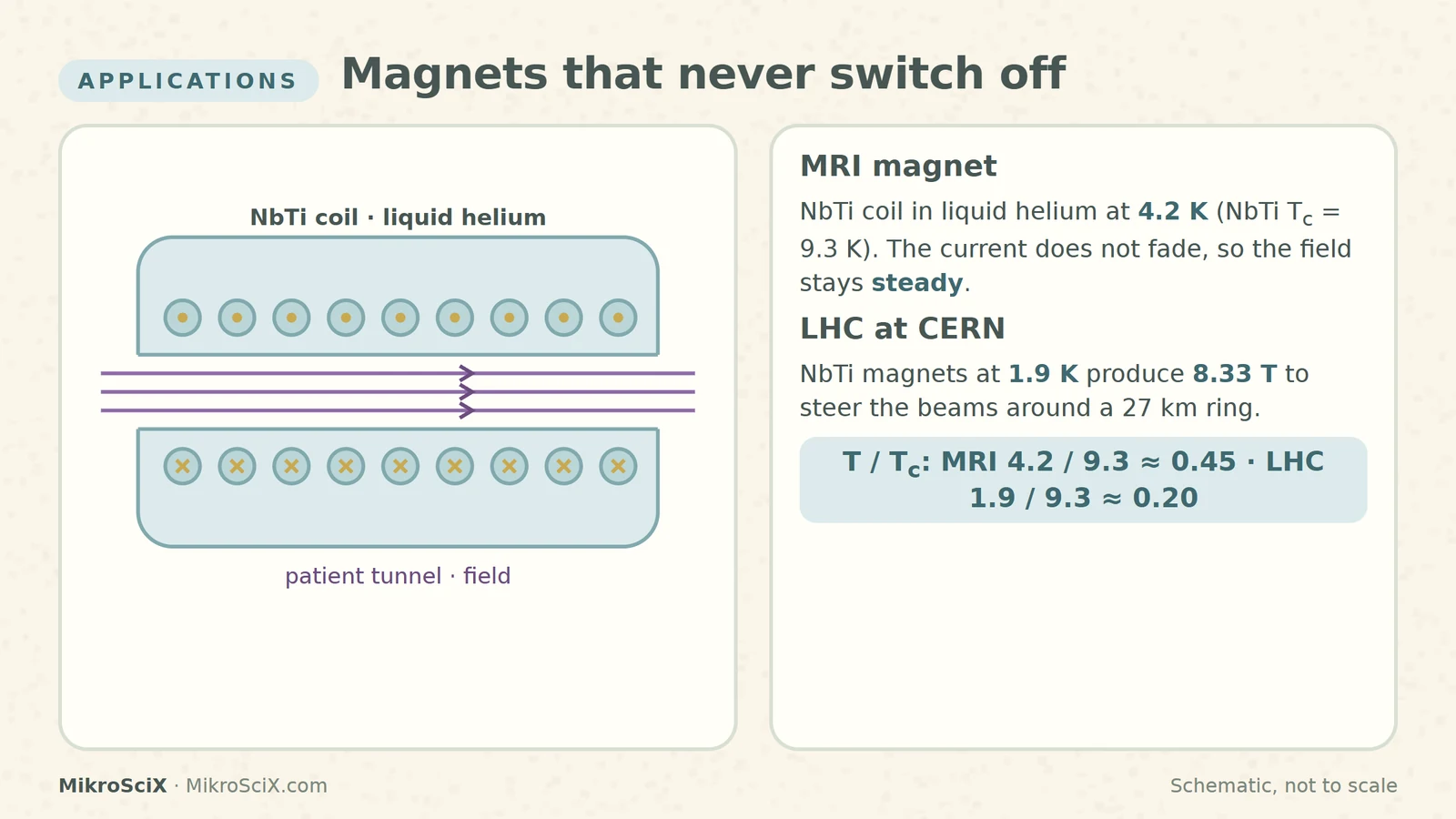
Check it yourself. Operating temperature as a fraction of Tc: MRI 4.2 / 9.3 ≈ 0.45; LHC 1.9 / 9.3 ≈ 0.20. Running well below Tc buys a larger margin for current and field, which is why the LHC goes colder than an MRI.
What breaks: reduced-helium and helium-free MRI magnets exist, so "every MRI sits in a helium bath" is no longer quite true. The physics is the same; only the cooling changes.
How to recognise a superconductor
- Resistance: a step to unmeasurably small at a critical temperature, not a slow fade.
- Persistence: a ring current with no measurable decay.
- Field: a weak field pushed out when the sample is cooled in it.
- Cold: always below Tc, and below a critical current and field.
A superconductor is defined by two things you can watch from outside: resistance that steps to zero, and a field that is pushed out. Both need it to be colder than its critical temperature.
Try it yourself
- A sample's resistance falls from 0.2 Ω to 0.15 Ω between 50 K and 20 K. Superconductor? Answer: no evidence. A gradual fall is normal metallic behaviour; look for a step to unmeasurably small.
- Your sensor sees a 0.1 % drop in a ring current after one year. What is the lower limit on τ? Answer: t/τ ≤ ln(1/0.999) ≈ 0.0010, so τ ≥ about 1000 years.
- Convert 77 K and 9.3 K to °C. Answer: −196.15 °C and −263.85 °C.
- Can liquid nitrogen cool an NbTi magnet into the superconducting state? Answer: no. 77 K is far above NbTi's 9.3 K.
Sources
- van Delft & Kes (2010), The discovery of superconductivity, Physics Today 63(9), doi 10.1063/1.3490499
- Sarangi et al. (2005), Experimental evidence for zero DC resistance of superconductors, arXiv cond-mat/0506426
- HyperPhysics (Georgia State University), Meissner effect
- C. Yu, UC Irvine Physics 115B lecture notes, Superconductivity
- Wu et al. (1987), Superconductivity at 93 K in a new mixed-phase Y-Ba-Cu-O compound system, Phys. Rev. Lett. 58, 908
- Manso Jimeno, Vaughan & Geethanath (2022), Superconducting magnet designs and MRI accessibility: a review, arXiv 2205.08918
- CERN, Cryogenics: low temperatures, high performance
Diagrams are schematic and not to scale. The ring decay numbers (1 % threshold, L = 0.1 µH, R = 1 mΩ) are illustrative; all other numbers are from the sources. −180 °C is a rounded conversion of 93 K.