

PHYSIOLOGY · STUDENT GUIDE
Why do we hiccup? Two moves, 35 milliseconds apart
A hiccup is not one event but two: a sudden pull of the diaphragm, then a slam of the vocal cords about 35 milliseconds later. What drives the rhythm, what sets it off, why nobody knows what it is for, and why home remedies and long-lasting hiccups deserve a careful look. For undergraduate and graduate students. Not medical advice.
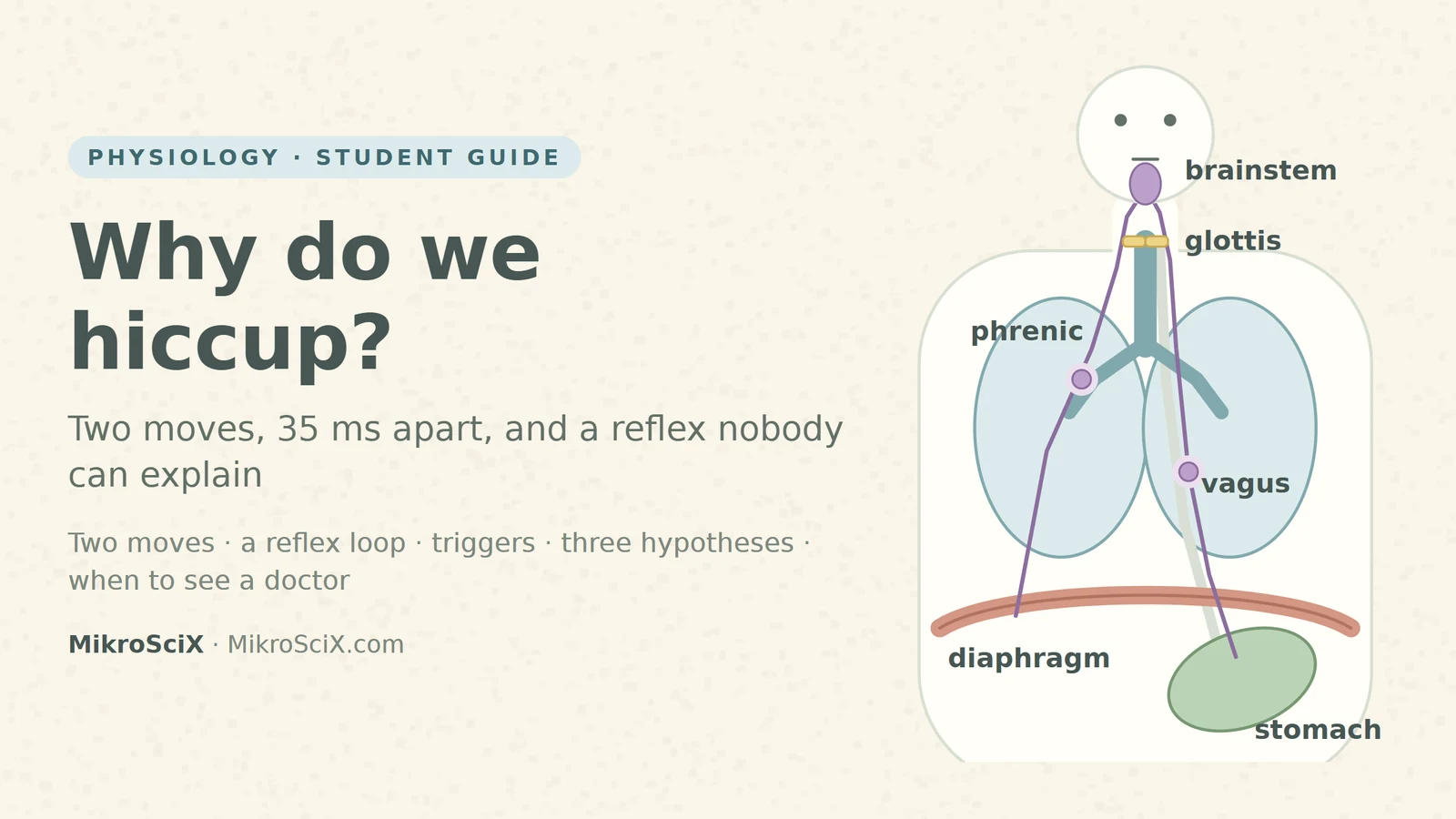
Everyone has hiccupped, and almost everyone has a favourite cure. Yet the hiccup is one of the odder reflexes in the body. It is sudden, rhythmic, involuntary and, as far as anyone can tell, useless in adults. A 2012 paper in BioEssays sums it up: there is "no known physiologic advantage for the common hiccup".
This guide takes the reflex apart step by step: what moves, in which order, which nerves carry the signal, what usually starts a bout, the competing ideas about why we have it, and one point that is easy to get wrong: what the evidence says about remedies and when hiccups are a reason to see a doctor.
1. Move one: the diaphragm jerks
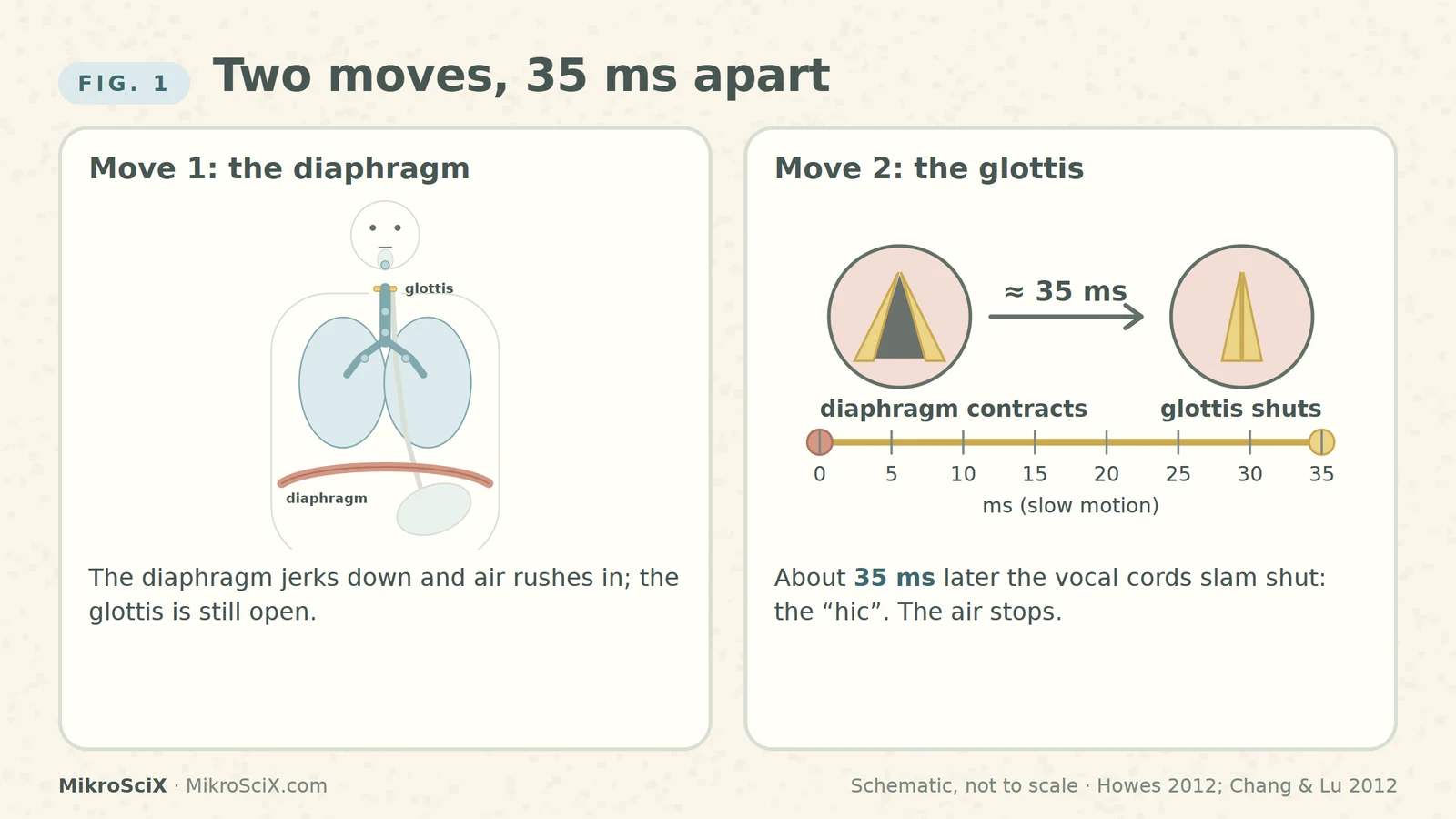
The diaphragm is the dome-shaped muscle under the lungs. In normal breathing it contracts smoothly, flattens and pulls air in. In a hiccup it contracts suddenly and involuntarily, often together with the intercostal muscles between the ribs. The chest volume jumps, the pressure in the lungs drops, and air rushes in through the windpipe.
Hiccups are often one-sided: Howes notes that the left half of the diaphragm is usually the one doing most of the work. The diaphragm is the main actor, but it is not what you hear.
2. Move two: the glottis slams shut
The glottis is the gap between the vocal cords at the top of the windpipe. About 35 milliseconds after the inspiratory muscles fire, the glottis closes abruptly. Air that was rushing in hits a closed door. That sudden closure is the "hic", and it also stops the breath, so a hiccup moves almost no air into the lungs.
Check it yourself: once a bout has started, hiccups usually repeat 4 to 60 times per minute, at a fairly constant rate for each person. At 60 per minute there is 1 second, or 1,000 ms, between hiccups; the glottis closes 35 ms into that, so the whole "inhale" lasts 35 / 1,000 = 3.5 % of the cycle. At 4 per minute the gap is 15 s, and 35 ms is only 0.23 % of it. The hiccup is a flicker inside a long pause.
One hiccup = a diaphragm jerk + a glottis slam about 35 ms later. The sound comes from the glottis, not from the diaphragm.
3. The reflex loop that keeps the rhythm
A hiccup is a reflex, so it has the classic three parts. The afferent (incoming) side carries signals from the oesophagus, the stomach and the underside of the diaphragm along the vagus and phrenic nerves and branches of the sympathetic chain. A centre in the brainstem, usually placed in the medulla and separate from the circuit that runs normal breathing, processes them. The efferent (outgoing) side runs mainly through the phrenic nerve to the diaphragm, with branches to the intercostal and neck muscles and to the glottis.
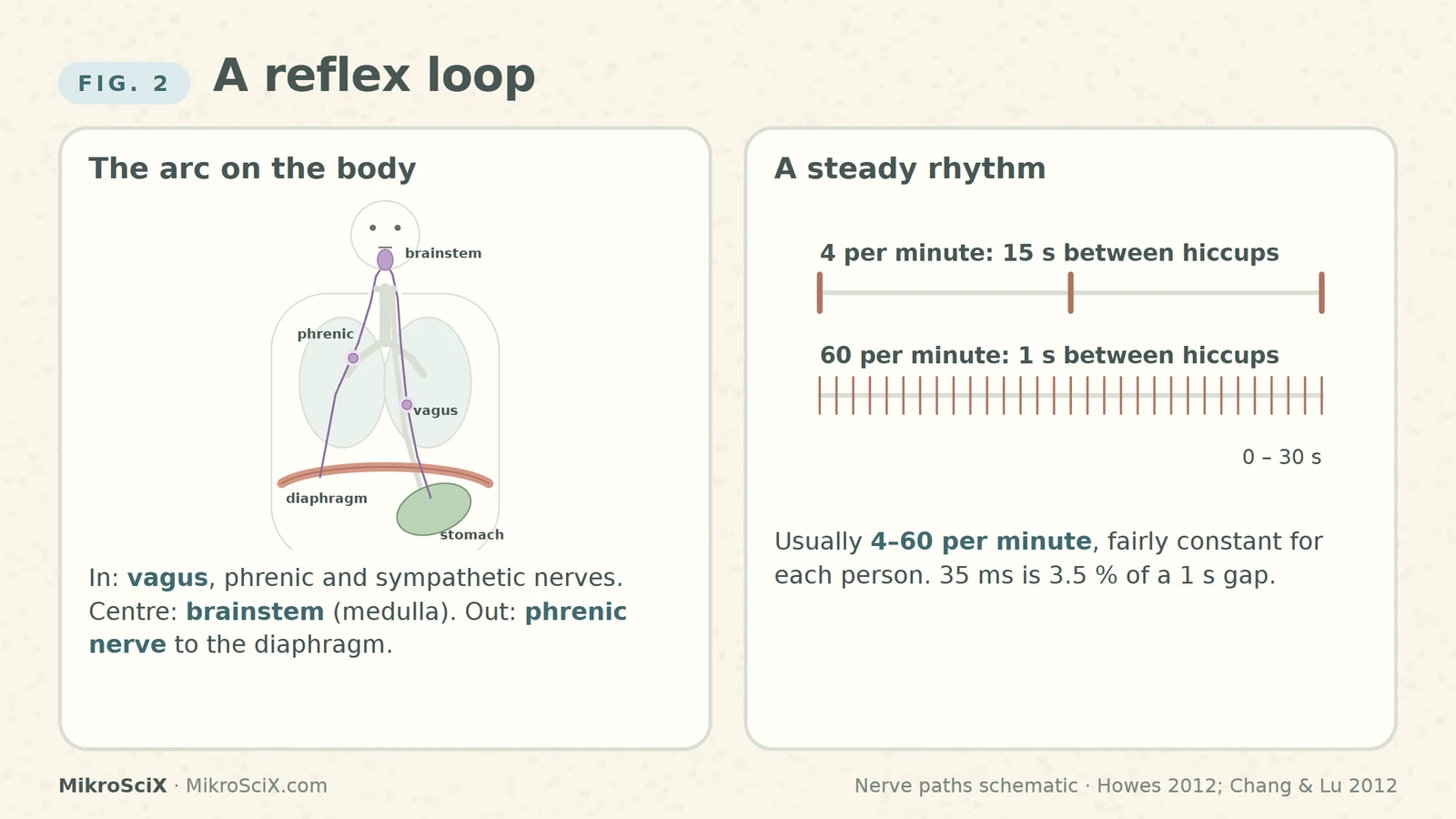
The central part is the least understood. Reviews describe it as "poorly understood" and note that it may involve a network between the brainstem and the upper spinal cord rather than one small spot. Once triggered, the loop keeps firing at a steady pace until something resets it, which is why a bout feels like a metronome.
Check it yourself: a ten-minute bout at 20 hiccups per minute, a rate inside the 4–60 range, gives 10 × 20 = 200 hiccups. Doubling the rate doubles the count, but the 35 ms gap inside each hiccup stays the same.
4. What sets it off
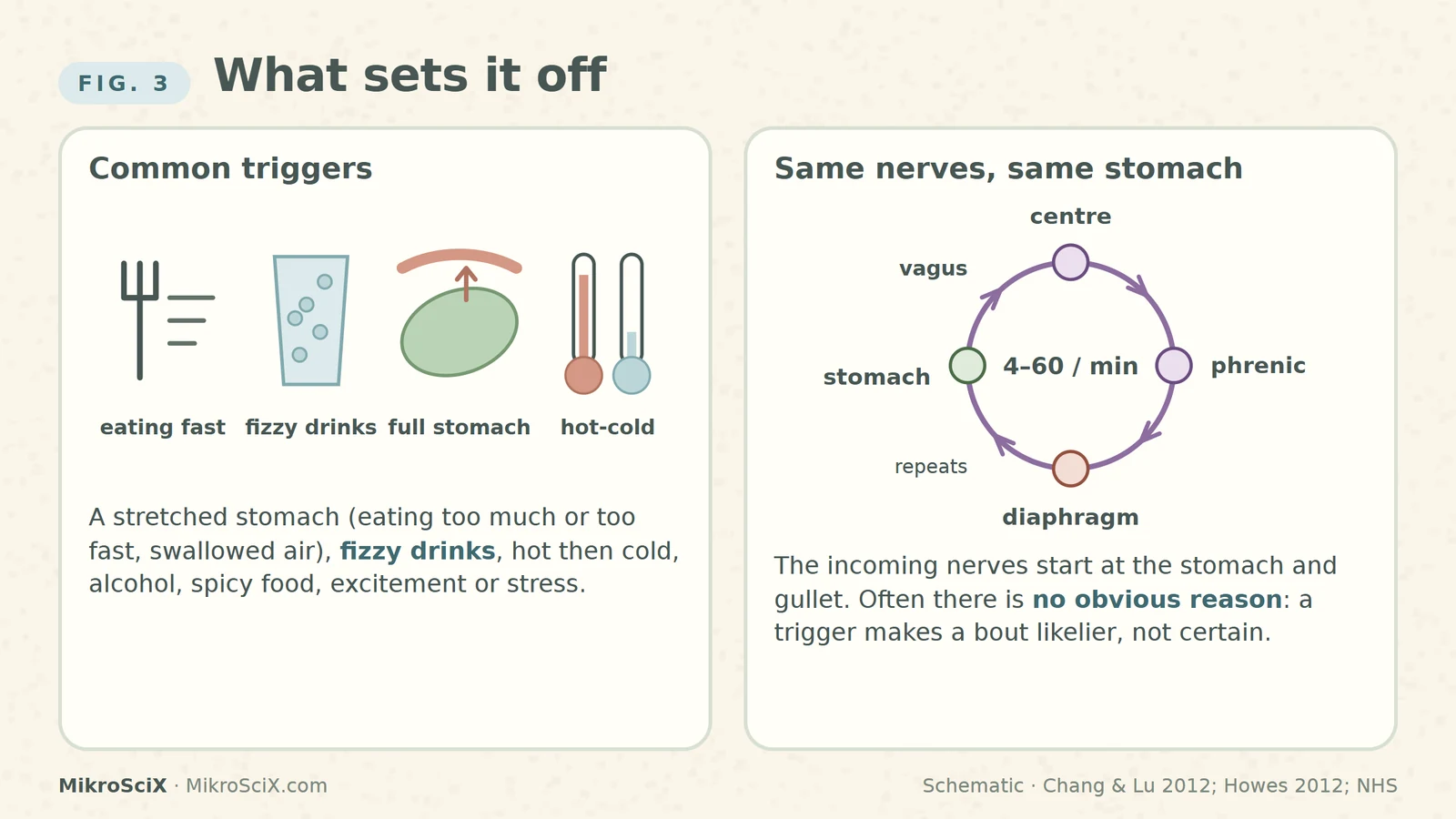
The same afferent nerves that feed the reflex come from the stomach and gullet, so it is no surprise that most everyday triggers involve them:
- a stretched stomach: eating too much or too fast, or swallowing air;
- fizzy drinks, which add gas to the stomach;
- sudden temperature changes in food or drink, such as something very cold right after something hot;
- alcohol, spicy food and smoking;
- excitement or stress.
The NHS adds a sobering point: often there is no obvious reason at all. A trigger makes a bout more likely; it does not cause one every time.
5. Why do we have it? Nobody knows
The honest answer is that the purpose of hiccups is unknown. Straus and colleagues opened their 2003 paper by stating that the neuronal origin and physiological significance of hiccups "are still unresolved". Three ideas get the most attention:
- A leftover of gill breathing. Straus et al. (2003) noticed that hiccups share features with the breathing pattern of amphibians: the glottis closes while the breathing muscles pull, the pattern appears early in development, it is suppressed by breathing more carbon dioxide and it can be abolished by the drug baclofen. A tadpole pumping water over its gills does just that, keeping the glottis shut so water does not enter the lungs. Their hypothesis: the hiccup is an archaic motor pattern that survived because the same circuits were reused for useful jobs such as suckling.
- A burp reflex for babies. Howes (2012) proposed that hiccups help suckling infants vent swallowed air: the sudden pull with a closed glottis lowers the pressure in the chest and could draw an air bubble up from the stomach. He adds plainly that "there is, as yet, no proof for this hypothesis".
- Training the developing brain. A 2019 EEG study of 13 newborns (30 to 42 weeks of gestational age) found that each hiccup's diaphragm contraction produced a response in the brain. The authors suggest hiccups may help the infant brain learn to sense its own breathing muscles. It is one small study of a possible role, not proof of a function.
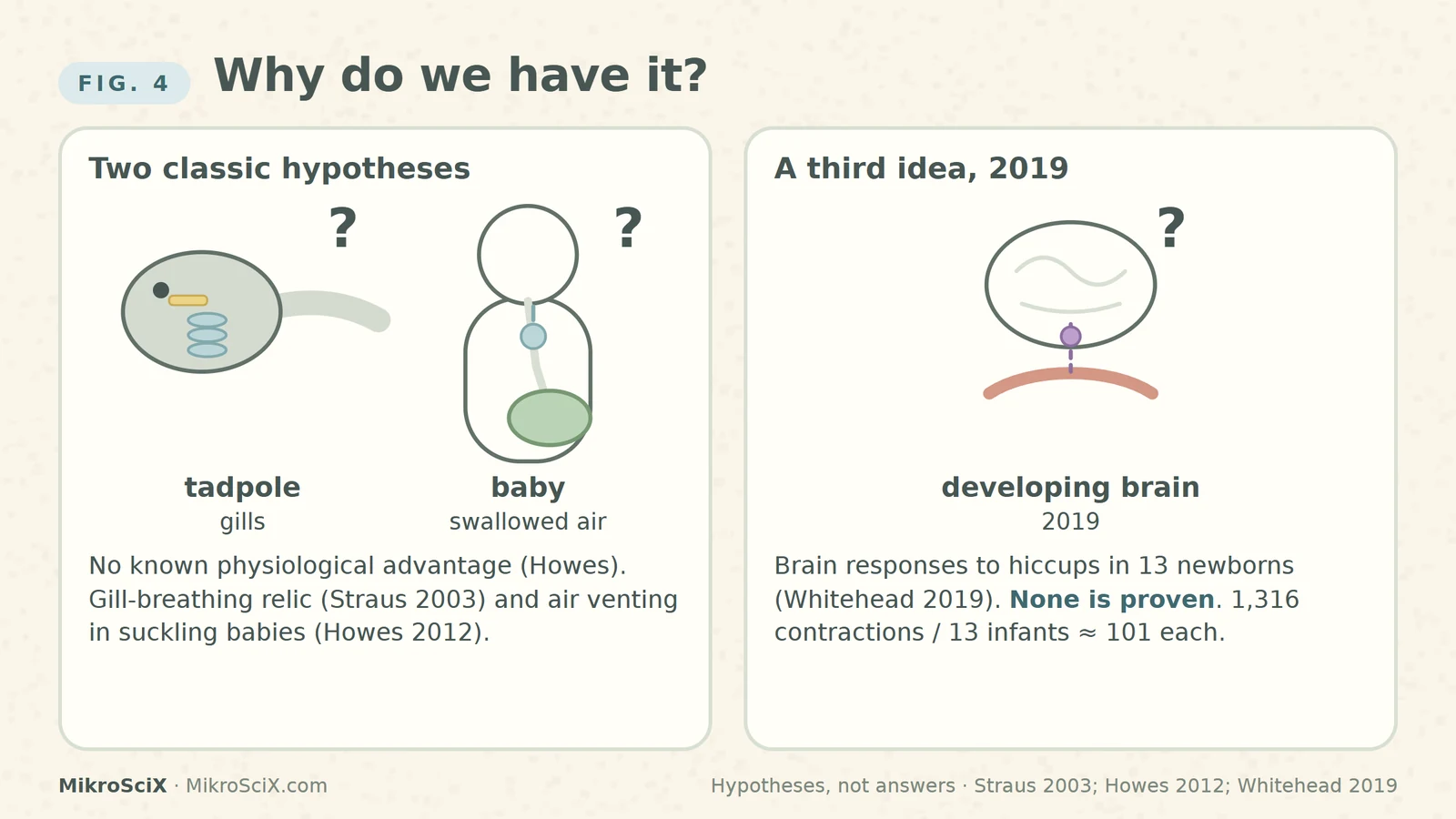
Check it yourself: the 2019 study analysed 1,316 diaphragm contractions from 13 infants, about 1,316 / 13 ≈ 101 per baby. Enough to average a brain response, far too few to settle why the reflex evolved.
Evolutionary stories about hiccups are hypotheses. Treat each as an idea to test, not as the answer.
6. The pitfall: remedies and long hiccups
Breathing into a paper bag, sipping ice-cold water, swallowing sugar, holding your breath: the NHS lists all of these and adds that although many people find them helpful, "there's no evidence that they work for everyone". That is not the same as saying they never work; it means nobody has shown which one works, for whom, better than waiting.
For long-lasting hiccups the evidence is thin too. A Cochrane review looked for trials of any treatment for persistent and intractable hiccups in adults. It found only four small trials, 305 people in total, all testing acupuncture and all at high risk of bias, and concluded that there is insufficient evidence to recommend any drug or non-drug treatment.
Duration matters. Hiccups that last more than 48 hours are called persistent, and they can be a sign of a medical condition or a side effect of a medicine, from irritation near the diaphragm to problems in the brainstem. The NHS advice is to see a GP if hiccups last longer than 48 hours or keep coming back and affect your life.
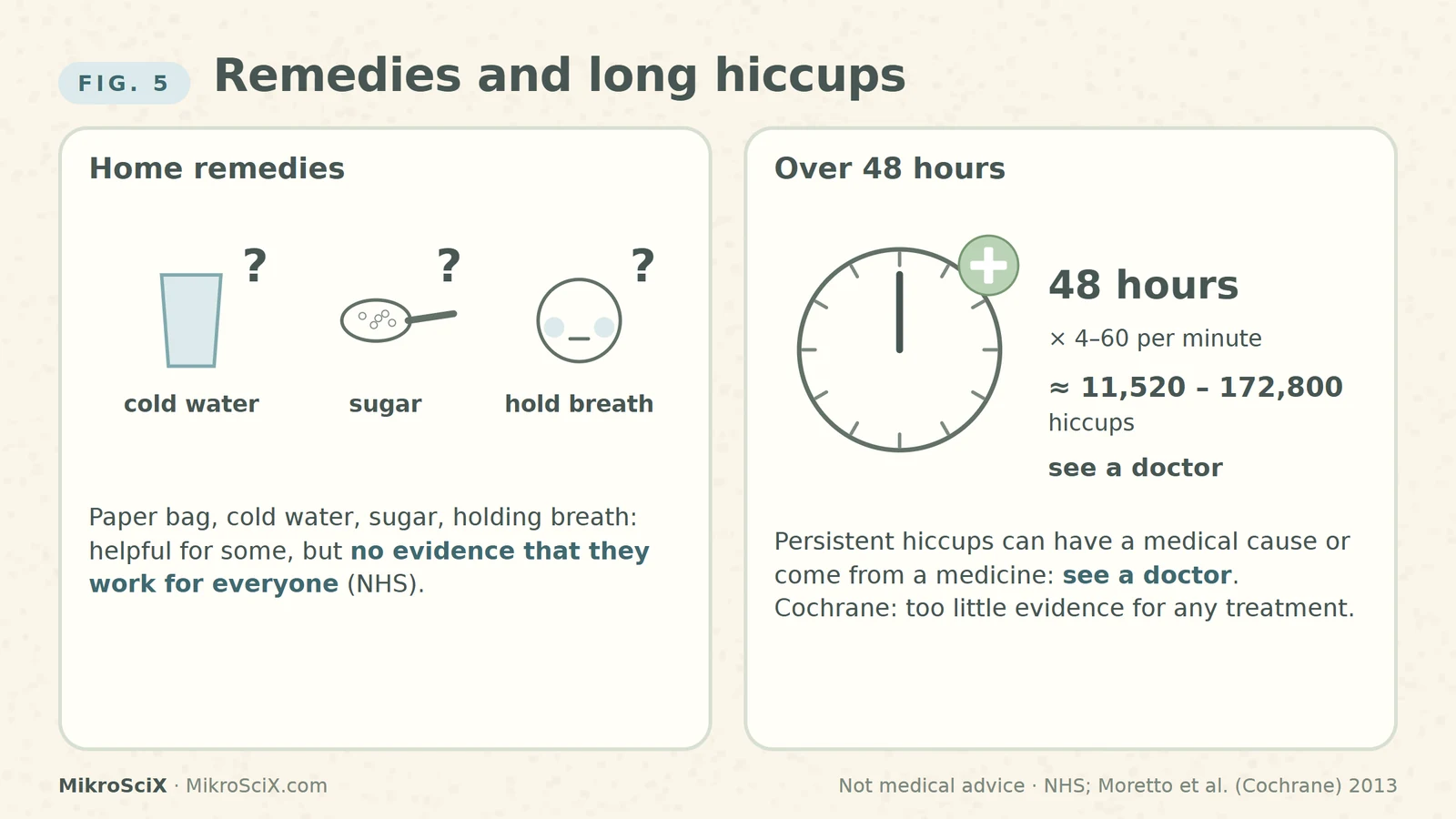
Check it yourself: 48 hours is 48 × 60 = 2,880 minutes. At 4 to 60 hiccups per minute that is 11,520 to 172,800 hiccups. Nobody should be expected to just sit that out.
7. How to read a hiccup, in one line each
- What moves: the diaphragm (and intercostals) jerk; about 35 ms later the glottis shuts.
- What you hear: the glottis closing, not the diaphragm.
- What runs it: a vagus/phrenic reflex loop through a brainstem centre, 4–60 times a minute.
- What starts it: often a full or bloated stomach, fizzy drinks, hot-then-cold, alcohol, excitement, or nothing obvious.
- What it is for: unknown; three hypotheses, none proven.
- What to do: most bouts stop on their own; remedies are unproven; over 48 hours, see a doctor.
Try it yourself
- A friend hiccups 30 times a minute. How long is the gap between hiccups, and what share of it is the 35 ms "inhale"? Answer: 2 s; 35 / 2,000 = 1.75 %.
- How many hiccups in 24 hours at 10 per minute? Answer: 24 × 60 × 10 = 14,400.
- Which happens first, the diaphragm contraction or the glottis closure, and which one makes the sound? Answer: the diaphragm first; the glottis closes about 35 ms later and makes the sound.
- Why is "tadpoles explain hiccups" not a fact? Answer: it is a hypothesis based on shared features, not a tested explanation; the purpose of hiccups is still unknown.
Watch the short
Videos don’t load automatically. The videos are hosted on YouTube. Allow YouTube once and every video on the site loads by itself; your choice is remembered. The articles never need consent.
Sources
- D. Howes — Hiccups: A new explanation for the mysterious reflex, BioEssays 34, 451 (2012)
- F.-Y. Chang, C.-L. Lu — Hiccup: Mystery, Nature and Treatment, J. Neurogastroenterol. Motil. 18, 123 (2012)
- C. Straus et al. — A phylogenetic hypothesis for the origin of hiccough, BioEssays 25, 182 (2003)
- E. N. Moretto et al. — Interventions for treating persistent and intractable hiccups in adults, Cochrane Database Syst. Rev. (2013)
- NHS — Hiccups
- K. Whitehead et al. — Event-related potentials following contraction of respiratory muscles in pre-term and full-term infants, Clin. Neurophysiol. (2019)
Diagrams are schematic and not to scale. The cycle shares (3.5 %, 0.23 %, 1.75 %), the hiccup counts (200; 11,520–172,800; 14,400) and 101 contractions per infant are our own arithmetic from the cited values (35 ms and 4–60 per minute from Howes 2012; 48 h from NHS and Cochrane; 1,316 contractions in 13 infants from Whitehead 2019). Not medical advice.